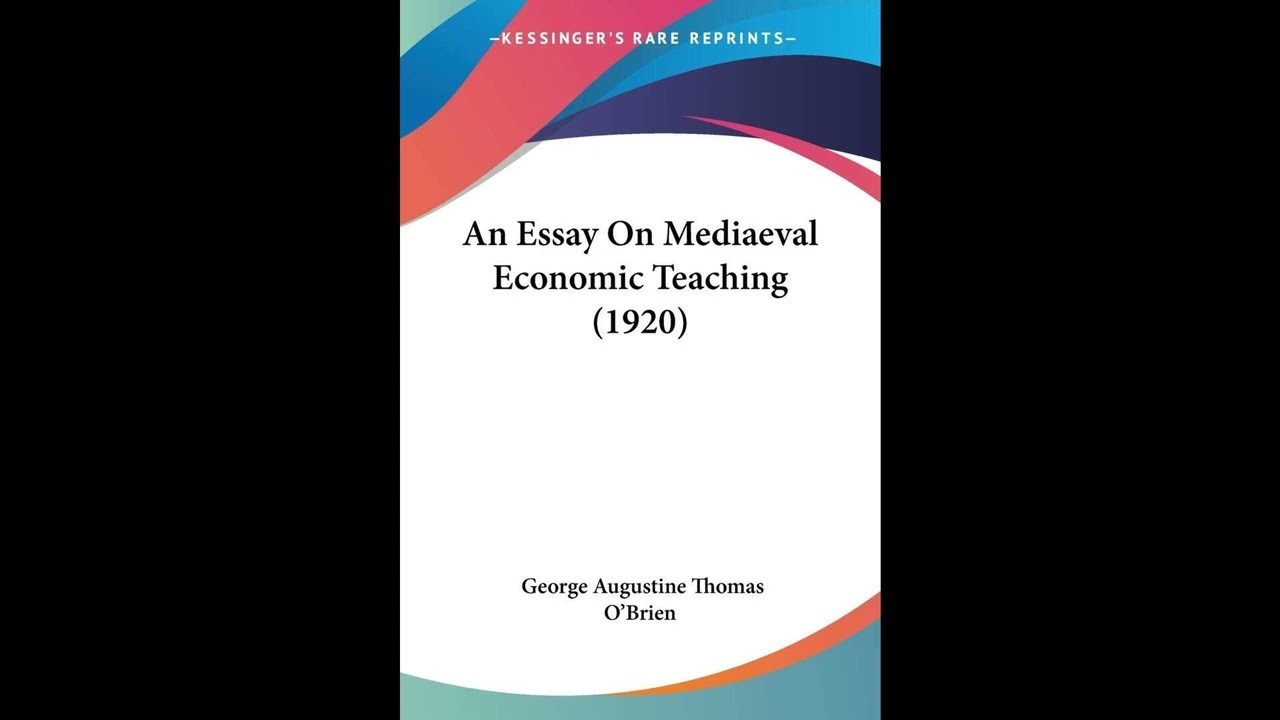
An Essay On Mediaeval Economic Teaching (1920)
Imagine a world where the pursuit of profit was not a self-evident good, but a practice rigorously scrutinized by moral philosophy and religious doctrine. A time when questions of fair pricing, usury, and the accumulation of wealth were not merely matters of market forces, but intense ethical and theological debates shaping the very fabric of society. George Augustine Thomas O'Brien's seminal 1920 work, "An Essay On Mediaeval Economic Teaching," invites us into this fascinating historical landscape. Far from being a dry academic relic, this book offers a profound lens through which to examine the roots of our modern economic systems and the persistent questions of social justice, individual gain, and communal responsibility that continue to challenge us today. Understanding how earlier societies grappled with wealth, labor, and commerce can illuminate our contemporary struggles, offering historical perspective on the ethical dimensions often overlooked in purely quantitative economic discussions. O'Brien's essay meticulously unpacks the intellectual framework that governed economic thought in Mediaeval Europe, roughly from the twelfth to the sixteenth centuries. He constructs his argument by first establishing the foundational principles derived from Aristotelian philosophy and Christian theology, which served as the bedrock for all subsequent economic discourse. The "main characters" in this intellectual drama are the scholastic philosophers and canon lawyers, figures like Thomas Aquinas, Albertus Magnus, and Duns Scotus, whose rigorous analytical methods were applied not just to theology but to the practicalities of daily commerce. O'Brien systematically introduces the listener to their theories, showing how these thinkers sought to reconcile the burgeoning commercial activities of their age with the prevailing moral imperatives of the Church. The central intellectual conflict O'Brien dissects is the perennial tension between the practical necessities of economic life—the need for trade, credit, and property—and the era's deep-seated ethical convictions regarding justice, charity, and the avoidance of sin. He illustrates how the Church, through its teachings and legal pronouncements, attempted to regulate economic behavior, particularly regarding issues considered morally perilous. The analytical arc of O'Brien's study moves from general principles to specific doctrines. He dedicates significant attention to the concept of the "just price," a complex idea that went far beyond mere market value, encompassing notions of fair labor, reasonable profit, and societal utility. He then meticulously details the elaborate debates surrounding usury, where the straightforward prohibition against interest in lending evolved into nuanced distinctions regarding risk, compensation for loss, and the nature of capital, revealing the era's attempts to adapt moral absolutes to changing economic realities without abandoning ethical grounding. George Augustine Thomas O'Brien, born in Dublin in 1891, was a distinguished Irish economist and historian whose scholarly output significantly shaped the understanding of economic history, particularly within the Irish context and the history of economic thought. Educated at University College Dublin, he dedicated his career to academia, eventually becoming Professor of National Economics at his alma mater in 1926, a position he held with distinction until 1961. His academic leadership extended beyond UCD, culminating in his presidency of the Royal Irish Academy from 1958 to 1961, a testament to his standing in the intellectual community. O'Brien's scholarship was characterized by a meticulous approach to historical sources and a deep engagement with economic theory. Prior to "An Essay On Mediaeval Economic Teaching," he published "The Economic History of Ireland in the Seventeenth Century" (1918), followed shortly by "The Economic History of Ireland from the Union to the Famine" (1921) and "Labour Organization" (1921). These works firmly established his reputation as a leading authority in economic history. His place in the canon is secured as a historian who not only documented economic developments but also critically analyzed the underlying ideas and moral philosophies that informed them. He brought a rigorous academic perspective to the intellectual traditions, particularly the Catholic tradition, that informed historical economic thought. O'Brien passed away in 1973, leaving behind a body of work that continues to be consulted by scholars today. One of the principal themes running through O'Brien's analysis is the intertwining of ethics and economics in the medieval worldview. He consistently demonstrates that, unlike much of modern economics, mediaeval thought did not conceive of economic activity as a sphere separate from moral judgment. Every transaction, every form of wealth accumulation, was subject to the overarching ethical framework of Christian doctrine. For example, O'Brien shows how the concept of the "just price" was not merely about supply and demand; it involved a moral assessment of the labor expended, the risk taken, and the societal need for the good. A merchant selling grain during a famine might command a higher price due to scarcity, but mediaeval moralists would still condemn an exorbitant price if it exploited the dire need of the community, highlighting a fundamental difference from purely market-driven pricing. Another significant theme is the evolution of economic ideas themselves, demonstrating that even within a seemingly rigid theological framework, economic doctrines were dynamic and subject to continuous reinterpretation. The intense debates surrounding usury provide a clear illustration. Initially, any charge for a loan was often condemned as sinful. However, as commerce grew more sophisticated, scholars began to distinguish between simple interest on a sterile loan and compensation for opportunity cost, risk, or loss of profit. O'Brien carefully traces these intellectual modifications, showing how the Church adapted its teachings to accommodate practical necessities while striving to maintain its moral authority. He reveals how these intellectual shifts paved the way for more modern understandings of credit and capital, but always against a backdrop of seeking social harmony rather than unfettered individual gain. "An Essay On Mediaeval Economic Teaching" appeared on the intellectual scene in 1920, a year deeply etched by the aftermath of the First World War. This period was characterized by immense global instability, economic upheaval, and profound social restructuring. Europe was grappling with reconstruction, staggering war debts, and the rise of new political and economic ideologies, including socialism and communism, which offered radical critiques of existing capitalist systems. In Ireland, O'Brien's homeland, the year 1920 was in the midst of the War of Independence, a time of intense national self-definition, political violence, and fundamental questions about the future social and economic structure of an independent Ireland. Against this backdrop of global and local ferment, O'Brien's work offered a timely examination of alternative economic paradigms. By looking back to a time when economic activity was explicitly subservient to moral and communal concerns, O'Brien provided a counterpoint to the increasingly secular and often ruthless economic theories of his own era. His meticulous historical analysis of how mediaeval thinkers tried to integrate ethics into commerce might have resonated with those seeking moral frameworks for the turbulent economic times. The book thus emerged not as a retreat into the past, but as a scholarly contribution to ongoing debates about the purpose of economic activity and the responsibilities of economic actors within a society trying to rebuild its values. Listening to "An Essay On Mediaeval Economic Teaching" as an audiobook offers a uniquely accessible way to engage with O'Brien's detailed scholarship. A clear, measured narration can transform what might, in print, appear as a dense academic text into an engaging intellectual discussion. The careful pacing of a skilled narrator allows the listener to absorb complex arguments, distinguishing between the various scholastic positions and O'Brien's own analytical synthesis. Over its several hours run length, the unfolding of historical ideas becomes an immersive experience, perfect for focused listening during commutes, while walking, or during dedicated study sessions. Pay particular attention to the narrator's articulation of key terms—like "just price" or the nuances of "usury"—as these distinctions are crucial to O'Brien's argument. The spoken word can bring a certain immediacy to these historical debates, making the progression of thought clear and inviting the listener to consider the enduring relevance of these mediaeval teachings to our own economic questions.
Enjoyed An Essay On Mediaeval Economic Teaching (1920)? A few ways to support us
Audible & Amazon links are affiliate; we may earn a small commission at no extra cost.
About this production
Human narration by a volunteer reader from LibriVox.org, the public-domain audiobook project. LibriVox volunteers record literary works whose copyright has expired in the United States, releasing the resulting recordings into the public domain.
An Essay On Mediaeval Economic Teaching (1920) by George Augustine Thomas O'Brien. The underlying text is in the U.S. public domain. We do not republish any modern copyrighted edition, translation, or commentary.
The 4K cinematic visuals accompanying this audiobook are generated by an AI image model from prompts derived from the source text. No copyrighted photos, paintings, or stock footage are used. AI generation is disclosed on every video on our YouTube channel as required by YouTube's altered/synthetic content policy.
English subtitles are transcribed from the LibriVox recording with OpenAI Whisper. Translations into the 11 other supported languages are produced by Meta's NLLB-200 neural translation model. No human translator's copyrighted translation is used.
Questions about sourcing or rights? See our DMCA & Sourcing policy or contact us.
Enjoyed this audiobook?
If you'd like to own a copy of An Essay On Mediaeval Economic Teaching (1920) or hear a professionally produced edition, the links below help support free audiobook production at no extra cost to you.
As an Amazon Associate we earn from qualifying purchases. Audible / print links are affiliate.