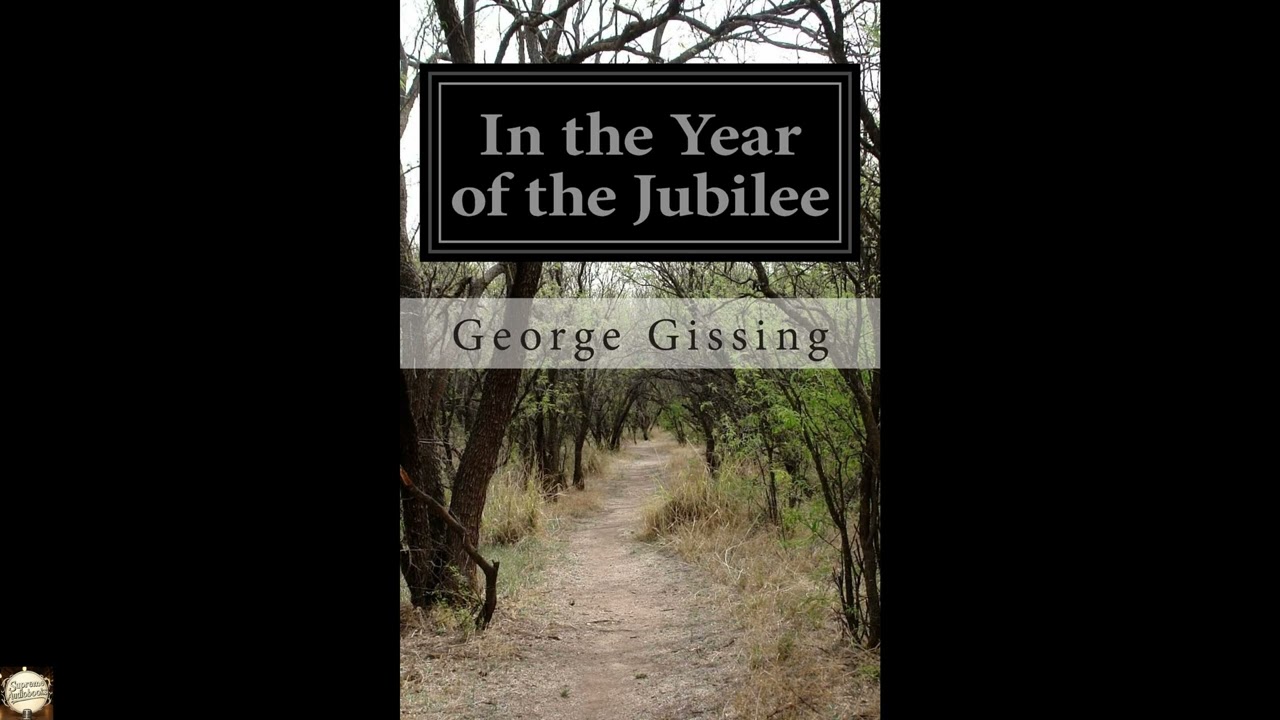
In the Year of the Jubilee
"In the Year of the Jubilee" by George Gissing pulls back the curtain on late Victorian London, offering a piercing look at the constraints placed upon women and the rigid dictates of class. This is not a quaint period piece, but a trenchant social commentary that feels startlingly relevant today, as we grapple with questions of autonomy, financial independence, and the evolving nature of relationships. Gissing’s meticulous gaze into the lives of ordinary people navigating an unforgiving society makes this a compelling story for anyone who understands the struggle to forge a path of one's own against the tide of expectation. The story introduces us to Nancy Lord, a spirited young woman whose life is upended by the sudden death of her mother. Liberated from the immediate oversight of her overbearing, conventional father, Nancy makes a choice that reverberates through the entire narrative: a secret, hasty marriage to Arthur Peachey, a man of lesser social standing than her own. Almost immediately, regret sets in, driven by the vast gulf between their aspirations and temperaments. Nancy flees this premature union, determined to assert her independence and make her own way in a world that offers few avenues for unattached women. She attempts to carve out a life free from marital bondage and economic dependence, a precarious existence that forces her into unexpected corners of London society. As Nancy grapples with her predicament, the novel also introduces us to the French family, particularly the two sisters, Fanny and Beatrice. Fanny embodies a different kind of defiance, living openly with a man outside the bounds of marriage, and suffering the consequences of social ostracism. Beatrice, meanwhile, navigates her own romantic entanglements and the limited choices available to her, reflecting the varied pressures and compromises Victorian women faced. The central conflict lies in Nancy’s relentless pursuit of self-determination, her yearning for intellectual fulfillment and a life of purpose, even as society, circumstance, and the lingering shadow of her marriage conspire to pull her back into conventional roles. It is a story of enduring ambition meeting the crushing weight of social reality. George Gissing, born in 1857 in Wakefield, Yorkshire, lived a life marked by intellectual brilliance, personal turmoil, and a profound sympathy for the struggling members of society. His early academic promise at Owens College, Manchester, was tragically cut short when he was imprisoned for theft, an act committed to support a young prostitute. This scandal irrevocably altered his trajectory. After a brief, difficult period in America, Gissing returned to London, determined to make a living as a writer. His own experiences with poverty, unhappy marriages—often to women from disadvantaged backgrounds—and ill health deeply informed his fiction. Gissing became a significant figure in the late Victorian literary scene, known for his unsparing social realism and his focus on the lives of the "unclassed" and intellectual women chafing against societal norms. His notable works include New Grub Street (1891), a searing indictment of the literary world and the harsh realities faced by writers, and The Odd Women (1893), another powerful exploration of women’s restricted lives and the burgeoning "New Woman" movement. He approached his subjects with a keen, often pessimistic, eye, earning him a unique place in the canon as a chronicler of the less glamorous, more authentic aspects of fin-de-siècle England, always striving to depict life as it truly was, rather than romanticizing it. He passed away in 1903, leaving behind a body of work that continues to provoke thought and discussion. The novel enacts several profound themes that resonate beyond its historical setting. Foremost among them is the struggle for women's independence and the constraints of marriage. Nancy’s flight from her husband, her attempts to secure work, and her desire for intellectual engagement exemplify the "New Woman" ideal—a woman seeking autonomy in a world that largely denied it. Her efforts to live without a male provider, such as her stint working for a shop owner, starkly reveal the economic precariousness and social judgment faced by such women. Another significant theme is social class and its insidious influence. Arthur Peachey's desperate attempts to ascend the social ladder and Nancy's "fall" through marriage illustrate how deeply ingrained class distinctions dictated opportunity and reputation in Victorian England. The humiliation Nancy endures when her secret marriage is threatened with exposure showcases the unforgiving nature of social convention. Furthermore, Gissing critiques the institution of marriage itself, often portraying it as a trap rather than a haven, particularly for women. The varying marital statuses and relationships of the characters—from Nancy’s ill-fated union to Fanny French’s unconventional arrangement—highlight the different ways women were confined or marginalized by societal expectations around matrimony. The novel also powerfully portrays urban alienation and the often-harsh realities of London life. The sheer scale and anonymity of the city become both a place of potential liberation for Nancy and a source of overwhelming struggle, where individuals can easily become lost or exploited. Gissing masterfully uses the city as a backdrop to amplify the personal crises of his characters, showing how the physical environment shapes their psychological states. "In the Year of the Jubilee" emerged during a fascinating moment in British history, the twilight of the Victorian era. The title itself refers to Queen Victoria's Golden Jubilee of 1887, a time of immense national pride and imperial celebration, yet beneath this veneer of prosperity, profound social changes and anxieties simmered. The late nineteenth century saw the rise of the "New Woman," a figure who challenged traditional gender roles, advocated for greater education, professional opportunities, and personal freedom. Gissing’s novel directly engages with these evolving ideas, depicting the friction between traditional expectations and the growing desire for female emancipation. Culturally, it was a period marked by increasing discussions about poverty, social reform, and the stark inequalities of industrial society, all of which find expression in Gissing's unflinching realism. His work was part of a broader literary movement that favored detailed, often critical, observations of contemporary life over romanticized ideals, offering a crucial lens through which to understand the complex societal shifts of the time. To experience "In the Year of the Jubilee" as an audiobook is to gain a deeper appreciation for Gissing’s nuanced character studies and atmospheric prose. The substantial length allows for thorough immersion in the meticulously crafted world of late Victorian London, giving ample space for the social critiques and personal dramas to unfold at a deliberate, thoughtful pace. A skilled narrator can bring to life the distinctive voices of London's various social strata, from the intellectual aspirations of Nancy Lord to the blunt pragmatism of her working-class husband. Listening allows the listener to fully absorb the weight of Gissing's social observations, to hear the subtle ironies in the dialogue, and to feel the oppressive, yet also liberating, atmosphere of the bustling metropolis. It’s an opportunity to truly hear the anxieties, hopes, and struggles of a bygone era rendered immediate and compelling through performance.
Enjoyed In the Year of the Jubilee? A few ways to support us
Audible & Amazon links are affiliate; we may earn a small commission at no extra cost.
About this production
Human narration by a volunteer reader from LibriVox.org, the public-domain audiobook project. LibriVox volunteers record literary works whose copyright has expired in the United States, releasing the resulting recordings into the public domain.
In the Year of the Jubilee by George Gissing. The underlying text is in the U.S. public domain. We do not republish any modern copyrighted edition, translation, or commentary.
The 4K cinematic visuals accompanying this audiobook are generated by an AI image model from prompts derived from the source text. No copyrighted photos, paintings, or stock footage are used. AI generation is disclosed on every video on our YouTube channel as required by YouTube's altered/synthetic content policy.
English subtitles are transcribed from the LibriVox recording with OpenAI Whisper. Translations into the 11 other supported languages are produced by Meta's NLLB-200 neural translation model. No human translator's copyrighted translation is used.
Questions about sourcing or rights? See our DMCA & Sourcing policy or contact us.
Enjoyed this audiobook?
If you'd like to own a copy of In the Year of the Jubilee or hear a professionally produced edition, the links below help support free audiobook production at no extra cost to you.
As an Amazon Associate we earn from qualifying purchases. Audible / print links are affiliate.