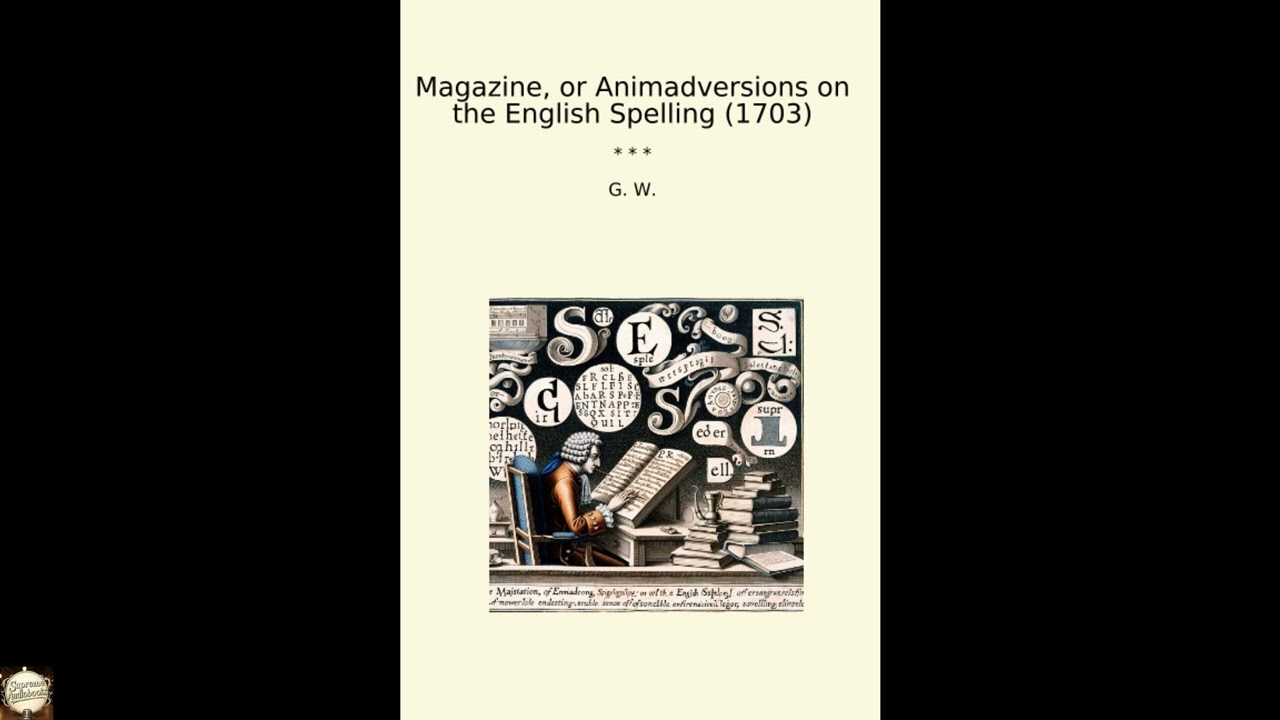
Magazine, or Animadversions on the English Spelling (1703) (Classic Books)
What if the very fabric of our communication, the written word, seemed to be falling apart at the seams? Imagine a time when the rules of spelling were less guidelines and more a wild, shifting landscape, where every author, every printer, every scribe seemed to follow their own capricious muse. This was the linguistic reality of early eighteenth-century England, and it is precisely this perceived chaos that Magazine, or Animadversions on the English Spelling confronts head-on. Published in 1703 by the enigmatic G. W., this remarkable volume isn’t merely a dusty historical curiosity; it is a lively, impassioned call for order, a deeply insightful commentary on language, and a fascinating window into the anxieties and aspirations of an era grappling with how to define itself through its mother tongue. Listening to it today offers a unique opportunity to understand the foundational battles that shaped the English we speak and write, revealing how deeply intertwined language is with logic, national identity, and the very act of knowing. The central "setting" for G. W.'s profound observations is the unruly state of English orthography itself, presented as a sprawling, untamed garden where consistency is rare and exceptions are legion. The author paints a vivid picture of a language suffering from a proliferation of inconsistent spellings, silent letters that serve no purpose, and a general lack of a unified system. Rather than a narrative with traditional characters, this text features a powerful, persuasive voice—G. W. himself—as the primary figure, confronting the challenges posed by linguistic disorder. His "adversaries" are the entrenched habits of printers, the ignorance of educators, and the sheer inertia of tradition, all of which contribute to the perceived "barbarity" of contemporary English spelling. The "story" of Magazine unfolds as a methodical and increasingly urgent argument. G. W. begins by meticulously diagnosing the problem, citing countless examples of words spelled in multiple, often contradictory ways within the same texts, or even by the same author. He details the historical accretions that have made English spelling so illogical, dissecting the reasons behind its often-arbitrary forms. The "conflict" is clearly articulated: a linguistic muddle that hinders learning, makes communication unnecessarily difficult, and even, in G. W.'s view, diminishes England's intellectual standing compared to nations with more regulated languages. The arc of his argument progresses from a detailed exposition of these problems—the "diseases" of English spelling—to a passionate plea for their "cure." He then systematically proposes principles for reform, advocating for a more rational, phonetically-aligned system that would bring clarity and precision to the written word. His proposals, though sometimes radical for their time, reflect a clear-sighted desire to streamline and improve language for the benefit of all. The author, G. W., remains a shadowy figure from the dawn of the eighteenth century, known to us only by these initials. In an era when authorship often carried social or political risks, or when individuals might publish anonymously out of modesty or a desire for intellectual focus over personal fame, such a signature was not uncommon. We can infer from the intellectual rigor and extensive linguistic knowledge displayed in Magazine that G. W. was a well-educated individual, likely a scholar, a clergyman, or an informed amateur deeply immersed in the intellectual currents of his time. He was certainly part of a growing class of thinkers who applied rational inquiry to various aspects of human experience, including language. While no specific birth or death dates are available for G. W., his work places him firmly within the period immediately following the Glorious Revolution and at the beginning of the Augustan Age, an exciting time of intellectual ferment in England. It is difficult to attribute other works to G. W. with certainty, given the prevalence of anonymous and pseudonymous publishing during the late seventeenth and early eighteenth centuries. However, Magazine itself firmly establishes his place, albeit a niche one, within the broader movement of linguistic commentary and reform. He stands as an early voice anticipating later, more famous efforts to standardize English. His "Animadversions" demonstrate an early application of Enlightenment principles—reason, order, and utility—to the perceived chaos of common practice. His ideas resonate with the general intellectual spirit of the period, a time when empirical observation and logical deduction were increasingly applied to everything from natural philosophy to social customs. Among the specific themes that Magazine vividly enacts is the overarching pursuit of order and logic in language. G. W. consistently applies rational principles to orthography, reflecting the broader Enlightenment ideals that were gaining traction. For instance, he meticulously categorizes various spelling inconsistencies, such as words with multiple acceptable spellings or those featuring silent letters that disrupt phonetic regularity. His suggestions for reform often involve simplifying vowel combinations or regularizing consonant clusters, all driven by a desire for a systematic, predictable written language. This stands in stark contrast to the often haphazard and historically layered nature of English spelling he observes. Another prominent theme is that of national identity and linguistic pride. G. W. articulates the belief that a standardized, logical English spelling reflects well on the nation, aiding its intellectual and commercial standing on the European stage. He argues that the confusing nature of English orthography makes it difficult for foreigners to learn, implicitly suggesting that a reformed spelling would elevate English to the same level of clarity and prestige enjoyed by languages like French. This demonstrates how deeply connected language standardization was to a nascent sense of national self-definition and cultural aspiration. Furthermore, the text reveals a palpable tension between tradition and reform. G. W. grapples with the weight of established practices—spellings that have been passed down through generations of scribes and printers, regardless of their phonetic sense—and the pressing need for improvement. While he acknowledges the deeply ingrained nature of some illogical spellings, he firmly advocates for change, sometimes suggesting gradual modifications and at other times hinting at more sweeping revisions. His work also highlights the inherent challenges of communication and literacy. He understands that a confusing written language impedes education, makes reading more difficult, and thus acts as a barrier to broader literacy and the spread of knowledge. The literary significance of Magazine lies in its status as a crucial primary document for understanding the history of English orthography. It illustrates the often-fierce intellectual battles fought over every letter and provides invaluable insight into the cultural and intellectual forces that eventually led to the standardization efforts of later centuries, ultimately shaping the English language into its modern form. The year 1703 places Magazine squarely in the reign of Queen Anne, a period of relative political stability after the Glorious Revolution. Culturally, this was the beginning of the Augustan Age, characterized by a renewed interest in classical ideals of order, reason, and elegant simplicity, particularly in literature. The rise of coffeehouses as centers for intellectual discourse fostered a burgeoning public sphere where ideas like G. W.'s could be debated. In the literary world, prominent figures such as Daniel Defoe, Joseph Addison, and Jonathan Swift were beginning to shape English prose, emphasizing clarity and wit. Swift, in particular, would later advocate for the creation of an English Academy to regulate and purify the language, a sentiment very much aligned with G. W.'s concerns. However, such an academy was never established, and the monumental work of Samuel Johnson’s Dictionary of the English Language was still half a century away. In this context, G. W.'s work emerged as a direct response to a very real problem: the significant variability in English spelling. Without an authoritative dictionary, academy, or widespread consistent printing standards, words were often spelled differently from one text to another, or even within the same document. Printers frequently followed their own house styles, leading to a bewildering lack of uniformity. The growing importance of print culture—newspapers, pamphlets, books—amplified the need for clear, unambiguous written communication. G. W.'s Magazine thus stands as a timely and articulate expression of the era's anxiety about linguistic anarchy and a passionate plea for the systematic rationalization of English spelling, reflecting a broader societal desire for order and progress in all intellectual endeavors. Listening to Magazine, or Animadversions on the English Spelling as an audiobook transforms what might appear as a dry historical treatise into a lively intellectual engagement. A skilled narrator brings the precise, often exasperated, and always logical voice of G. W. to life, allowing the listener to fully appreciate the rhetorical force of his arguments. The run length, encompassing several hours, means you can immerse yourself fully in the intricate details of his linguistic observations and proposed reforms, making it ideal for sustained listening during commutes, walks, or quiet evenings. Pay close attention to the narrator’s pacing, especially when G. W. lays out complex examples of inconsistent spellings; the delivery can heighten the subtle humor or deep frustration embedded in the original text. The audiobook format allows G. W.'s persuasive rhetoric to unfold naturally, giving you a direct auditory connection to a passionate historical debate about the very foundations of the English language. It is a chance to hear, rather than just read, the spirited defense of linguistic order from a time when the rules of English were far from settled.
Enjoyed Magazine, or Animadversions on the English Spelling (1703) (Classic Books)? A few ways to support us
Audible & Amazon links are affiliate; we may earn a small commission at no extra cost.
About this production
Human narration by a volunteer reader from LibriVox.org, the public-domain audiobook project. LibriVox volunteers record literary works whose copyright has expired in the United States, releasing the resulting recordings into the public domain.
Magazine, or Animadversions on the English Spelling (1703) (Classic Books) by G. W. The underlying text is in the U.S. public domain. We do not republish any modern copyrighted edition, translation, or commentary.
The 4K cinematic visuals accompanying this audiobook are generated by an AI image model from prompts derived from the source text. No copyrighted photos, paintings, or stock footage are used. AI generation is disclosed on every video on our YouTube channel as required by YouTube's altered/synthetic content policy.
English subtitles are transcribed from the LibriVox recording with OpenAI Whisper. Translations into the 11 other supported languages are produced by Meta's NLLB-200 neural translation model. No human translator's copyrighted translation is used.
Questions about sourcing or rights? See our DMCA & Sourcing policy or contact us.
Enjoyed this audiobook?
If you'd like to own a copy of Magazine, or Animadversions on the English Spelling (1703) (Classic Books) or hear a professionally produced edition, the links below help support free audiobook production at no extra cost to you.
As an Amazon Associate we earn from qualifying purchases. Audible / print links are affiliate.
More Audiobooks
Notes and Queries, Index of Volume 2, May-December, 1850 (Classic Books)
Notes and Queries, Number 166, January 1, 1853 A Medium of Inter-communication
Notes and Queries, Number 135, May 29, 1852; A Medium of Inter-communication
Notes and Queries, Number 169, January 22, 1853