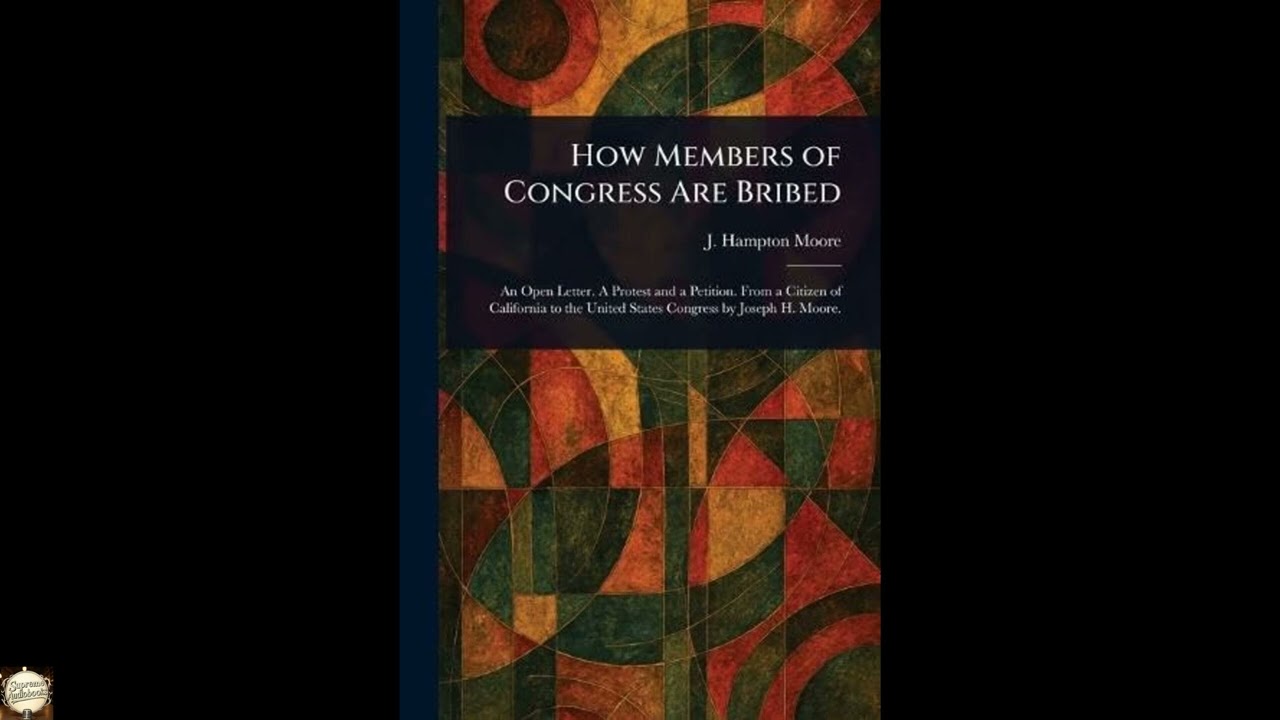
How Members of Congress Are Bribed
In an era where headlines frequently detail the influence of money in politics, the mechanisms of power, and the opaque dealings behind closed doors, Joseph Hampton Moore’s "How Members of Congress Are Bribed" emerges as a chillingly relevant and profoundly illuminating work. Though published decades ago, the book’s clear-eyed examination of financial influence, disguised favors, and the subtle corrosion of public trust feels as immediate as today’s newsfeed. This is not simply a historical curiosity but a foundational text for understanding the enduring dynamics between wealth and legislative action, offering a stark reminder that many of the systems we contend with now have deep, well-established roots. Moore pulls back the curtain on the subtle art of legislative persuasion, revealing not only outright corruption but the far more insidious practices that subtly bend the will of elected officials. Moore’s narrative transports us to a bustling late nineteenth-century Washington D.C., a city undergoing rapid expansion and transformation. The Capitol dome looms large, a symbol of democratic ideals, yet beneath its shadow, a more transactional reality thrives. We follow Arthur Sterling, a young, earnest journalist newly arrived from the Midwest, armed with a sharp mind and an unwavering belief in the power of truth. Sterling has secured a position with a prominent muckraking newspaper and sets his sights on exposing the hidden forces shaping national policy. His initial investigations focus on the more obvious instances of kickbacks and direct payments, but he soon discovers a far more complex and legally ambiguous web of influence peddling. As Sterling navigates the ornate halls of Congress, the smoky backrooms of powerful lobbyists, and the opulent salons of society hostesses, he encounters a gallery of characters who embody the era’s political landscape. There is Senator Silas Thorne, a seemingly unblemished elder statesman whose legislative decisions consistently favor a certain industrial trust; Mr. Henderson, a charming and ubiquitous "fixer" who always seems to have the ear of key committee members; and Mrs. Alva Vanderbilt, a socialite whose lavish parties are essential venues for forging political alliances. Sterling's initial investigations involve tracing a lucrative government contract awarded under suspicious circumstances. He soon finds himself observing the subtle exchange of information, the placement of relatives in strategic government posts, and the careful framing of "campaign contributions" that arrive precisely when critical votes are pending. His quest to understand these mechanisms forms the heart of the story, as he grapples with the sophisticated methods by which private interests quietly steer the course of public law, often without a single dollar changing hands directly as a "bribe." The unfolding narrative presents a meticulous, often disheartening, account of how a dedicated individual attempts to penetrate and expose a system designed for opacity. Joseph Hampton Moore, a figure often associated with the American Realist movement and the era of investigative journalism, spent his life observing and dissecting the mechanics of power. Born in 1868 in a small town in upstate New York, Moore moved to Boston in his youth, where he began his career as a reporter for various newspapers. His early work focused on municipal corruption and the plight of the urban poor, earning him a reputation for rigorous factual reporting and an unflinching eye for social injustice. By the turn of the century, Moore relocated to Washington D.C., immersing himself in the political arena, a decision that profoundly shaped his literary output. Moore’s keen insight into the inner workings of government and his knack for vivid characterization quickly set him apart. Besides "How Members of Congress Are Bribed," he authored "The City’s Skeleton Key," a novel detailing urban political machines, and "Behind the Industrial Curtain," a series of essays exposing the monopolistic practices of the era’s powerful trusts. His prose, characterized by its clarity and directness, placed him firmly within the muckraking tradition, alongside contemporaries like Ida Tarbell and Lincoln Steffens. Moore did not merely report facts; he crafted narratives that illuminated the human consequences of systemic corruption, cementing his place as an essential voice in American letters during a period of profound social and political reckoning. He passed away in 1937, leaving behind a body of work that continues to provoke thought and stimulate public discourse. "How Members of Congress Are Bribed" enacts several enduring themes. Foremost among them is the insidious nature of systemic corruption, which often operates not through overt illegal acts, but through a network of quasi-legal influence. Moore shows us this through Arthur Sterling's realization that the most dangerous forms of bribery are rarely cash in a brown envelope; instead, they are the promise of future employment, the silent partnership in a lucrative venture, or the carefully placed relative on a corporate board—all exchanges that subtly warp legislative priorities. One poignant scene details Sterling’s observation of a seemingly innocuous dinner party where a powerful industrialist, over brandy and cigars, "casually" discusses a proposed tariff amendment with a Congressman, offering no direct payment but leaving the legislator with a clear understanding of the industrialist's "support" for his upcoming re-election campaign. Another significant theme is the erosion of idealism in the face of entrenched power. Arthur Sterling begins his investigation with a fervent belief that truth will prevail, but he gradually confronts the staggering resilience of the system, observing how easily moral lines blur and how few are truly willing to risk their careers for principles. A moment of profound disillusionment occurs when Sterling presents compelling evidence of a Senator's financial impropriety to his editor, only for the editor to explain, with weary resignation, that publishing such an exposé without ironclad, unimpeachable legal proof would be career suicide for them both, given the Senator's powerful allies. The book also illuminates the public’s vulnerability to manipulation and distraction, demonstrating how complex legislative issues are often obscured by rhetoric, while the true beneficiaries remain hidden from plain view. This work emerged from a specific and turbulent period in American history, often referred to as the Gilded Age and the subsequent Progressive Era. The late 19th and early 20th centuries witnessed unprecedented industrial growth, giving rise to immense corporate wealth and powerful trusts in industries like railroads, oil, and steel. Concurrently, political machines wielded enormous influence in cities, and the federal government faced increasing pressure from these moneyed interests. Public concern grew over monopolies, economic inequality, and the perceived corruption of democratic institutions. It was during this time that investigative journalism, dubbed "muckraking" by President Theodore Roosevelt, flourished. Writers like Moore saw it as their duty to expose the hidden realities of American society, challenging the façade of prosperity and highlighting the abuses of power. "How Members of Congress Are Bribed" thus arrived as a critical response to the pervasive cynicism and calls for reform, offering a detailed, fictionalized account that mirrored the very real anxieties of a nation grappling with its own democratic integrity. To experience "How Members of Congress Are Bribed" as an audiobook is to gain an immediate, visceral connection to its potent message. The narration brings Moore’s precise, often sardonic prose to life, allowing the listener to absorb the intricate details of political machination with remarkable clarity. Over its several hours run length, the steady pacing allows for full immersion in Arthur Sterling's evolving understanding of Washington's undercurrents, drawing listeners into the tension of his investigations and the moral weight of his discoveries. A skilled narrator can deftly distinguish between the earnest idealism of Sterling, the smooth pronouncements of the politicians, and the calculating tones of the lobbyists, creating a palpable atmosphere of polite deceit and concealed influence. The precise phrasing and nuanced dialogue, particularly in scenes of subtle negotiation or veiled threats, take on an added dimension through spoken delivery, revealing layers of meaning that might be overlooked in a silent reading. It allows the full impact of Moore’s observations, delivered with a detached but keenly felt concern, to resonate long after the final chapter.
Enjoyed How Members of Congress Are Bribed? A few ways to support us
Audible & Amazon links are affiliate; we may earn a small commission at no extra cost.
About this production
Human narration by a volunteer reader from LibriVox.org, the public-domain audiobook project. LibriVox volunteers record literary works whose copyright has expired in the United States, releasing the resulting recordings into the public domain.
How Members of Congress Are Bribed by Joseph Hampton Moore. The underlying text is in the U.S. public domain. We do not republish any modern copyrighted edition, translation, or commentary.
The 4K cinematic visuals accompanying this audiobook are generated by an AI image model from prompts derived from the source text. No copyrighted photos, paintings, or stock footage are used. AI generation is disclosed on every video on our YouTube channel as required by YouTube's altered/synthetic content policy.
English subtitles are transcribed from the LibriVox recording with OpenAI Whisper. Translations into the 11 other supported languages are produced by Meta's NLLB-200 neural translation model. No human translator's copyrighted translation is used.
Questions about sourcing or rights? See our DMCA & Sourcing policy or contact us.
Enjoyed this audiobook?
If you'd like to own a copy of How Members of Congress Are Bribed or hear a professionally produced edition, the links below help support free audiobook production at no extra cost to you.
As an Amazon Associate we earn from qualifying purchases. Audible / print links are affiliate.