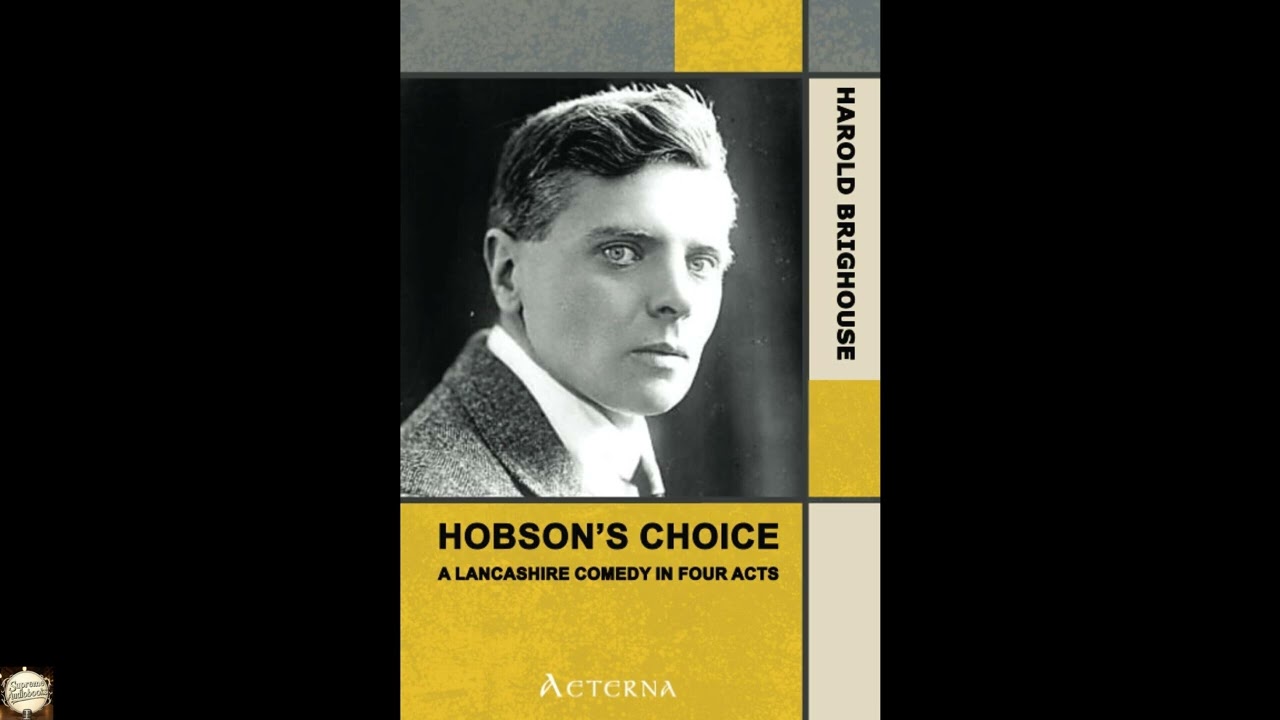
Hobson's Choice: A Lancashire Comedy in Four Acts
Imagine a bustling Lancashire boot shop in the late 19th century, presided over by a cantankerous, dictatorial widower and his three unmarried daughters. Then imagine the eldest daughter—plain, thirty, and indispensable—deciding she’s had enough. Instead of waiting for a husband or a dowry, she takes matters into her own capable hands, picking a man for herself and setting in motion a chain of events that will upend her family, challenge societal norms, and establish her as a formidable force of nature. This is the spirited heart of Harold Brighouse’s Hobson’s Choice, a classic British comedy that remains remarkably fresh and pertinent today. It’s a witty examination of ambition, independence, and the perennial struggle between generations, offering both laughter and insight into the human spirit that refuses to be confined. The stage is set in Salford, a vibrant industrial town near Manchester, around 1880. Henry Horatio Hobson, a prosperous if perpetually inebriated bootmaker, rules his shop and his home with a heavy hand. His three daughters, Maggie, Alice, and Vicky, work for him without wages, their lives circumscribed by his whims. Alice and Vicky, prettier and more conventional, yearn for husbands and escape, but Hobson refuses to grant them dowries, seeing no reason to lose their labor. Maggie, the eldest, possesses a sharp mind and a strong will, qualities her father dismisses and undervalues. She is the true engine of the business, a fact Hobson conveniently overlooks while reveling in his own self-importance and frequent trips to the local pub. The central conflict ignites when Hobson, in a fit of pique, threatens to turn Maggie out, assuming she is destined for spinsterhood. Instead, Maggie issues an ultimatum: she will marry, and she will choose her own husband. Her choice falls upon Willie Mossop, Hobson’s skilled but timid boot-hand, a man whom Maggie recognizes as possessing untapped potential despite his lack of education and social standing. She proposes to him not out of romance, but with a pragmatic vision for their future: they will marry, leave Hobson’s oppressive roof, and open their own boot shop, competing directly with her father. Willie, initially terrified by her forceful proposition, slowly comes to accept her vision, setting them on a course to transform not only their own lives but also the fate of the entire Hobson family. The story then follows their audacious rise, Maggie’s strategic brilliance, and Hobson’s gradual decline as his control slips away. Harold Brighouse, born in 1882 in Eccles, Lancashire, was uniquely positioned to pen a story like Hobson’s Choice. His formative years were spent amidst the industrial landscape he so vividly brought to life in his plays. Initially working in his family’s cotton-spinning business, Brighouse developed a keen eye for the social dynamics and character types of northern England. This firsthand experience lent his writing an authenticity that resonated deeply with audiences. He emerged as a key figure in the Manchester School of dramatists, a movement championed by Annie Horniman at the Gaiety Theatre. This group sought to create realistic, regionally focused plays that depicted the lives of ordinary people with honesty and humor, contrasting sharply with the more artificial London theatre scene of the time. While Hobson’s Choice, which premiered in 1916, became his most celebrated work, Brighouse was a prolific writer, also known for other stage successes such as The Price of Coal and Lonesome Like, as well as novels and short stories. His distinctive voice helped shape the landscape of modern British drama, showcasing the rich dramatic potential of regional life and dialect. Brighouse passed away in 1958, leaving behind a legacy of incisive, entertaining plays that continue to be performed and cherished. At its core, Hobson’s Choice is a profound exploration of several enduring human themes. One primary theme is social mobility and the overturning of established class structures. Maggie Hobson and Willie Mossop, starting from humble positions as a shop assistant and a boot-hand, skillfully navigate the rigid social ladders of Victorian England. Their success isn't granted; it's earned through Maggie's business acumen and Willie’s burgeoning skill and dedication, illustrating how ingenuity and hard work can carve out new opportunities, even for those without inherited wealth or status. Listeners witness Willie’s transformation from a meek, illiterate employee to a confident, successful entrepreneur, a testament to Maggie's belief in his potential. Another potent theme woven throughout the play is female emancipation and the assertion of individual will. Maggie defies the conventions of her era, where a woman’s destiny was often dictated by her father or husband. She actively chooses her path, her spouse, and her business, refusing to be a passive recipient of fate. Her assertive decision to marry Willie, and her subsequent guidance of their joint enterprise, serves as a powerful illustration of agency in a society where women had limited options. Maggie’s quiet determination and practical intelligence stand in stark contrast to the bluster and traditional thinking of her father, making her a truly pioneering character. When Harold Brighouse's play first graced the stage in 1916, the world was a very different place. Europe was engulfed in the Great War, and the grim realities of conflict made the play's domestic comedy and its late-Victorian setting a welcome respite for audiences. Though written and performed during wartime, the story itself harks back to the 1880s, allowing Brighouse to cast a slightly retrospective eye on the social rigidities and burgeoning independence movements of that earlier era. It emerged during a time when women's suffrage was gaining momentum, and the burgeoning calls for greater equality were subtly reflected in works like Hobson's Choice, which presented a woman heroically seizing control of her own destiny. The play also reflects a wider cultural shift in British theatre. The rise of the Manchester School, to which Brighouse belonged, signaled a departure from the more ornate and often melodramatic plays of London's West End. Instead, these regional playwrights focused on realism, often using local dialects and drawing inspiration from the daily lives of the working and lower-middle classes in industrial centers. This commitment to authenticity, married with sharp comedic writing, gave Hobson's Choice its distinctive voice and ensured its lasting appeal as a cornerstone of British drama. Listening to Hobson’s Choice as an audiobook brings this vibrant comedy to life in a way that truly honors its theatrical origins. The narration allows the listener to fully appreciate Brighouse’s meticulous ear for the distinctive Lancashire dialect and the comedic timing embedded in the dialogue. Over several hours of listening, the listener can immerse themselves in the authentic atmosphere of Victorian Salford, from the clatter of the boot shop to the quiet intensity of Maggie’s strategic planning. The nuances of Hobson’s bluster, Maggie’s unwavering resolve, and Willie’s gradual blossoming through the narrator’s voice work create a vivid experience, making the humor land with precision and the dramatic shifts in power feel genuinely impactful. It is a chance to hear a classic play perform its magic, allowing every clever line and character revelation to unfold directly in your mind’s ear.
Enjoyed Hobson's Choice: A Lancashire Comedy in Four Acts? A few ways to support us
Audible & Amazon links are affiliate; we may earn a small commission at no extra cost.
About this production
Human narration by a volunteer reader from LibriVox.org, the public-domain audiobook project. LibriVox volunteers record literary works whose copyright has expired in the United States, releasing the resulting recordings into the public domain.
Hobson's Choice: A Lancashire Comedy in Four Acts by Harold Brighouse. The underlying text is in the U.S. public domain. We do not republish any modern copyrighted edition, translation, or commentary.
The 4K cinematic visuals accompanying this audiobook are generated by an AI image model from prompts derived from the source text. No copyrighted photos, paintings, or stock footage are used. AI generation is disclosed on every video on our YouTube channel as required by YouTube's altered/synthetic content policy.
English subtitles are transcribed from the LibriVox recording with OpenAI Whisper. Translations into the 11 other supported languages are produced by Meta's NLLB-200 neural translation model. No human translator's copyrighted translation is used.
Questions about sourcing or rights? See our DMCA & Sourcing policy or contact us.
Enjoyed this audiobook?
If you'd like to own a copy of Hobson's Choice: A Lancashire Comedy in Four Acts or hear a professionally produced edition, the links below help support free audiobook production at no extra cost to you.
As an Amazon Associate we earn from qualifying purchases. Audible / print links are affiliate.