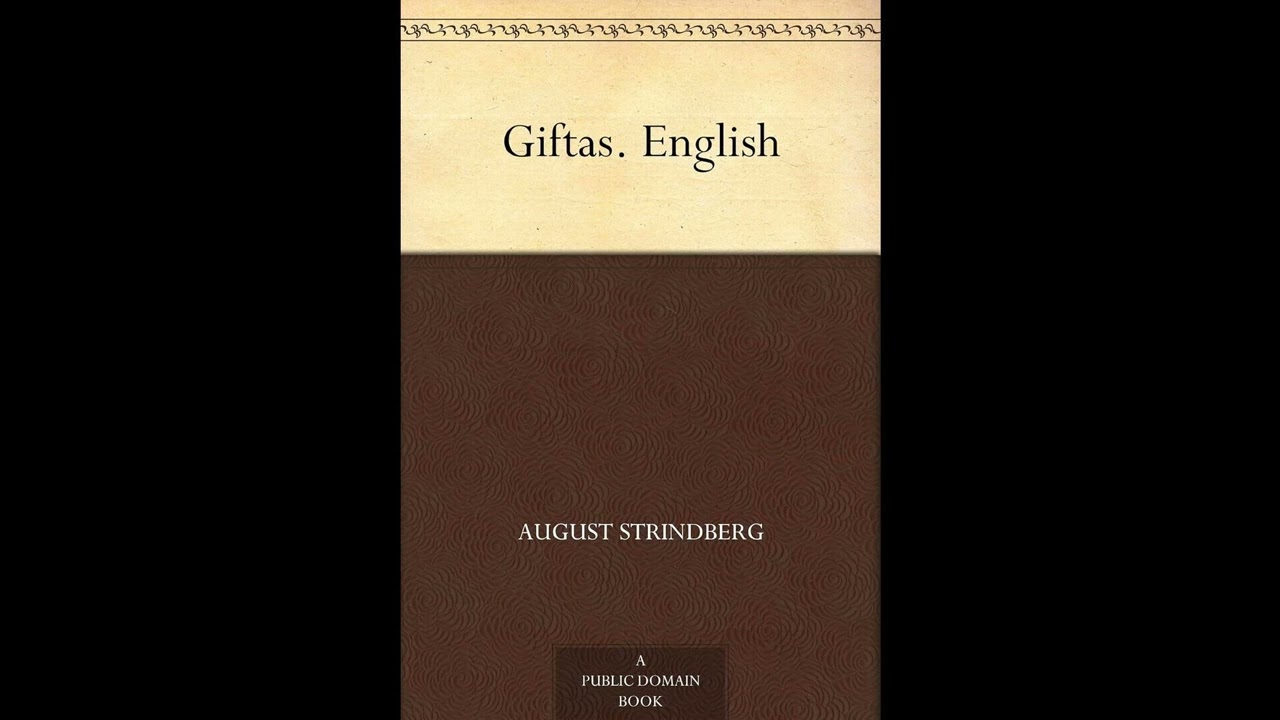
Giftas. English
August Strindberg’s Giftas, or "Married" in English, is not a simple love story but a potent collection of short narratives that dissect the institution of marriage with a scalpel-sharp wit and unflinching honesty. Published in two volumes in 1884 and 1886, these twelve tales ignited a firestorm of controversy upon their release, challenging the romanticized notions of matrimony prevalent in late 19th-century Europe. Today, as conversations about gender roles, power dynamics within relationships, and the societal pressures surrounding partnership continue to evolve, Strindberg's provocative insights remain remarkably pertinent. Listening to Giftas means confronting the raw, often uncomfortable truths about human connection, expectation, and disillusionment that resonate as powerfully now as they did over a century ago. It is a work that invites listeners to reconsider what it means to be bound to another, for better or for worse. The stories within Giftas transport the listener into the varied domestic spheres of late 19th-century Sweden, often focusing on bourgeois and middle-class households, but occasionally venturing into other social strata. Each story introduces a new set of characters – husbands and wives, fiancés and fiancées – grappling with the realities of married life or the prospect of it. The central conflict that runs through the entire collection is the clash between idealized notions of love and companionship, often nurtured by societal expectations, and the frequently messy, frustrating, and sometimes brutal realities of cohabitation. From the moment a couple exchanges vows, or even before, the narrative arc of these tales often traces a descent from initial optimism or conventional acceptance into a deeper understanding of the inherent struggles and compromises. Strindberg masterfully illustrates the shifting power dynamics, the unspoken resentments, and the subtle manipulations that can permeate even the most seemingly harmonious relationships. We meet couples navigating financial woes, infidelity, the arrival of children, the expectations of in-laws, and the slow erosion of individual identity. The author portrays men and women alike as flawed, complex beings, each burdened by their own desires, insecurities, and the roles society has prescribed for them. Without revealing the specific conclusions of these compelling narratives, it is safe to say that Giftas offers a panoramic, often satirical, and sometimes heartbreaking view of marital bliss—or lack thereof—rarely shying away from uncomfortable truths about human nature and the societal constructs that shape our most intimate bonds. The author of this incendiary collection was Johan August Strindberg, born in Stockholm, Sweden, in 1849. His life was as tumultuous and dramatic as many of his literary creations. Strindberg’s childhood was marked by poverty and an often-strained relationship with his parents, experiences that deeply influenced his later critiques of family life and societal institutions. He pursued various careers – schoolteacher, librarian, journalist, telegraph operator – before dedicating himself fully to writing. His personal life was particularly turbulent, encompassing three marriages, each ending in divorce, and periods of intense emotional and mental distress, including the spiritual crisis he famously documented as his "Inferno" period. Strindberg emerged as a towering figure in modern European literature, celebrated and reviled for his innovative and often controversial works across drama, fiction, and autobiography. He was a leading proponent of Naturalism in the 1880s, producing plays like The Father and Miss Julie, which stripped away romantic facades to reveal raw psychological conflict and societal pressures. Later, he moved towards Symbolism and even pre-Expressionism, particularly in his dream plays such as A Dream Play and The Ghost Sonata. His profound psychological insights and formal experimentation profoundly impacted playwrights from Eugene O'Neill to Ingmar Bergman, cementing his place as one of the most influential figures in the development of modern theater and prose. One of the central themes that pulsate through Giftas is the intricate interplay of gender roles and societal expectations within marriage. Strindberg often presents men struggling with the perceived loss of their patriarchal authority and women asserting newfound independence or chafing under traditional constraints. For instance, in one story, a husband finds his sense of masculinity challenged as his wife embraces progressive ideals, leading to a subtle but persistent power struggle within their home. Another recurring idea is the sharp contrast between idealized romance and mundane reality. The initial flush of love or the carefully constructed image of a happy couple often gives way to financial worries, domestic drudgery, and the inevitable disillusionment that arises from unmet expectations. We see this enacted in stories where initial passion dissolves into polite indifference, or where a husband’s romantic notions about his wife are shattered by her practical, sometimes unromantic, nature. Another prominent theme is the hypocrisy of bourgeois society, which often demanded a facade of propriety and happiness, even as underlying tensions and infidelities festered. Strindberg cleverly exposes the double standards applied to men and women, particularly regarding fidelity and public reputation. He also dissects the economic dimensions of marriage, showing how financial dependence or independence profoundly shapes the dynamics between spouses. A wife’s inheritance, for example, might grant her an unexpected leverage, while a husband’s professional failures could tip the balance of power dramatically. These stories are not just observations; they are often provocations, designed to stir debate and challenge comfortable assumptions. When Giftas first appeared in the 1880s, Europe was in the throes of significant social and intellectual upheaval. The latter half of the 19th century saw the rise of industrialization, urbanization, and rapid advancements in science and technology, all of which contributed to a questioning of traditional institutions. Crucially, the "Woman Question" was a heated topic of public debate, fueled by the growing women's rights movement and the emergence of authors like Henrik Ibsen, whose play A Doll's House (1879) famously depicted a woman leaving her marriage to find herself. Strindberg’s work emerged directly into this context, often as a fiercely debated counter-narrative, lambasting what he saw as the excesses of emerging feminism and what he perceived as the emasculating effects of modern marriage on men, while simultaneously exposing the inherent flaws of the patriarchal system he seemed to defend. His unflinching naturalism and willingness to portray the raw, unvarnished realities of human relationships made Giftas a cultural lightning rod. Listening to Giftas as an audiobook offers a particularly immersive way to experience Strindberg's keen psychological observations and his distinctive voice. The collection's "several hours" run time allows each distinct story to unfold at a measured pace, giving the listener ample opportunity to absorb the nuances of character and situation. A skilled narrator can bring out the sharp wit, the biting irony, and the underlying pathos in Strindberg's prose, distinguishing between the often-conflicting inner thoughts and outward pronouncements of the various men and women. The dialogue, which forms the backbone of these domestic dramas, gains an immediate, intimate quality when spoken, enhancing the atmosphere of quiet desperation or simmering conflict. The auditory experience transforms the text into a series of intimate confessions and fraught encounters, making the historical context and universal themes feel incredibly present and personal.
Enjoyed Giftas. English? A few ways to support us
Audible & Amazon links are affiliate; we may earn a small commission at no extra cost.
About this production
Human narration by a volunteer reader from LibriVox.org, the public-domain audiobook project. LibriVox volunteers record literary works whose copyright has expired in the United States, releasing the resulting recordings into the public domain.
Giftas. English by August Strindberg. The underlying text is in the U.S. public domain. We do not republish any modern copyrighted edition, translation, or commentary.
The 4K cinematic visuals accompanying this audiobook are generated by an AI image model from prompts derived from the source text. No copyrighted photos, paintings, or stock footage are used. AI generation is disclosed on every video on our YouTube channel as required by YouTube's altered/synthetic content policy.
English subtitles are transcribed from the LibriVox recording with OpenAI Whisper. Translations into the 11 other supported languages are produced by Meta's NLLB-200 neural translation model. No human translator's copyrighted translation is used.
Questions about sourcing or rights? See our DMCA & Sourcing policy or contact us.
Enjoyed this audiobook?
If you'd like to own a copy of Giftas. English or hear a professionally produced edition, the links below help support free audiobook production at no extra cost to you.
As an Amazon Associate we earn from qualifying purchases. Audible / print links are affiliate.