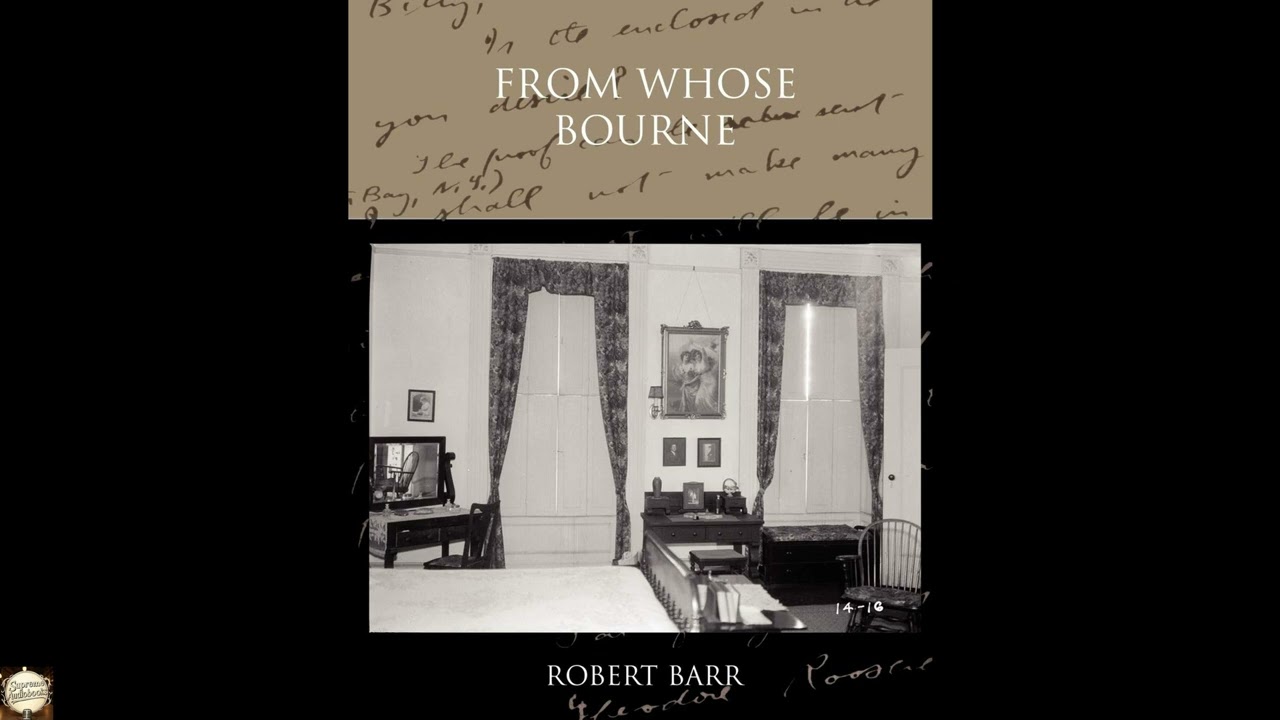
From Whose Bourne
Robert Barr's From Whose Bourne is an extraordinary literary invention that invites listeners to reconsider the ultimate boundary: death itself. Published at the close of the Victorian era, this novella offers a uniquely intimate and surprisingly humorous account of the afterlife, narrated not by an omniscient storyteller, but by a ghost himself. Imagine observing your own funeral, overhearing the condolences, and witnessing the immediate aftermath of your departure from a perspective no living person can ever truly know. This novel provides exactly that vantage point, blending existential pondering with keen social observation and a touch of the absurd. It challenges our preconceived notions of grief, remembrance, and the subtle ways life continues even after one of its participants has moved on, making it a compelling listen for anyone who has ever contemplated what lies beyond. The story introduces us to Robert Bell, a man who, without preamble, suddenly finds himself deceased. The transition is less a dramatic crossing and more an abrupt shift in perception. Robert is still very much "present," yet utterly intangible and unseen by the living world. His primary focus quickly becomes his wife, Henrietta, whom he watches with a mixture of love, concern, and growing exasperation. From his spectral perch, Robert observes Henrietta’s mourning process, which doesn’t unfold quite as he had imagined. He sees her handling his affairs, receiving visitors, and making decisions about her future—all while remaining oblivious to his constant, frustrated presence. Robert's post-mortem existence is a fascinating exercise in futility. He tries to communicate, to intervene, to express his feelings, but his efforts are met with the impenetrable wall between the living and the dead. This central conflict drives the narrative forward, as Robert grapples with his impotence, his inability to offer comfort or even voice an opinion on the practical matters of his estate. His observations of the human tendency to move on, to adapt, and even to find new paths in the wake of loss, form the heart of the story, allowing Barr to gently satirize Victorian social customs and the often performative nature of grief. The narrative keeps us engaged with Robert's changing reactions to Henrietta's decisions and his dawning, sometimes painful, understanding of his new, isolated reality. Robert Barr, born in Glasgow, Scotland, in 1849, experienced a life that spanned two continents and saw the dawn of modern journalism and popular fiction. Emigrating to Canada with his family at a young age, he began his career as a teacher before pivoting to journalism, eventually becoming a staff writer for The Detroit Free Press. His work at the paper honed his concise, engaging prose and his sharp eye for human nature. By 1890, Barr had moved to London, England, a hub of literary activity, where he solidified his reputation as a prolific and popular author. He became an important figure in the literary scene of the fin de siècle, known for his wit and his ability to craft entertaining stories that often contained a deeper social commentary. In London, Barr co-founded The Idler magazine with the renowned humorist Jerome K. Jerome, a publication that quickly became a platform for "New Humor" and featured contributions from authors like Rudyard Kipling and Arthur Conan Doyle. Barr himself contributed numerous short stories and serials to the magazine, establishing his distinctive voice. While perhaps not as universally recognized today as some of his contemporaries, his influence on popular literature, particularly in the realm of short fiction and humorous narratives, was significant during his lifetime. Beyond From Whose Bourne, he is remembered for his detective stories featuring Eugène Valmont and historical romances such as The Countess Tekla, showcasing his versatility across genres. From Whose Bourne keenly examines the theme of appearance versus reality. Robert, as a ghost, sees the world without the filters of societal expectation or personal bias, observing how people behave when they believe no one is watching. He notes the subtle shifts in his wife's demeanor, the perhaps less-than-sincere condolences of acquaintances, and the pragmatic decisions that quickly replace raw grief. This spectral perspective throws into sharp relief the everyday deceptions and self-deceptions that characterize human interaction. Another prominent theme is the nature of remembrance and letting go. Robert initially expects an eternal, agonizing grief from Henrietta, but as he watches her slowly adapt and even begin to look towards a future without him, he grapples with the painful truth that life, and love, continue beyond the grave, sometimes in unexpected directions. The book also addresses the profound isolation that death imposes, not just on the bereaved, but on the deceased themselves. Robert's inability to communicate his presence, his thoughts, or his affection creates a poignant sense of detachment, even while he remains intimately connected to his former life. This highlights the ultimate, unbridgeable chasm between worlds. Furthermore, Barr injects a surprising amount of humor into what could otherwise be a melancholic narrative. Robert's exasperated attempts to interact with the physical world—trying to move objects, whisper warnings, or simply gain attention—become sources of gentle comedy, showing the absurdity inherent in his predicament and softening the existential questions at the story's core. The late nineteenth century, the period in which From Whose Bourne was written, was a time of immense cultural and intellectual ferment. The rise of spiritualism and séances, a widespread fascination with the occult, and an increasingly scientific worldview often clashed with traditional religious beliefs. Authors like Barr were perfectly positioned to comment on this shifting landscape. Ghost stories were popular, but Barr offered a fresh take, moving beyond mere scares to something more introspective and even comedic. The era also saw the flourishing of popular magazines and a growing readership eager for entertaining and thought-provoking fiction that blended elements of the fantastic with social commentary. Barr’s work reflects the broader literary movement of "New Humor," which favored wit, irony, and a less moralistic tone than earlier Victorian humor. From Whose Bourne emerged from this environment, appealing to an audience that was increasingly open to narratives that questioned established norms and found humor in the human condition, even in the face of death. It was a period when authors felt free to experiment with narrative voice and perspective, leading to inventive tales that still resonate today with their cleverness and psychological insight. The book served as a thoughtful yet accessible reflection on universal human experiences, filtered through a fantastical conceit that felt perfectly suited to its time. Listening to From Whose Bourne as an audiobook offers a unique opportunity to immerse oneself fully in Robert Bell's disembodied perspective. A skilled narrator can artfully convey the subtle shifts in Robert’s emotional state—from his initial bewilderment to his growing resignation, his moments of frustration, and his eventual philosophical acceptance. The voice becomes the central conduit for his unseen presence, allowing listeners to experience the world through his spectral senses. The careful pacing of the narration can highlight the poignant observations and the moments of gentle satire, giving each passage its full weight. The absence of visual cues in an audiobook enhances the story's central premise: Robert is present but unseen, his voice the only evidence of his existence. This several-hours-long performance provides a perfect companion for quiet contemplation, allowing the listener to truly inhabit the "bourne" between worlds.
Enjoyed From Whose Bourne? A few ways to support us
Audible & Amazon links are affiliate; we may earn a small commission at no extra cost.
About this production
Human narration by a volunteer reader from LibriVox.org, the public-domain audiobook project. LibriVox volunteers record literary works whose copyright has expired in the United States, releasing the resulting recordings into the public domain.
From Whose Bourne by Robert Barr. The underlying text is in the U.S. public domain. We do not republish any modern copyrighted edition, translation, or commentary.
The 4K cinematic visuals accompanying this audiobook are generated by an AI image model from prompts derived from the source text. No copyrighted photos, paintings, or stock footage are used. AI generation is disclosed on every video on our YouTube channel as required by YouTube's altered/synthetic content policy.
English subtitles are transcribed from the LibriVox recording with OpenAI Whisper. Translations into the 11 other supported languages are produced by Meta's NLLB-200 neural translation model. No human translator's copyrighted translation is used.
Questions about sourcing or rights? See our DMCA & Sourcing policy or contact us.
Enjoyed this audiobook?
If you'd like to own a copy of From Whose Bourne or hear a professionally produced edition, the links below help support free audiobook production at no extra cost to you.
As an Amazon Associate we earn from qualifying purchases. Audible / print links are affiliate.