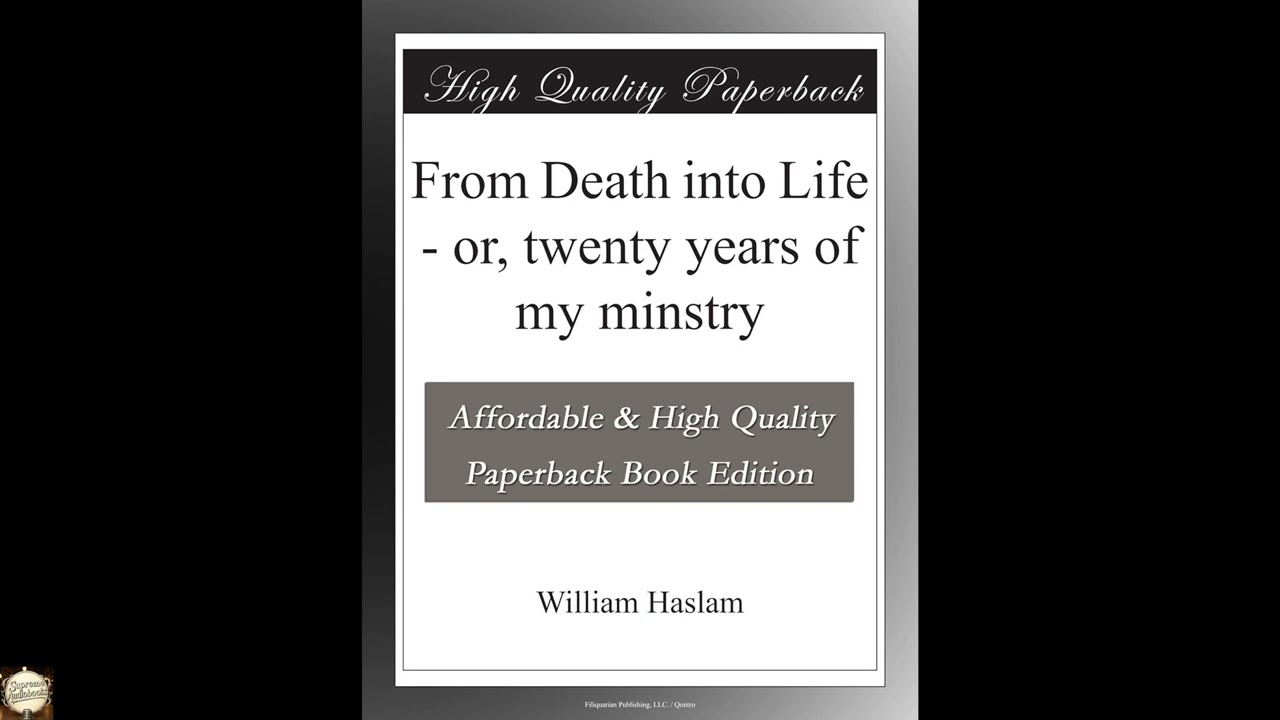
From Death into Life - or, twenty years of my minstry
For those drawn to stories of profound personal transformation and the challenging, often revolutionary path of faith, William Haslam's "From Death into Life" offers an unvarnished and compelling account. Originally published in 1880, this autobiography details the first two decades of Haslam's remarkable ministry following a deeply personal spiritual awakening. It's not merely a historical document; it's a testament to the power of conviction, a window into the spiritual fervor of Victorian England, and a human drama that speaks to anyone wrestling with authenticity, purpose, or the true meaning of their calling, regardless of their own beliefs. This is a narrative about finding one's authentic voice and the courage to live by it, even when it means challenging established norms and enduring personal trials. The story begins with William Haslam as an Anglican clergyman in the mid-19th century, seemingly fulfilling his duties in parishes across rural Cornwall. Yet, beneath the veneer of professional piety, Haslam admits to a profound spiritual emptiness. He preached sermons, administered sacraments, and led his congregation through the rituals of the church, all while confessing that he himself did not possess the vibrant faith he expounded. This internal contradiction forms the initial, silent conflict of the narrative, painting a picture of a man performing a sacred office without truly experiencing its core. His early ministry is marked by a conventional, formal approach, often met with indifference or a polite, surface-level adherence from his parishioners. The central turning point, depicted with vivid and often raw honesty, arrives in 1845 while Haslam is ministering in Perranzabuloe. Overwhelmed by a sense of his own spiritual inadequacy and the lack of genuine impact from his ministry, he experiences a radical, life-altering conversion. This moment, which he describes as moving "from death into life," transforms his understanding of faith, his role as a clergyman, and his approach to ministry entirely. From this point forward, the narrative shifts dramatically. Haslam becomes a fervent evangelist, traveling across Cornwall and beyond, holding revival meetings that often drew hundreds, sometimes thousands. He recounts the struggles with skepticism from fellow clergy, the often-emotional responses of the congregations, and the profound changes he witnessed in individuals and communities touched by the powerful message he now preached with unshakeable conviction. He chronicles the resistance, the long nights of preaching, and the immense satisfaction of seeing lives fundamentally altered. William Haslam, born in 1810, was an influential figure in the evangelical revival movements of 19th-century Britain. Educated at Pembroke College, Cambridge, he was ordained into the Church of England in 1834. His early clerical career, as he candidly explains in his writings, was conventional and largely devoid of personal spiritual depth. It was his transformative experience in 1845, a moment of profound personal awakening, that redefined his life and ministry. This conversion shifted him from a dutiful but uninspired parson to a passionate, itinerant preacher, dedicated to spreading a message of personal salvation and spiritual renewal. Haslam became a leading voice in the "Cornish Revival" and his influence extended throughout England and parts of Scotland. He was known for his direct, powerful preaching style and his ability to connect with ordinary people, drawing them into large, fervent meetings. Beyond "From Death into Life," Haslam also penned "Yet Not I, or, More Years of My Ministry" (1882), which continued the account of his later life and work, and "The Full Assurance of Faith and Hope and Understanding" (1880), further articulating his theological convictions. His writings provide invaluable insight into the methods and impact of Victorian evangelicalism, placing him within the lineage of revivalist figures who shaped religious life during a period of significant social and spiritual change. Haslam passed away in 1883, leaving behind a legacy of dedicated service and an enduring written record of his faith. One of the most powerful themes woven through "From Death into Life" is the concept of spiritual conversion and the quest for personal authenticity. Haslam describes his profound sense of unreality before his awakening, how he preached about a God he felt he barely knew. His moment of crisis, where he publicly confesses his own spiritual barrenness to his astonished congregation, serves as a stark example of a man tearing down the walls of pretense to embrace a genuine, if initially terrifying, truth. This act of vulnerability not only transforms him but also ignites a responsive chord in those who hear him, illustrating that true leadership often stems from personal honesty rather than outward perfection. Another significant theme is the dynamic of revivalism and its social impact. Haslam's accounts are replete with descriptions of packed churches, spontaneous gatherings in fields, and the emotional outpourings that characterized these meetings. He recounts how entire communities, previously marked by apathy or traditionalism, were stirred by a renewed spiritual fervor. He gives examples of how individuals found new purpose, abandoned destructive habits, and engaged in acts of charity, demonstrating the tangible, community-level changes that followed in the wake of his intense, often controversial, evangelistic efforts. This offers a compelling look at how religious movements can act as catalysts for social and moral transformation. When William Haslam penned "From Death into Life" in 1880, Britain was deep in the Victorian era, a time of immense social flux, rapid industrialization, and significant religious questioning. The Church of England, while established, faced challenges from growing Nonconformist denominations, scientific advancements that questioned traditional doctrines, and the social dislocations caused by urban expansion. There was a widespread perception among many evangelicals that a spiritual decline was occurring, prompting waves of revival movements across the country. Haslam's ministry and memoir emerged from this context, representing a fervent response to what he and many others saw as a spiritual drought. His work aligned with a broader evangelical surge that emphasized personal conversion, the authority of scripture, and the importance of missionary outreach, often challenging the more staid, formal practices of the established church. The book serves as a primary source for understanding these powerful undercurrents in 19th-century British religious history. Listening to "From Death into Life" as an audiobook offers a unique and intimate way to experience Haslam's candid memoir. The spoken word brings a heightened immediacy to his personal reflections and dramatic accounts of revival. A skilled narrator can convey the sincerity and conviction in Haslam's voice, whether he is describing his initial spiritual barrenness, the seismic shift of his conversion, or the relentless energy of his subsequent twenty years of ministry. The pacing of the narration can underscore the gradual build-up to his awakening, the intensity of his evangelical sermons, and the quiet moments of reflection that punctuate his active life. Listeners can fully immerse themselves in the atmosphere of Victorian England's spiritual landscape, feeling the weight of the ecclesiastical struggles and the uplift of the communal awakenings Haslam so vividly describes. The sheer length of several hours allows for deep engagement, letting the narrative unfold with the gravity and detail it demands.
Enjoyed From Death into Life - or, twenty years of my minstry? A few ways to support us
Audible & Amazon links are affiliate; we may earn a small commission at no extra cost.
About this production
Human narration by a volunteer reader from LibriVox.org, the public-domain audiobook project. LibriVox volunteers record literary works whose copyright has expired in the United States, releasing the resulting recordings into the public domain.
From Death into Life - or, twenty years of my minstry by William Haslam. The underlying text is in the U.S. public domain. We do not republish any modern copyrighted edition, translation, or commentary.
The 4K cinematic visuals accompanying this audiobook are generated by an AI image model from prompts derived from the source text. No copyrighted photos, paintings, or stock footage are used. AI generation is disclosed on every video on our YouTube channel as required by YouTube's altered/synthetic content policy.
English subtitles are transcribed from the LibriVox recording with OpenAI Whisper. Translations into the 11 other supported languages are produced by Meta's NLLB-200 neural translation model. No human translator's copyrighted translation is used.
Questions about sourcing or rights? See our DMCA & Sourcing policy or contact us.
Enjoyed this audiobook?
If you'd like to own a copy of From Death into Life - or, twenty years of my minstry or hear a professionally produced edition, the links below help support free audiobook production at no extra cost to you.
As an Amazon Associate we earn from qualifying purchases. Audible / print links are affiliate.
More Audiobooks
A Medieval Mystic: A Short Account of the Life and Writings of Blessed John Ruysbroe- Full Audiobook
"Poems in Two Volumes, Volume 1"
Recollections Of A Long Life: An Autobiography
Paul Gosslett's Confessions in Love, Law, and the Civil Service