Four-Dimensional Vistas
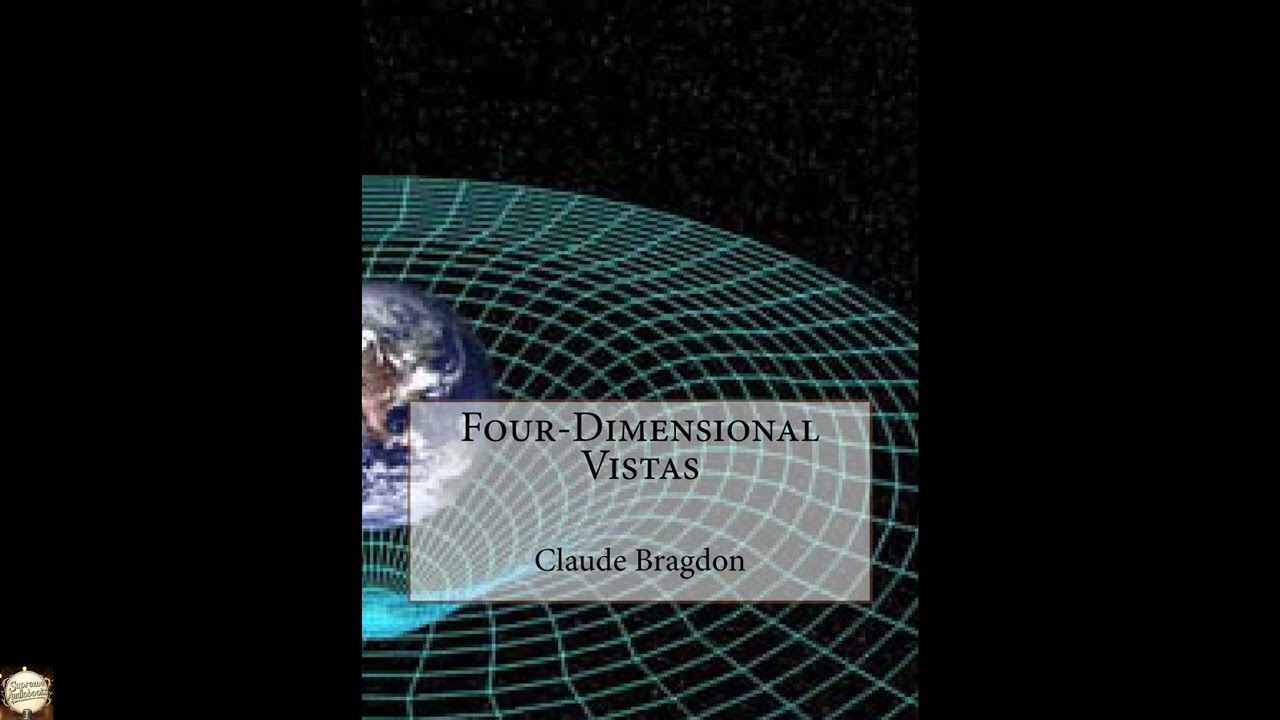
Step beyond the confines of our familiar three-dimensional world and glimpse an existence both alien and profoundly intimate. Claude Bragdon’s Four-Dimensional Vistas is more than a book; it is an invitation to reshape perception, a mental gymnasium designed to stretch the boundaries of human understanding. Originally penned at a pivotal moment in intellectual history, this enduring work continues to resonate today, offering a unique lens through which to comprehend the universe—and our place within it. For those who suspect there is more to reality than meets the eye, or for anyone seeking a thoughtful challenge to conventional thinking, Bragdon’s vision presents a compelling and deeply rewarding intellectual adventure that remains startlingly relevant in an age still grappling with the nature of reality and consciousness. Bragdon begins by meticulously setting the stage, inviting the listener to consider the limitations inherent in our ingrained, everyday perception. He guides us through thought experiments that gently dismantle our assumptions about space and form. Imagine, he suggests, a being confined to a two-dimensional plane, utterly unable to conceive of "up" or "down." This flatlander might perceive a sphere passing through their world not as a single, unchanging object, but as a series of expanding and contracting circles, appearing and disappearing without obvious cause. This elegant analogy establishes the foundational concept: that our own three-dimensional experience might similarly be just a partial view of a larger, unseen reality. From this ground, the book progresses, leading the mind through a sequence of increasingly sophisticated ideas. Bragdon introduces the theoretical framework of the fourth dimension not as a mere mathematical abstraction, but as a space that interacts with and informs our own. He posits that if we could perceive this higher dimension, many of the mysteries and paradoxes of our world might resolve into elegant simplicities. The argument steadily builds, transforming abstract concepts into graspable mental images, illustrating how movements and changes we observe might simply be projections or cross-sections of operations occurring in a more expansive, four-dimensional realm. The aim is not to provide definitive answers, but to open the mind to the possibility, to cultivate a new way of seeing. Claude Fayette Bragdon (1866–1946) was an American architect, writer, and theatrical designer whose career spanned the late nineteenth and early twentieth centuries. Born in Oswego, New York, Bragdon became a prominent figure in the Rochester architectural scene, designing notable structures such as the Rochester Central Station and the Bevier Memorial Building for the Rochester Institute of Technology. However, his interests extended far beyond the blueprint. Deeply influenced by spiritual and esoteric traditions, particularly Theosophy, Bragdon sought to bridge the realms of science, art, and mysticism. He believed that underlying patterns connected all forms of creation, from the geometry of a building to the structure of the cosmos itself. His extensive written output reflects this broad curiosity. Beyond Four-Dimensional Vistas, Bragdon authored numerous other works, including A Primer of Higher Space (The Fourth Dimension), Projective Ornament, and Architecture and Democracy, all of which explore the intersection of geometry, symbolism, and consciousness. He was also instrumental in introducing the work of Russian mystic P.D. Ouspensky to the English-speaking world through his translations. Bragdon’s place in the intellectual canon is unique; he stands as an influential, though often overlooked, figure who synthesized cutting-edge scientific speculation with ancient spiritual wisdom, offering a holistic worldview at a time when specialization was becoming the norm. At its heart, Four-Dimensional Vistas grapples with several profound themes. One primary theme is the relativity of perception: the idea that what we consider "real" is entirely dependent on our sensory and cognitive filters. Bragdon illustrates this by showing how a two-dimensional inhabitant could never truly grasp a sphere until they developed a higher-dimensional awareness, directly challenging our own assumed completeness of vision. This leads naturally to the theme of transcendent consciousness, suggesting that human awareness is capable of expanding beyond its current limitations. He proposes exercises in mental visualization, akin to meditation, that can train the mind to conceptualize space in non-Euclidean ways, thereby nudging consciousness toward a more expansive understanding. A third significant theme is the unity of science and spirituality. Bragdon consistently draws parallels between mathematical principles and spiritual insights, suggesting that the quest for higher dimensions is not just a scientific endeavor but a spiritual one, too. For example, he presents intricate geometrical diagrams not merely as abstract figures but as symbolic representations of cosmic law, implying that the same fundamental structures underpin both the visible and invisible worlds. This ties into the final theme of universal order, a belief that beneath the apparent chaos of phenomena lies an elegant, interconnected framework, patiently waiting to be discovered by an awakened mind. The intellectual currents that flowed during Bragdon’s active period—roughly the turn of the twentieth century and the decades immediately following—provide vital context for Four-Dimensional Vistas. This was an era of immense scientific upheaval, as figures like Einstein were fundamentally reshaping our understanding of space, time, and gravity. Concepts like non-Euclidean geometry and the potential for a fourth spatial dimension were no longer relegated to the fringes of mathematics but were entering popular discourse, challenging ingrained Newtonian worldviews. Concurrently, there was a widespread cultural fascination with spiritualism, Theosophy, and various forms of esoteric thought, often driven by a yearning for meaning amidst rapid industrialization and social change. Bragdon’s work emerged precisely from this fertile cross-section. It responded to the scientific advancements by taking the theoretical implications seriously, moving beyond pure mathematics to consider the existential and spiritual ramifications of a multi-dimensional universe. At the same time, it offered a structured, intellectually rigorous framework for understanding spiritual ideas that might otherwise seem vague or ungrounded. The book tapped into a collective desire to integrate the material and the mystical, to find a coherent explanation for phenomena that defied conventional wisdom, positioning it as a pivotal text for those seeking to reconcile science with a broader sense of meaning. Listening to Four-Dimensional Vistas as an audiobook offers a unique advantage for processing its complex concepts. The "several hours" run length allows the listener to absorb Bragdon's intricate arguments at a measured pace, free from the visual demands of reading dense theoretical text. A skilled narrator's voice can become a guiding presence, articulating the often-abstract ideas with clarity and precision, allowing the mind to focus entirely on comprehension rather than decoding. Listen for the deliberate pacing, which often mirrors Bragdon's own methodical unveiling of concepts, building layers of understanding incrementally. The auditory experience fosters a contemplative atmosphere, transforming what could be a challenging intellectual exercise into a meditative immersion, perfectly suited for delving into the expansive possibilities of higher dimensions.
Enjoyed Four-Dimensional Vistas? A few ways to support us
Audible & Amazon links are affiliate; we may earn a small commission at no extra cost.
About this production
Human narration by a volunteer reader from LibriVox.org, the public-domain audiobook project. LibriVox volunteers record literary works whose copyright has expired in the United States, releasing the resulting recordings into the public domain.
Four-Dimensional Vistas by Claude Bragdon. The underlying text is in the U.S. public domain. We do not republish any modern copyrighted edition, translation, or commentary.
The 4K cinematic visuals accompanying this audiobook are generated by an AI image model from prompts derived from the source text. No copyrighted photos, paintings, or stock footage are used. AI generation is disclosed on every video on our YouTube channel as required by YouTube's altered/synthetic content policy.
English subtitles are transcribed from the LibriVox recording with OpenAI Whisper. Translations into the 11 other supported languages are produced by Meta's NLLB-200 neural translation model. No human translator's copyrighted translation is used.
Questions about sourcing or rights? See our DMCA & Sourcing policy or contact us.
Enjoyed this audiobook?
If you'd like to own a copy of Four-Dimensional Vistas or hear a professionally produced edition, the links below help support free audiobook production at no extra cost to you.
As an Amazon Associate we earn from qualifying purchases. Audible / print links are affiliate.