Rosa Alchemica
What if the world we perceive—the solid ground of reason, the clear light of day—is merely a thin veil over something far older, stranger, and profoundly more real? W.B. Yeats’s Rosa Alchemica, first published in 1897, invites listeners into precisely such a question, drawing them into a compelling narrative where the pursuit of arcane knowledge threatens to shatter the very foundations of sanity. This is not merely a ghost story or an occult fantasy; it is a philosophical meditation in the guise of a haunting tale, a pivotal piece from one of the twentieth century’s greatest literary figures, offering a unique window into the mystical currents that animated Yeats’s own life and the broader cultural anxieties of his era. For anyone interested in the enduring power of myth, the allure of the unknown, or the intricate dance between art and the esoteric, this classic work resonates with startling clarity even today. The story opens in late nineteenth-century Dublin, where our narrator, Michael Robartes, a reclusive scholar, finds himself increasingly disenchanted with the superficiality of modern life and the sterile confines of academic study. His true passion lies in the forgotten wisdom of the ancients, in alchemy, magic, and the mystical traditions that promise a deeper understanding of existence. His quiet, almost melancholic life takes a dramatic turn with the unexpected arrival of Owen Aherne, a fellow seeker who shares Robartes’s spiritual hunger but possesses a more fervent, almost zealous dedication to occult pursuits. Aherne believes he has found the key to unlocking the true essence of the universe—a secret order known as the "Order of the Alchemical Rose," said to be heirs to an ancient, pre-Christian spirituality rooted in Ireland's pagan past. Robartes, though initially skeptical of Aherne's intensity, is ultimately persuaded by the promise of profound revelations. He agrees to leave his familiar world behind and accompany Aherne to a remote, decaying mansion on an isolated island, the alleged sanctuary of this enigmatic order. Within the decaying grandeur of the house, surrounded by strange artifacts, faded hangings, and the lingering scent of antiquity, Robartes is gradually initiated into the Order's elaborate, ritualistic practices. These ceremonies, shrouded in archaic symbolism and conducted with intense solemnity, are designed to awaken dormant faculties, to dissolve the boundaries between the mundane and the spiritual, and to summon divine presences. As Robartes experiences increasingly vivid and unsettling phenomena, the line between waking reality and visionary experience begins to blur, leading him down a path where his rational mind struggles to comprehend the sublime and terrifying truths that are being unveiled. The story builds toward a climactic confrontation with the limits of human perception and the overwhelming force of the spiritual realm, leaving Robartes forever altered by his glimpse behind the curtain of the everyday. William Butler Yeats, the author of this potent novella, was born in Sandymount, Dublin, in 1865, and passed away in Menton, France, in 1939. A towering figure in English literature, Yeats was not merely a poet but a force of nature, deeply embedded in the cultural and political life of his native Ireland. His early years were marked by an intense fascination with Irish folklore, myth, and the supernatural, a passion that would profoundly shape his artistic vision. He became a central figure in the Irish Literary Revival, working tirelessly to foster a distinctly Irish cultural identity distinct from that of Britain. Beyond his poetry, Yeats’s life was punctuated by his unrequited love for the revolutionary Maud Gonne, his involvement in various esoteric societies like the Hermetic Order of the Golden Dawn, and his co-founding of the Abbey Theatre in Dublin, which became a crucible for Irish dramatic talent. He was a Senator of the Irish Free State from 1922 to 1928, demonstrating his commitment to civic life alongside his artistic pursuits. In 1923, he was awarded the Nobel Prize in Literature, a recognition of his profound impact on the literary world and his innovative contributions to modern poetry, including collections such as The Tower, The Wild Swans at Coole, and powerful political poems like Easter, 1916. His poetic voice, which evolved from an early Symbolist lyricism to a more austere and symbolic modernism, consistently returned to themes of spiritual longing, national identity, and the search for transcendent meaning. At its core, Rosa Alchemica enacts the enduring tension between the allure of the occult and the demands of rational existence. Robartes's yearning for mystical truths, evident in his dismissal of conventional scholarship, represents the human desire to connect with something beyond the material world. This is powerfully shown in his growing discomfort with ordinary conversations and his heightened sense of awareness when contemplating ancient rituals, suggesting a deep-seated spiritual hunger that logic cannot satisfy. Another central theme is the transient nature of beauty and the inevitability of decay. The decrepit yet grand mansion where the Order resides, described with its faded tapestries and strange, dust-laden artifacts, serves as a poignant symbol of a glorious past giving way to ruin, yet still retaining a haunting, powerful presence. The novella also grapples with the fluid nature of reality and perception. As Robartes undergoes the Order's rituals, his senses are overwhelmed, and his understanding of what is real is repeatedly challenged. The narrative blurs the distinction between dreams, visions, and objective experience, raising the unsettling possibility that our everyday world is merely one layer of a far more complex and elusive truth. Furthermore, Yeats subtly weaves in the theme of art and ritual as pathways to the divine. The intricate ceremonies and symbolic objects within the Order are presented not just as mere practices, but as artistic expressions designed to reshape consciousness and open channels to otherworldly forces, reflecting Yeats’s own belief in the transformative power of symbolic art and poetry. Rosa Alchemica emerged from a specific moment in history—the fin de siècle period of the late nineteenth century. This was an era marked by a reaction against the scientific rationalism and Victorian materialism that had dominated much of the century. There was a widespread sense of spiritual unease, a turning away from established religion, and a growing fascination with spiritualism, the occult, and esoteric traditions. Societies like the Theosophical Society and the Hermetic Order of the Golden Dawn (which Yeats himself joined) flourished, attracting intellectuals, artists, and poets disillusioned with the perceived emptiness of modern life. Culturally, Ireland was experiencing its own fervent awakening, known as the Celtic Revival. This movement sought to reclaim and celebrate Ireland's ancient myths, folklore, and Gaelic heritage, distinguishing it from British cultural influence. Yeats was a key architect of this revival, believing that Ireland’s unique spiritual traditions could offer a powerful alternative to the soulless industrialization of England. Rosa Alchemica, with its fusion of Irish paganism, esoteric ritual, and a critique of modernity, stands as a testament to these overlapping currents, an artistic response to the spiritual and cultural yearning that defined the age. It represents Yeats's personal quest to synthesize ancient wisdom with modern artistic expression, crafting a mythology for a newly imagined Ireland. To experience Rosa Alchemica as an audiobook is to immerse oneself in its unique, often hypnotic atmosphere. The precise, carefully chosen language of Yeats, rich with symbolic resonance and a melancholic beauty, takes on new dimensions when voiced. The listener can fully surrender to the slow, deliberate pacing of the narrative, allowing the scholarly narrator's contemplative tone to draw them deeper into Robartes's unsettling spiritual quest. Listen for the subtle shifts in the narrator's voice, reflecting his initial skepticism, his growing wonder, and his eventual profound disquiet as the rituals unfold. The dialogue, often laden with philosophical implications and arcane references, gains a particular weight and rhythm, allowing its density to become a part of the sensory experience rather than a barrier. This narrative, a journey into the hidden corners of the mind and spirit, is perfectly suited for an attentive listen, where the nuances of tone and inflection can amplify the story's eerie charm and its lasting philosophical questions.
Enjoyed Rosa Alchemica? A few ways to support us
Audible & Amazon links are affiliate; we may earn a small commission at no extra cost.
About this production
Human narration by a volunteer reader from LibriVox.org, the public-domain audiobook project. LibriVox volunteers record literary works whose copyright has expired in the United States, releasing the resulting recordings into the public domain.
Rosa Alchemica by W B Yeats. The underlying text is in the U.S. public domain. We do not republish any modern copyrighted edition, translation, or commentary.
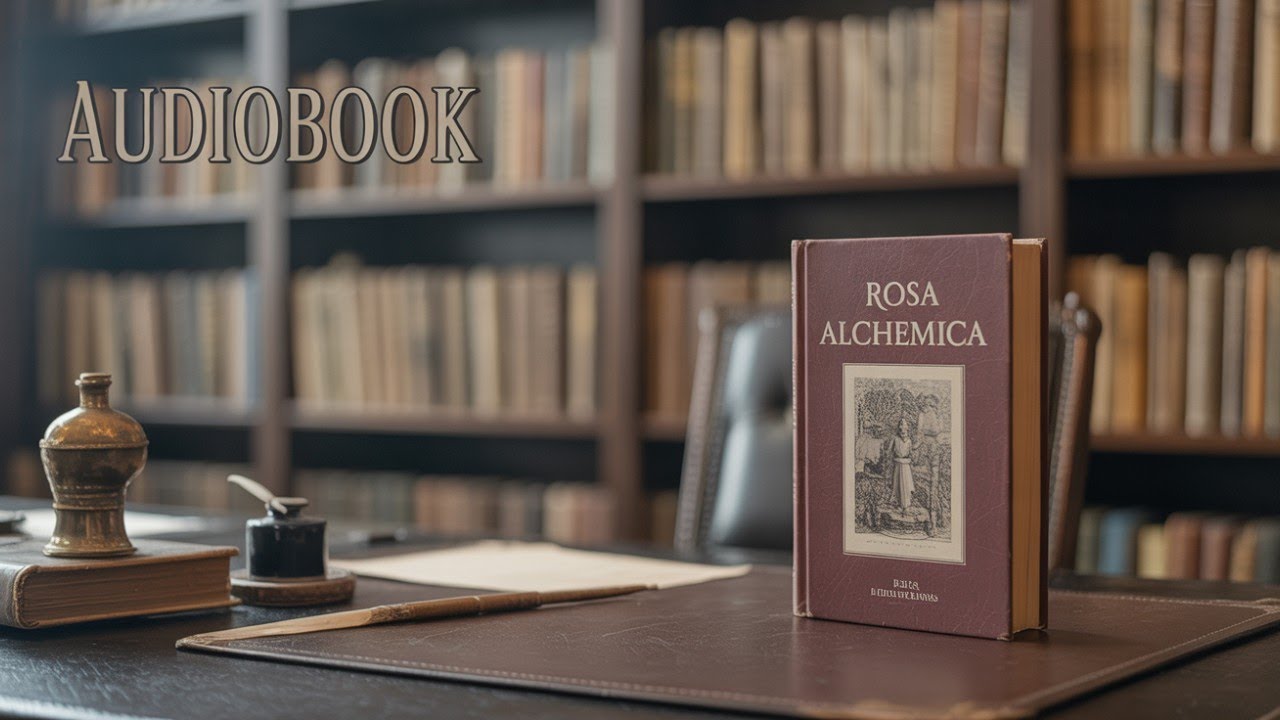
The 4K cinematic visuals accompanying this audiobook are generated by an AI image model from prompts derived from the source text. No copyrighted photos, paintings, or stock footage are used. AI generation is disclosed on every video on our YouTube channel as required by YouTube's altered/synthetic content policy.
English subtitles are transcribed from the LibriVox recording with OpenAI Whisper. Translations into the 11 other supported languages are produced by Meta's NLLB-200 neural translation model. No human translator's copyrighted translation is used.
Questions about sourcing or rights? See our DMCA & Sourcing policy or contact us.
Enjoyed this audiobook?
If you'd like to own a copy of Rosa Alchemica or hear a professionally produced edition, the links below help support free audiobook production at no extra cost to you.
As an Amazon Associate we earn from qualifying purchases. Audible / print links are affiliate.