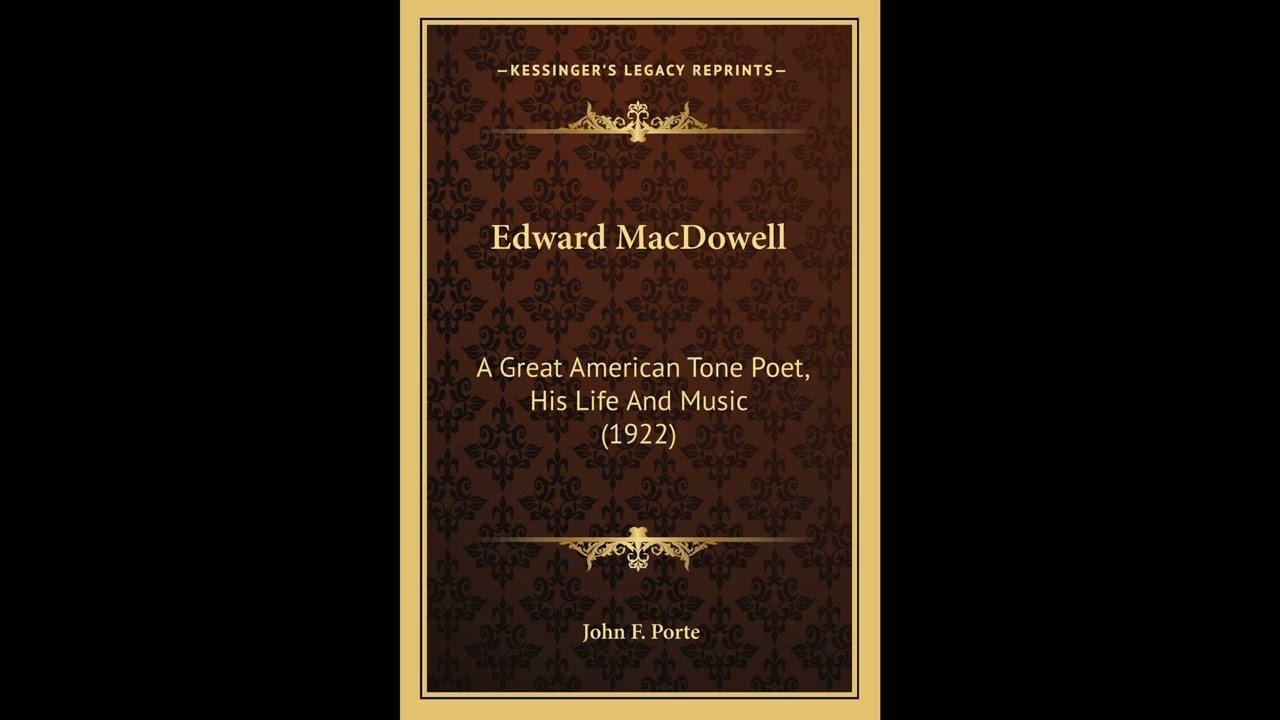
Edward MacDowell: A Great American Tone Poet, His Life And Music
Edward MacDowell: A Great American Tone Poet, His Life And Music offers a vital look into the heart of early American classical music through the life and struggles of one of its most important figures. This book is not merely a recounting of facts; it is an ardent plea for the recognition of a uniquely American artistic voice, urging listeners to understand the complex forces that shaped MacDowell's compositions and his enduring legacy. In an era when America was still finding its artistic footing on the global stage, MacDowell stood as a pioneer, wrestling with European influences while striving to forge a distinct national idiom. His story, told with detail and passion, remains profoundly relevant today as we continue to grapple with questions of cultural identity, the value of artistic education, and the personal cost of creative ambition. The narrative unfurls through the life of Edward MacDowell, tracing his path from a precocious musical talent in New York City to his rigorous European training and eventual return to America as a celebrated composer and performer. We encounter MacDowell first as a gifted child, whose early aptitude for the piano set him on an extraordinary course. The story then moves to his formative years in Paris, Stuttgart, Wiesbaden, and Frankfurt, where he absorbed the rich traditions of European Romanticism, studying under revered masters and refining his technique. It was during this period that MacDowell began to publish his first significant works, earning praise and recognition from established figures like Franz Liszt, which gave him an invaluable early boost. The central conflict that emerges is MacDowell's internal and external struggle to synthesize his profound European schooling with an insistent desire to express something authentic to his American homeland. Upon his return to the United States, MacDowell's life takes on new dimensions. He establishes himself first in Boston, then in New York, becoming not only a prominent composer and pianist but also a pivotal educator. His appointment as the first head of the Department of Music at Columbia University marks a significant turn, showcasing his ambition to elevate music within American academia. However, this period is also colored by considerable personal and professional strain. The demands of administrative work, coupled with profound disagreements over the role and philosophy of art education within the university setting, weigh heavily upon him. The narrative portrays a man deeply committed to his artistic ideals, often at odds with the bureaucratic realities of institutional life, leading to a dramatic resolution in his academic career. John F Porte's dedicated account of Edward MacDowell's life stands as a cornerstone in the historical understanding of American music. As a biographer writing in the early decades of the twentieth century, Porte was well-positioned to capture the spirit of an era yearning to define its own cultural heroes. While specific biographical details about Porte himself are often modest, his commitment to illuminating MacDowell's artistic contributions is clear on every page. This book, published relatively soon after MacDowell's untimely passing, served to solidify the composer's place as a seminal figure, preserving his story for future generations. Porte's meticulous research and heartfelt presentation underscore his admiration for MacDowell, ensuring that the composer's personal struggles and artistic triumphs would not be forgotten. It is through works like Porte's that the early canon of American artists began to coalesce, providing invaluable insights into the period's cultural aspirations and artistic production. The book brings forth several potent themes. Foremost is the search for an American voice in art. MacDowell, keenly aware of the European dominance in classical music, consciously sought to imbue his compositions with elements that resonated with American landscapes and folklore. For example, his "Indian Suite," Opus 48, attempts to interpret indigenous melodies and rhythms, moving beyond mere imitation to synthesize a new sound. Another significant theme is the tension between rigorous European training and the drive for an American artistic identity. MacDowell's early works clearly demonstrate the influence of German Romanticism, yet his later compositions, such as his "Woodland Sketches," Opus 51, with their evocative titles like "To a Wild Rose" and "Will o' the Wisp," reveal a composer striving for a distinctly American pastoral sensibility, drawing inspiration from his native landscape rather than solely from European literary traditions. A third central theme centers on the artist's struggle with institutional demands. MacDowell's turbulent tenure at Columbia University provides a stark example. His resignation, spurred by fundamental disagreements with the university president over the curriculum and the proper place of the fine arts, illuminates the challenges artists face when their creative ideals clash with academic structures. Finally, the intersection of music and literature is consistently present. MacDowell was deeply moved by poetry and often found inspiration in literary works, translating their sentiments into musical form. Many of his piano pieces bear programmatic titles, suggesting narrative or visual scenes, allowing the listener to perceive the music as a direct extension of poetic thought. His symphonic poems, like "Lancelot and Elaine," further illustrate his profound engagement with literary themes. This biography emerged from a specific cultural moment in American history—the late nineteenth and early twentieth centuries—when the nation was consciously establishing its own identity separate from its European progenitors. Following the Civil War, America was rapidly industrializing and looking inward to foster its own distinct cultural institutions and artistic expressions. There was a burgeoning sense of national pride that fueled a desire for "great American artists" who could stand alongside their European counterparts. In the realm of classical music, American composers were still fighting for recognition against the established traditions of Germany, France, and Italy. Figures like Edward MacDowell were at the forefront of this movement, daring to compose music that was both technically sophisticated and uniquely American in spirit. Porte's biography, appearing after MacDowell's death in 1908, served to consecrate his memory and secure his place as a national musical hero, contributing to the broader project of defining an American cultural heritage. Listening to Edward MacDowell: A Great American Tone Poet, His Life And Music as an audiobook transforms the biographical experience into an intimate encounter with a pivotal figure. The narrator's voice, carefully chosen for its clarity and thoughtful cadence, provides a steady companion through MacDowell's often tumultuous life. The "several hours" run length allows for a deep, sustained immersion, giving listeners ample opportunity to absorb the details of his artistic development, personal triumphs, and tragic setbacks without feeling rushed. A skilled narrator can modulate pacing to reflect the energetic optimism of MacDowell's youth, the earnest dedication of his student years, the ambitious drive of his professional career, and the somber undertones of his later struggles. The voice can bring forth the passion of his artistic convictions and the quiet contemplation found in his nature-inspired compositions, crafting an atmosphere that evokes the intellectual and artistic currents of a bygone era. Through careful articulation and sensitive delivery, the audiobook ensures that MacDowell's story, and Porte's admiration for him, resonates profoundly.
Enjoyed Edward MacDowell: A Great American Tone Poet, His Life And Music? A few ways to support us
Audible & Amazon links are affiliate; we may earn a small commission at no extra cost.
About this production
Human narration by a volunteer reader from LibriVox.org, the public-domain audiobook project. LibriVox volunteers record literary works whose copyright has expired in the United States, releasing the resulting recordings into the public domain.
Edward MacDowell: A Great American Tone Poet, His Life And Music by John F Porte. The underlying text is in the U.S. public domain. We do not republish any modern copyrighted edition, translation, or commentary.
The 4K cinematic visuals accompanying this audiobook are generated by an AI image model from prompts derived from the source text. No copyrighted photos, paintings, or stock footage are used. AI generation is disclosed on every video on our YouTube channel as required by YouTube's altered/synthetic content policy.
English subtitles are transcribed from the LibriVox recording with OpenAI Whisper. Translations into the 11 other supported languages are produced by Meta's NLLB-200 neural translation model. No human translator's copyrighted translation is used.
Questions about sourcing or rights? See our DMCA & Sourcing policy or contact us.
Enjoyed this audiobook?
If you'd like to own a copy of Edward MacDowell: A Great American Tone Poet, His Life And Music or hear a professionally produced edition, the links below help support free audiobook production at no extra cost to you.
As an Amazon Associate we earn from qualifying purchases. Audible / print links are affiliate.