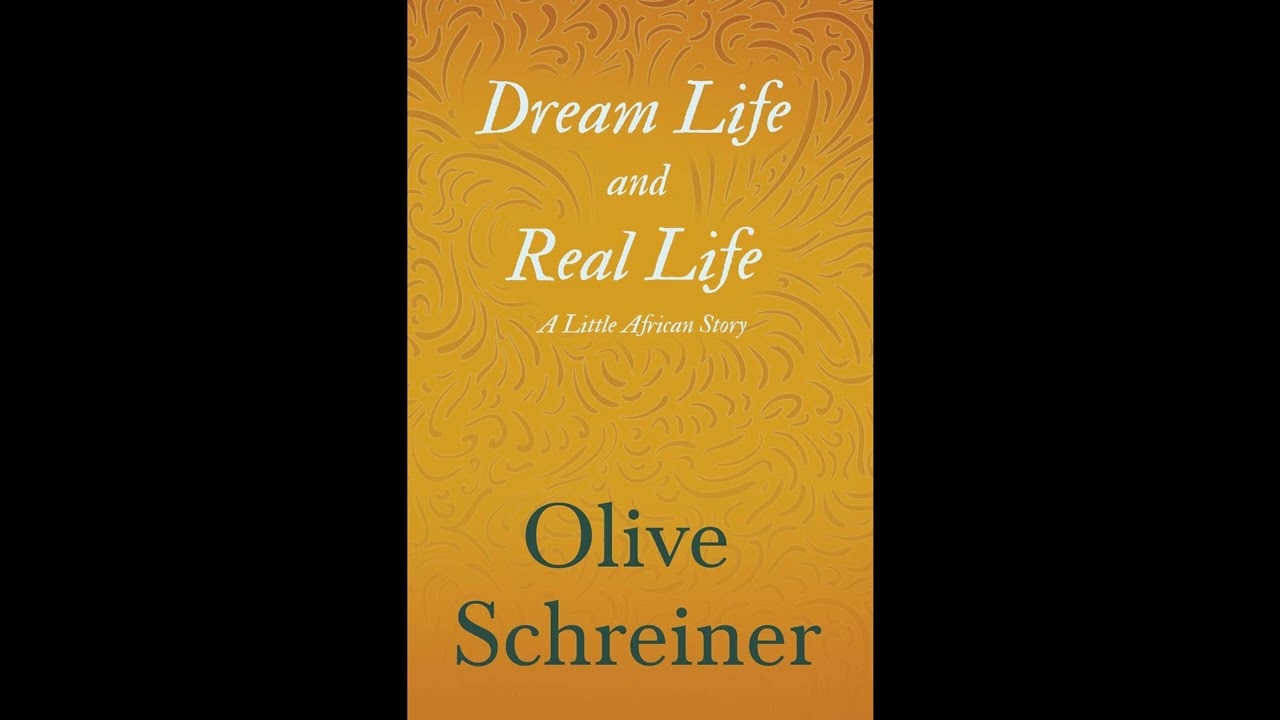
Dream Life and Real Life - A Little African Story
Step into the evocative landscapes of nineteenth-century South Africa, a world both starkly beautiful and profoundly challenging, where the inner lives of individuals often clashed with the harsh realities of their existence. Olive Schreiner's "Dream Life and Real Life - A Little African Story" invites listeners into a collection of narratives that are at once deeply personal and universally resonant. These are not merely tales of a bygone era; they are incisive observations on the human spirit, on the struggle for autonomy, and on the enduring power of imagination in the face of societal constraint and personal sorrow. For anyone who has ever felt the pull between what is and what could be, or wrestled with the compromises demanded by the world, Schreiner's voice speaks with a clarity and poignancy that remains remarkably pertinent today, offering solace and insight into the timeless dilemmas of the heart and mind. The central narrative, "Dream Life and Real Life," transports us to a secluded homestead on the South African veld, a place where vast horizons meet the confines of everyday life. Here, we meet Rebekah, a young woman whose spirit is as expansive as the landscape around her, yet whose physical circumstances offer little scope for her burgeoning intellect and profound inner world. Her days are filled with the mundane duties of rural life, but her nights—and often her waking moments—are illuminated by vivid, intricate dreams, allegories, and deeply felt imaginings that form a counter-reality. These inner visions are not idle fantasies but rather the very essence of her being, offering a sanctuary from the often brutal and unfulfilling demands of her family and community. Rebekah's central conflict arises from the profound chasm between this rich internal life and the unyielding external pressures. She yearns for connection, understanding, and a life that aligns with her spiritual and intellectual aspirations, yet she is constrained by patriarchal expectations, limited opportunities, and the emotional distance of those around her. The story follows her attempts to reconcile these two irreconcilable worlds, to find a place where her dreams can take root in reality, or perhaps to simply survive intact despite their divergence. Through encounters with various characters who represent different facets of the colonial society—some sympathetic, some deeply flawed—Rebekah navigates a path fraught with disillusionment, sacrifice, and moments of profound, albeit often fleeting, clarity. Her story is a quiet yet powerful testament to the resilience of the individual spirit when faced with immense external and internal strife. Olive Schreiner, the author of these compelling stories, was a figure of immense intellectual and moral courage, born in 1855 to missionary parents in the remote Cape Colony. Her childhood was marked by severe hardship, poverty, and a profound sense of isolation, which she largely overcame through voracious self-education and an unshakeable belief in her own observations. These early experiences profoundly shaped her worldview, instilling in her a deep empathy for the marginalized and a keen critical eye for social injustice. She moved to England in her twenties, initially to study medicine, but soon found her true calling in writing, bursting onto the literary scene with her groundbreaking novel, "The Story of an African Farm," published under the pseudonym Ralph Iron in 1883. This novel, a semi-autobiographical account of life on the veld and a scathing critique of Victorian gender roles and religious dogma, established her as a major voice. Schreiner’s influence extended far beyond literature; she was a passionate social reformer, a fervent anti-war activist during the Second Boer War, and a pioneering feminist thinker whose work, "Woman and Labour" (1911), remains a foundational text in feminist literature. Throughout her life, she challenged convention, advocated for women's rights, and spoke out against imperialism, racial discrimination, and social hypocrisy, all while maintaining a complex and often turbulent personal life. She returned to South Africa for extended periods, remaining deeply connected to her homeland, and continued to write and publish until her death in 1920, leaving behind a legacy as one of the most significant South African authors and a vital voice in late nineteenth and early twentieth-century social thought. One prominent theme within "Dream Life and Real Life" is the enduring conflict between the inner world of imagination and the harsh demands of external reality. Rebekah's dreams are not mere escapism; they are shown to be the very wellspring of her spirit, a source of moral guidance and intellectual growth. For instance, in one striking allegorical sequence, a character labors tirelessly on a monumental structure, a symbol of their life's work and aspirations, only for it to be constantly threatened by the indifference or active destruction of others. This image powerfully illustrates how individual creativity and spiritual striving are often at odds with the mundane, materialistic, or uncomprehending forces of society. Another central concern is the repression of female agency and potential within a patriarchal society. Rebekah's intellect and spiritual depth are largely unrecognized and unvalued by those around her, her talents seen as inconvenient or even dangerous, rather than as gifts to be nurtured. This theme is keenly felt in the quiet desperation that permeates many of her interactions, a longing for intellectual companionship and emotional freedom that is consistently denied. Furthermore, the collection grapples with themes of colonial alienation and the search for authentic connection. While not explicitly a political tract, the colonial setting subtly underscores a sense of dislocation and otherness, even among the white settlers, as they strive to build lives in a land that often feels indifferent or hostile. The landscape itself acts as a character, both a source of solace and a stark reflection of life’s difficulties. There is also a quiet yet firm critique of conventional religious piety versus genuine spiritual experience. Characters who profess faith often embody hypocrisy or rigid dogma, while true insight and compassion frequently come from unexpected sources or from an internal, unconventional spiritual path. Schreiner's work, through these narratives, consistently champions the sensitive, the unconventional, and the truth-seeker against the pressures of conformity and superficiality. The late Victorian period, when "Dream Life and Real Life" first appeared in 1893, was a time of immense social and political upheaval across the British Empire. It was an era defined by imperial expansion, technological advancement, and significant shifts in societal values, particularly concerning the roles of women and the nature of religious belief. Darwin's theories had challenged traditional faith, industrialization was rapidly changing urban landscapes, and a nascent women's suffrage movement was beginning to gather momentum. Schreiner's writing emerged from this ferment, offering a critical voice from the colonial periphery that often ran counter to the prevailing imperial and patriarchal narratives emanating from the metropolitan center. Her nuanced portrayal of women's inner lives and struggles for intellectual and personal freedom resonated deeply with the burgeoning feminist consciousness of the time, while her sharp observations on colonial life provided a perspective that was both insider and outsider. This collection, published a decade after her major success, cemented her reputation not just as a novelist but as a profound philosophical storyteller, contributing to the broader literary conversation about realism, psychology, and social critique at a pivotal moment in literary history. To hear Schreiner's precise, often poetic prose read aloud adds a layer of intimacy and depth to the experience of "Dream Life and Real Life." The several hours of narration allow ample time to fully immerse oneself in her intricate thought processes and the nuanced emotional landscapes of her characters. A skilled narrator will bring out the delicate balance between the lyrical descriptions of the South African veld and the sharp, sometimes cutting, psychological observations. Listeners can anticipate a pacing that allows the allegorical passages to unfold with their full symbolic weight, while moments of dialogue convey both the spoken word and the unsaid truths beneath. The atmosphere of quiet contemplation, interspersed with moments of intense emotional resonance, is particularly well-suited to the audiobook format, offering a chance to truly absorb the profound questions Schreiner poses about human existence, identity, and the enduring search for meaning in a world that often seems indifferent to our deepest aspirations.
Enjoyed Dream Life and Real Life - A Little African Story? A few ways to support us
Audible & Amazon links are affiliate; we may earn a small commission at no extra cost.
About this production
Human narration by a volunteer reader from LibriVox.org, the public-domain audiobook project. LibriVox volunteers record literary works whose copyright has expired in the United States, releasing the resulting recordings into the public domain.
Dream Life and Real Life - A Little African Story by Olive Schreiner. The underlying text is in the U.S. public domain. We do not republish any modern copyrighted edition, translation, or commentary.
The 4K cinematic visuals accompanying this audiobook are generated by an AI image model from prompts derived from the source text. No copyrighted photos, paintings, or stock footage are used. AI generation is disclosed on every video on our YouTube channel as required by YouTube's altered/synthetic content policy.
English subtitles are transcribed from the LibriVox recording with OpenAI Whisper. Translations into the 11 other supported languages are produced by Meta's NLLB-200 neural translation model. No human translator's copyrighted translation is used.
Questions about sourcing or rights? See our DMCA & Sourcing policy or contact us.
Enjoyed this audiobook?
If you'd like to own a copy of Dream Life and Real Life - A Little African Story or hear a professionally produced edition, the links below help support free audiobook production at no extra cost to you.
As an Amazon Associate we earn from qualifying purchases. Audible / print links are affiliate.