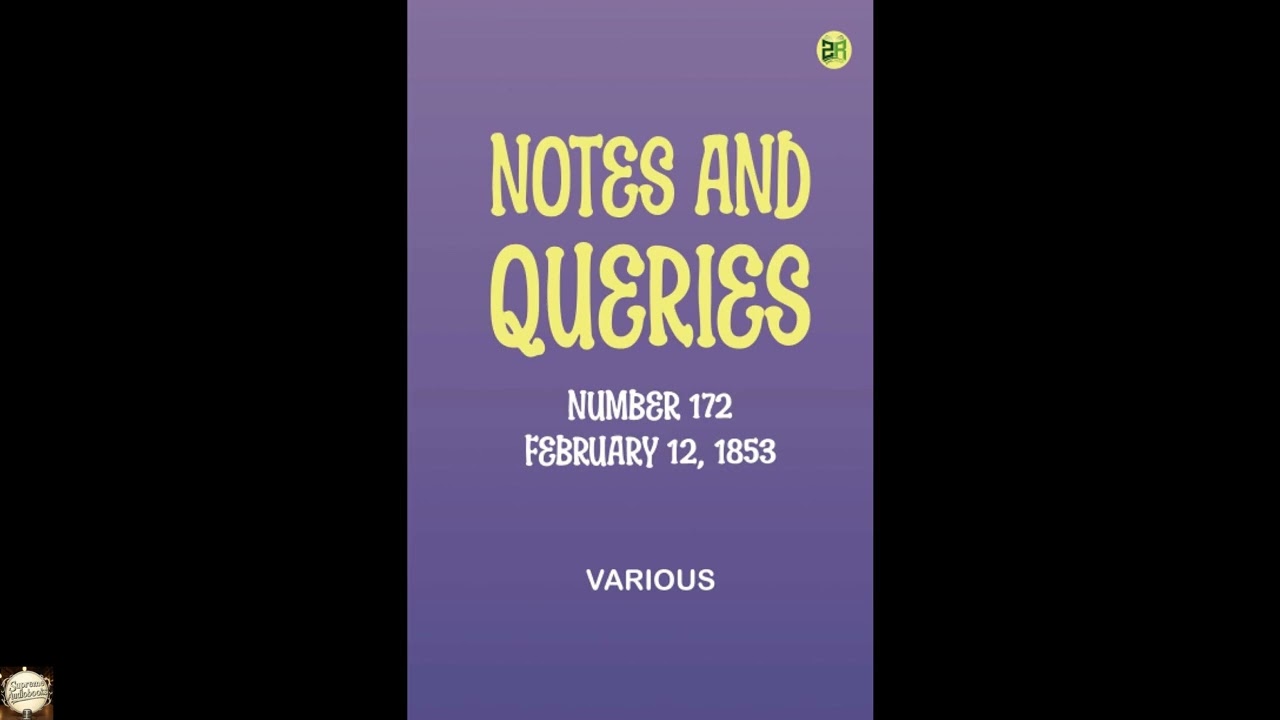
Notes and Queries, Number 176, March 12, 1853; A Medium of Inter-communication
Imagine a world without search engines, without digital archives, without instant messaging—a world where every obscure fact, every etymological puzzle, every whispered piece of folklore required diligent research and a network of equally curious minds. This is the intellectual landscape into which Notes and Queries emerged, and Number 176, from March 12, 1853, offers a direct, unvarnished window into that very particular moment. Far from a single narrative, this volume is an auditory expedition into the collective consciousness of Victorian scholars, amateur historians, and passionate dilettantes, united by an insatiable hunger for knowledge and a desire to preserve the fleeting minutiae of history and language. It speaks to anyone who relishes the thrill of discovery, the satisfaction of an answered question, and the enduring power of shared curiosity. Within the covers of this particular issue, one finds a delightful miscellany of short contributions, each a self-contained miniature of intellectual endeavor. The primary architecture consists of "Notes," "Queries," and "Replies." A "Note" might present a new discovery concerning a historical figure, an observation on a forgotten literary reference, or a detailed account of a local custom on the verge of disappearing. One might encounter, for instance, a brief article shedding light on the precise wording of a forgotten Elizabethan ballad, or a correspondent's musings on the origins of a particular architectural feature in a provincial church. These are not grand theses, but rather concise contributions, each aiming to add a small but significant piece to the broader mosaic of human understanding. Interspersed with these observations are the "Queries"—questions posed by readers to the larger community. These questions range widely, from requests for information on obscure literary allusions, to inquiries about the etymology of a peculiar word, to pleas for details regarding specific genealogical lines or historical events. A query might ask for clarification on the precise location of a battlefield mentioned in an old chronicle, or seek the source of a cryptic proverb. The "Replies" then follow, often in subsequent issues, but sometimes present in the same one, as knowledgeable readers offer their insights, provide citations, or debate previous answers, illustrating the lively, ongoing discourse that animated the publication. The overall arc of the listening experience thus becomes a series of intellectual engagements—a question posed, an observation offered, a debate initiated—each contributing to a communal effort to compile, correct, and distribute information. There is no conventional protagonist or unfolding plot, but rather the collective pursuit of truth through many individual voices. The "author" of Notes and Queries, Number 176, March 12, 1853 is not a singular figure, but rather the collective intelligence and widespread curiosity of the mid-Victorian reading public, guided by a visionary editor. The periodical itself was founded in 1849 by William John Thoms, a distinguished antiquarian, librarian, and early folklorist. Thoms—best known for coining the term "folklore" in 1846—envisioned Notes and Queries as a "Medium of Inter-communication" for literary men, artists, and all interested in historical and general literary subjects. He sought to create a forum where questions could be asked and answered, where forgotten facts could be brought to light, and where the ephemeral details of culture and history could be recorded for posterity. Thoms's genius lay in recognizing the widespread, often isolated, intellectual pursuits of his contemporaries and providing them with a centralized platform. Under his editorship, the journal rapidly became an indispensable resource for scholars across Britain and beyond, allowing individuals to consult a vast, informal network of experts. It brought together academics from universities, country parsons with local historical knowledge, retired professionals with time for research, and simply anyone with a passionate interest in a specific corner of human knowledge. The enduring success of Notes and Queries – which continues to this day – stands as a testament to Thoms's original concept and the enduring human desire to share and consolidate learning. Several key themes resonate throughout this specific issue of Notes and Queries. One prominent theme is the pursuit of exact knowledge and clarification. Many entries are driven by a need to verify a date, pinpoint a reference, or correct a common misconception. For example, a "Query" might seek the definitive origin of a seemingly commonplace idiom, demonstrating a meticulous drive for accuracy that often characterizes scholarly endeavor. A "Reply" might then meticulously cite contemporary sources to provide the sought-after detail, illustrating a rigorous commitment to factual precision. This constant striving for definition and specificity underpins much of the communication. Another significant theme is the preservation of vanishing cultural details. Many "Notes" specifically record local customs, regional dialects, or historical anecdotes that risked being lost to time. A correspondent might describe a unique harvest festival observed in a remote shire, or detail a particular usage of language specific to a coastal community. These contributions act as vital early ethnographic records, capturing aspects of British life and linguistic evolution before standardization and modernization eroded them. The "inter-communication" itself becomes a collective act of cultural conservation, building a comprehensive record piece by piece. The year 1853, when this particular issue was published, fell squarely within the burgeoning mid-Victorian era, a period of immense change and intellectual ferment in Great Britain. The Industrial Revolution had reshaped the landscape and society, fostering a growing middle class with increased literacy and leisure time for intellectual pursuits. Print culture was flourishing, with a proliferation of newspapers, magazines, and periodicals catering to diverse interests. Simultaneously, there was a heightened sense of historical consciousness and an increasing professionalization of various academic disciplines. Scholars and enthusiasts alike felt an urgent need to systematize knowledge, document history, and understand the rapid transformations occurring around them. Notes and Queries perfectly addressed this environment, providing a necessary forum for the scattered, yet burgeoning, intellectual energies of the age. It was a time when the boundaries between "amateur" and "professional" scholarship were more fluid, and a widely accessible publication could serve as a vital clearinghouse for a multitude of inquiries and discoveries. Listening to Notes and Queries, Number 176, March 12, 1853 as an audiobook transforms the experience of this historical artifact. The narration allows the listener to appreciate the distinctive rhythm of Victorian prose, often formal yet imbued with a palpable sense of earnest intellectual engagement. A skilled voice actor can subtly differentiate between the various "voices" implied by the different contributions—the precise query, the authoritative reply, the observational note—giving each snippet its own character and bringing to life the invisible community of correspondents. The relatively short, discrete nature of each entry means the pacing remains brisk, shifting from one fascinating subject to another without lingering too long, making it an ideal companion for shorter listening sessions. One can hear the dedication to clarity in the language, the careful construction of arguments, and the sheer delight in uncovering an obscure fact, allowing the listener to truly inhabit the intellectual world of the mid-nineteenth century.
Enjoyed Notes and Queries, Number 176, March 12, 1853; A Medium of Inter-communication? A few ways to support us
Audible & Amazon links are affiliate; we may earn a small commission at no extra cost.
About this production
Human narration by a volunteer reader from LibriVox.org, the public-domain audiobook project. LibriVox volunteers record literary works whose copyright has expired in the United States, releasing the resulting recordings into the public domain.
Notes and Queries, Number 176, March 12, 1853; A Medium of Inter-communication. The underlying text is in the U.S. public domain. We do not republish any modern copyrighted edition, translation, or commentary.
The 4K cinematic visuals accompanying this audiobook are generated by an AI image model from prompts derived from the source text. No copyrighted photos, paintings, or stock footage are used. AI generation is disclosed on every video on our YouTube channel as required by YouTube's altered/synthetic content policy.
English subtitles are transcribed from the LibriVox recording with OpenAI Whisper. Translations into the 11 other supported languages are produced by Meta's NLLB-200 neural translation model. No human translator's copyrighted translation is used.
Questions about sourcing or rights? See our DMCA & Sourcing policy or contact us.
Enjoyed this audiobook?
If you'd like to own a copy of Notes and Queries, Number 176, March 12, 1853; A Medium of Inter-communication or hear a professionally produced edition, the links below help support free audiobook production at no extra cost to you.
As an Amazon Associate we earn from qualifying purchases. Audible / print links are affiliate.