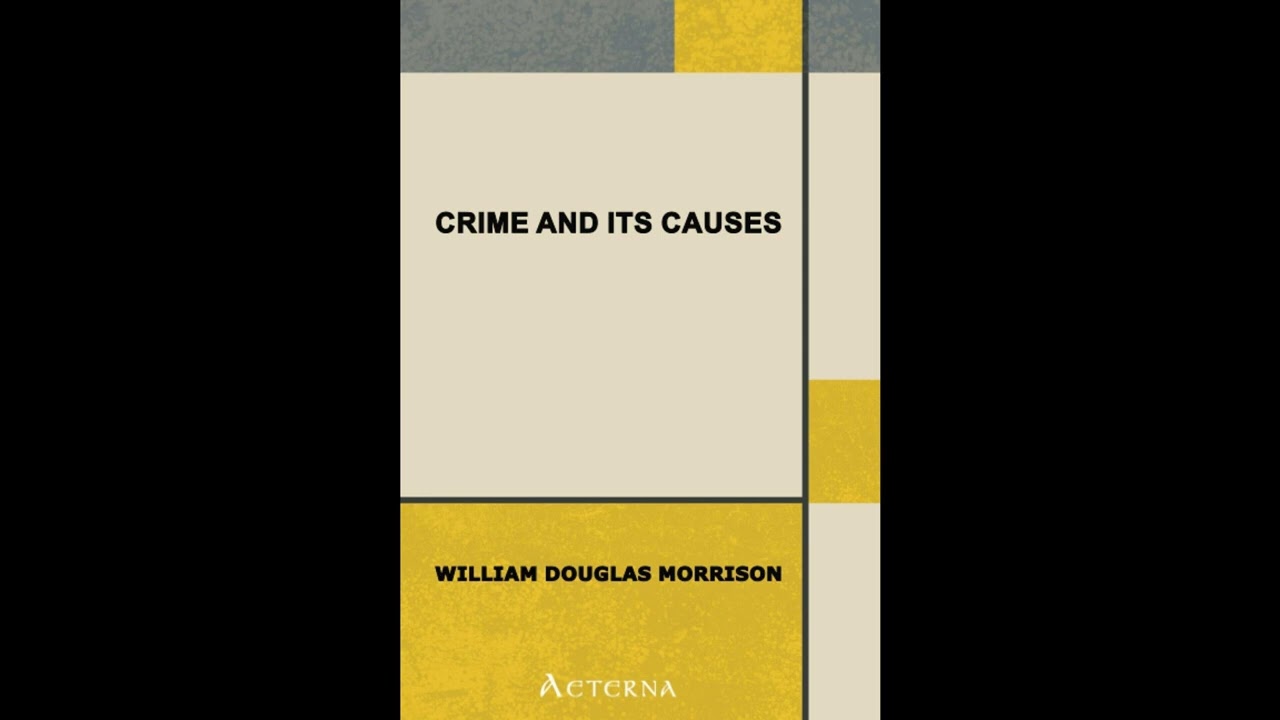
Crime and Its Causes
Step into the intellectual currents of an era grappling with the very definition of justice, morality, and the human condition with William Douglas Morrison's foundational text, Crime and Its Causes. Far from a dry academic exercise, this remarkable work, penned at the cusp of modern sociology and criminology, invites listeners to challenge long-held assumptions about why individuals commit offenses. Morrison’s incisive observations, drawn from direct experience and rigorous thought, remain startlingly relevant in our own time, when societies still contend with the cycles of poverty, opportunity, and consequence. This audiobook offers not merely a historical artifact, but a vital lens through which to examine enduring questions about the nature of wrongdoing and the responsibility of the community. Morrison’s scholarly yet accessible inquiry unfolds not through a traditional narrative of characters and events, but as a meticulously constructed argument, a systematic dismantling of simplistic notions about criminal behavior. He begins by surveying the prevailing theories of his day, many of which attributed crime solely to inherent moral depravity, racial characteristics, or even phrenological predispositions. Rather than accepting these easy answers, Morrison meticulously builds his case by examining the complex interplay of factors that contribute to crime. Listeners are introduced to an array of societal influences, from the profound impact of poverty and inadequate housing to the lack of educational opportunities and the failures of existing social support systems. His focus is not on individual villainy, but on the societal conditions that can push individuals towards actions deemed unlawful. The arc of Morrison’s investigation moves from broad societal analysis to a pointed critique of the penal institutions designed to address crime. He scrutinizes the effectiveness—or often, the ineffectiveness—of prisons, workhouses, and legal frameworks, questioning whether these systems truly rehabilitate or merely perpetuate a cycle of recidivism. His “characters,” if one might call them such, are the various theories of causation, the social statistics he marshals, and the voices of reform and reaction he implicitly engages. He confronts the "central conflict" between the punitive impulses of society and the emerging understanding of crime as a social phenomenon rather than a purely individual failing. Morrison’s ultimate aim is to shift the discourse from condemnation to understanding, from retribution to prevention, charting a path toward more humane and effective responses to lawbreaking. William Douglas Morrison (1853-1943) was a figure of considerable importance in the development of modern criminology and social reform. A Scottish minister by training, his most impactful work came from his practical experience as a prison chaplain, notably at H.M. Prison, Wandsworth, in England. This direct immersion in the lives of incarcerated individuals granted him a unique and often heartbreaking perspective that permeated his writings. Unlike many academics who theorized from a distance, Morrison saw firsthand the poverty, mental illness, and systemic disadvantages that often preceded criminal acts. His work, including Juvenile Offenders (1896) and The Punishment and Prevention of Crime (1898), positioned him as a leading advocate for moving away from purely retributive justice models. He was a vocal proponent of environmental and social explanations for crime, arguing against the then-popular biological determinism espoused by figures like Cesare Lombroso, who sought to identify "born criminals" through physical characteristics. Morrison's contributions placed him squarely within the burgeoning field of sociological criminology, challenging prevailing moralistic views and urging a more scientific, compassionate, and evidence-based approach to understanding and addressing crime. One of the principal themes Morrison enacts throughout Crime and Its Causes is the profound influence of social environment and poverty on criminal behavior. He presents concrete examples, discussing how inadequate housing, unemployment, and lack of basic necessities push individuals, particularly the young, towards petty theft or more serious offenses as a means of survival or desperation. He illustrates this by detailing how families living in squalid conditions, without access to education or steady work, are far more likely to see their members entangled in the legal system, positing crime not as a moral failing but as a symptom of deeper societal malaise. Another central theme is the necessity of penal reform and rehabilitation. Morrison critiques the prevailing punitive systems of his era, arguing that harsh sentences and inhumane prison conditions often fail to deter future crime and instead harden individuals, making their reintegration into society more difficult. He advocates for educational programs, vocational training, and more humane treatment within the prison system, suggesting that true justice lies in prevention and restoration rather than mere punishment. His arguments lay the groundwork for a more modern approach to criminal justice, emphasizing the potential for change and societal responsibility. Morrison's treatise emerged during a period of intense social and intellectual ferment in the late nineteenth and early twentieth centuries. The Industrial Revolution had created unprecedented urban growth, leading to stark contrasts between immense wealth and grinding poverty, overcrowded slums, and significant social unrest. This era also saw the rise of new scientific disciplines, including sociology, psychology, and anthropology, which sought to apply scientific methods to human behavior and society. Philosophers and social reformers were actively debating the nature of free will versus determinism, the role of heredity versus environment, and the responsibilities of the state towards its citizens. In this context, Crime and Its Causes was a powerful voice challenging established paradigms. It appeared at a time when biological theories of crime, such as those emphasizing inherited criminality, were gaining traction. Morrison’s work offered a crucial counter-narrative, shifting the focus from individual pathology to societal pathology. His arguments contributed significantly to the humanitarian movements of the time, advocating for greater compassion and understanding for those caught in the criminal justice system and influencing the broader movement for penal reform that would gain momentum in the decades to follow. Listening to Crime and Its Causes as an audiobook offers a unique advantage for absorbing its intricate arguments and historical weight. The sustained, measured pace of a skilled narrator allows listeners to truly digest Morrison's carefully constructed points, giving ample time for reflection on his observations without the hurried feel of skimming a printed text. The clarity of the spoken word helps to unpack potentially complex sociological concepts and historical data, making the material accessible and engaging. The several hours of listening provide a comprehensive immersion into Morrison's thought, allowing the listener to follow the logical flow of his inquiry and appreciate the foundational questions he poses, all delivered with an authoritative yet thoughtful cadence that respects the profundity of the subject matter.
Enjoyed Crime and Its Causes? A few ways to support us
Audible & Amazon links are affiliate; we may earn a small commission at no extra cost.
About this production
Human narration by a volunteer reader from LibriVox.org, the public-domain audiobook project. LibriVox volunteers record literary works whose copyright has expired in the United States, releasing the resulting recordings into the public domain.
Crime and Its Causes by William Douglas Morrison. The underlying text is in the U.S. public domain. We do not republish any modern copyrighted edition, translation, or commentary.
The 4K cinematic visuals accompanying this audiobook are generated by an AI image model from prompts derived from the source text. No copyrighted photos, paintings, or stock footage are used. AI generation is disclosed on every video on our YouTube channel as required by YouTube's altered/synthetic content policy.
English subtitles are transcribed from the LibriVox recording with OpenAI Whisper. Translations into the 11 other supported languages are produced by Meta's NLLB-200 neural translation model. No human translator's copyrighted translation is used.
Questions about sourcing or rights? See our DMCA & Sourcing policy or contact us.
Enjoyed this audiobook?
If you'd like to own a copy of Crime and Its Causes or hear a professionally produced edition, the links below help support free audiobook production at no extra cost to you.
As an Amazon Associate we earn from qualifying purchases. Audible / print links are affiliate.