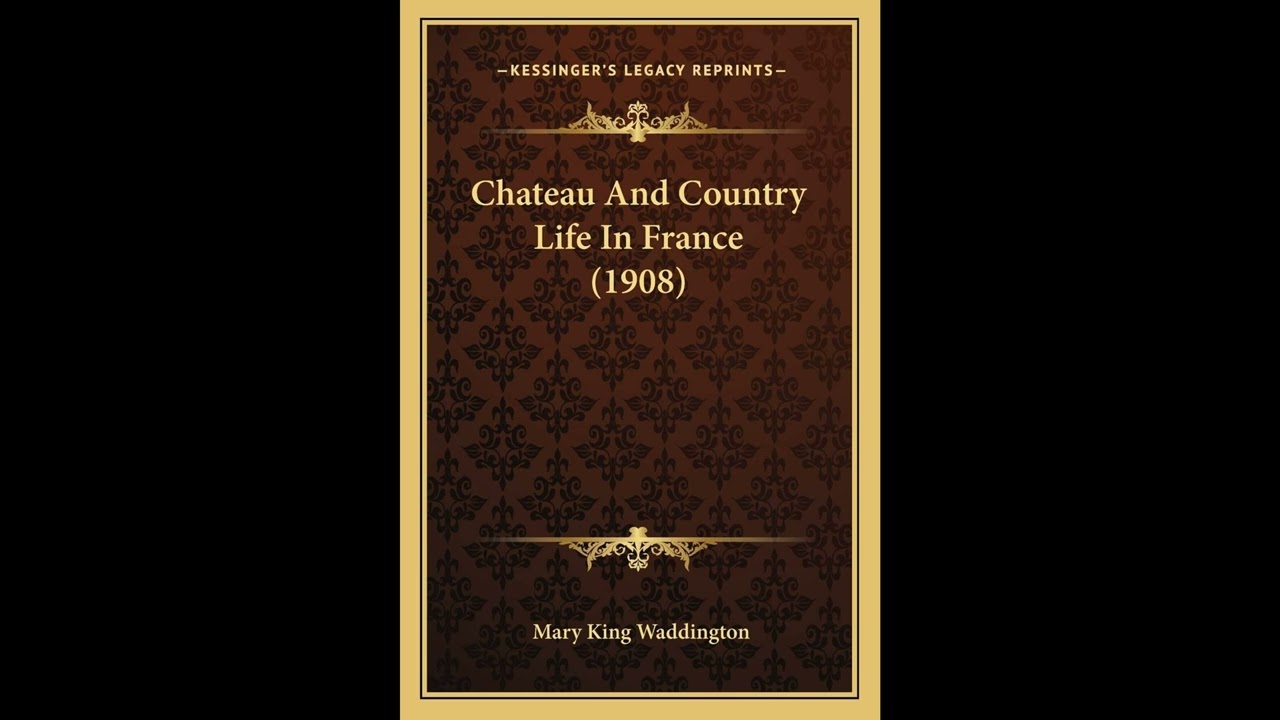
Chateau And Country Life In France
Step into a lost world where the rhythms of the French countryside dictated daily life, and the grandeur of a chateau served as both home and a bustling hub of activity. Mary King Waddington's Chateau And Country Life In France is more than just a memoir; it is an exquisitely detailed portal, transporting listeners to the late nineteenth and early twentieth centuries, offering an intimate glimpse into a vanishing aristocratic France through the eyes of an astute and charming American expatriate. What makes this account so compelling today is its unique blend of personal anecdote and sharp social commentary, presenting not only a beautifully rendered historical document but also a poignant reflection on cultural differences, the passage of time, and the enduring human desire for connection and understanding across diverse traditions. The narrative unfolds primarily at the Château de Boury, the family estate in Normandy, where Mary Waddington, an American married into French high society, became its chatelaine. From the first pages, she establishes the serene yet demanding environment of rural French life as she experiences it. We see the chateau not as a mere dwelling, but as a living entity, its history intertwined with the lives of the family, the staff, and the local villagers. The "plot," if one can call it that in a memoir, is the cycle of the seasons and the ceaseless round of duties and pleasures that attend running such an establishment. We encounter a cast of characters — the diligent servants, the deferential tenants, the local curé, and visiting dignitaries — all painted with Waddington's perceptive brush. Her observations are always centered around the daily existence at Boury, from the intricacies of managing a large household and its associated farms to the social obligations of her position. There are accounts of local festivals, market days, harvest seasons, and the quiet dignity of country routines. The narrative arc follows these natural rhythms, interspersed with visits from family and friends, and occasional trips to Paris or other European cities. While there is no grand dramatic conflict in the conventional sense, the quiet tension lies in Waddington's continuous negotiation between her American heritage and the deeply ingrained customs of her adopted French home, always handled with humor and grace. The author, Mary Alsop King Waddington, was born in New York City in 1833. Her father, Charles King, served as president of Columbia College, placing her at the heart of an intellectual and prominent American family. In 1872, she married William Henry Waddington, a distinguished French statesman and diplomat. This marriage was a pivotal event, fundamentally reshaping her life and providing her with an unparalleled vantage point into French society at its highest echelons. William Waddington, a Protestant of English descent, held numerous key positions, including Minister of Foreign Affairs and later Prime Minister of France, and also served as Ambassador to Great Britain. Mary Waddington was a prolific letter writer, and much of her published work originated from her extensive correspondence and diaries. Her earlier collection, Letters of a Diplomat's Wife (published in 1903), chronicled her experiences in various European capitals alongside her husband. Chateau And Country Life In France, published subsequently, distilled her observations specifically on her life in the French countryside. Her writings are significant not only for their historical detail but also for the distinctive voice they embody — that of an educated, intelligent woman navigating a complex social landscape with both curiosity and respect. She occupies a unique place in literature, offering a vital firsthand account of an aristocratic world on the cusp of significant change, viewed from the perspective of an insightful cultural intermediary. Several resonant themes resonate throughout Chateau And Country Life In France. One prominent theme is the cultural observation and comparison between her American upbringing and her life in France. For instance, she often describes the polite but firm social hierarchy of French rural society, noting how different it was from the more fluid social structures she knew in America. She might recount a detailed explanation of the proper protocol for receiving a village dignitary, underscoring the subtle nuances of French etiquette that she, as an outsider, had to learn and respect. Another recurring theme is the enduring charm and challenges of rural life. She dedicates considerable attention to the seasonal tasks of the estate — the grape harvest, the gathering of chestnuts, the care of the farm animals — illustrating the deep connection between the people and the land. Her descriptions of the yearly village fairs, with their unique customs and simple joys, concretely show the beauty and sometimes arduous realities of country existence. Beyond the immediate concerns of the chateau, Waddington also thoughtfully considers the role of women in society during this era. As the chatelaine, she carried substantial responsibilities for the household, staff, and often the well-being of the surrounding community. Her anecdotes frequently reveal the expectations placed upon women of her class, but also their quiet strength and influence. Furthermore, the book acts as a testament to a vanishing era. Writing at a time when the world was rapidly modernizing, Waddington’s detailed accounts of horse-drawn carriages, traditional farming methods, and entrenched social customs offer a poignant sense of a way of life that was already fading even as she documented it. She implicitly acknowledges that the specific customs and social interactions she meticulously records might soon be relics of the past. The period in which Chateau And Country Life In France was written and published — roughly the turn of the twentieth century, specifically the Belle Époque in France — was a time of immense societal and political transformation. France, under the Third Republic, was experiencing relative stability and prosperity after the Franco-Prussian War, yet underneath lay currents of social change, burgeoning industrialization, and growing international tensions that would eventually lead to the First World War. This work emerged then as part of a broader trend of personal memoirs and travelogues, particularly from well-educated women, who used their unique positions to document their experiences and observations of foreign cultures. It was a time when the printed word offered a powerful medium for connecting distant worlds and preserving firsthand accounts before rapid global changes rendered them irretrievable. Waddington’s position as both an insider and an outsider gave her a singularly valuable perspective on a French society that was simultaneously fiercely traditional and quietly evolving. Listening to Chateau And Country Life In France as an audiobook transforms this historical document into an immersive experience. Over several hours, a skilled narrator can bring to life Mary Waddington's elegant prose, allowing her distinctive voice — intelligent, witty, and profoundly observant — to truly shine. The measured pacing of the narration can perfectly match the reflective nature of the text, inviting listeners to slow down and savor the details. Pay attention to how the narrator articulates the occasional French phrases or names, adding authenticity to the atmosphere. The descriptions of daily routines, the nuances of conversation among her guests, and the sounds and sights of the Norman countryside become almost tangible, creating a sense of being right there, beside Waddington, experiencing the quiet grandeur and gentle rhythms of a bygone French existence.
Enjoyed Chateau And Country Life In France? A few ways to support us
Audible & Amazon links are affiliate; we may earn a small commission at no extra cost.
About this production
Human narration by a volunteer reader from LibriVox.org, the public-domain audiobook project. LibriVox volunteers record literary works whose copyright has expired in the United States, releasing the resulting recordings into the public domain.
Chateau And Country Life In France by Mary King Waddington. The underlying text is in the U.S. public domain. We do not republish any modern copyrighted edition, translation, or commentary.
The 4K cinematic visuals accompanying this audiobook are generated by an AI image model from prompts derived from the source text. No copyrighted photos, paintings, or stock footage are used. AI generation is disclosed on every video on our YouTube channel as required by YouTube's altered/synthetic content policy.
English subtitles are transcribed from the LibriVox recording with OpenAI Whisper. Translations into the 11 other supported languages are produced by Meta's NLLB-200 neural translation model. No human translator's copyrighted translation is used.
Questions about sourcing or rights? See our DMCA & Sourcing policy or contact us.
Enjoyed this audiobook?
If you'd like to own a copy of Chateau And Country Life In France or hear a professionally produced edition, the links below help support free audiobook production at no extra cost to you.
As an Amazon Associate we earn from qualifying purchases. Audible / print links are affiliate.