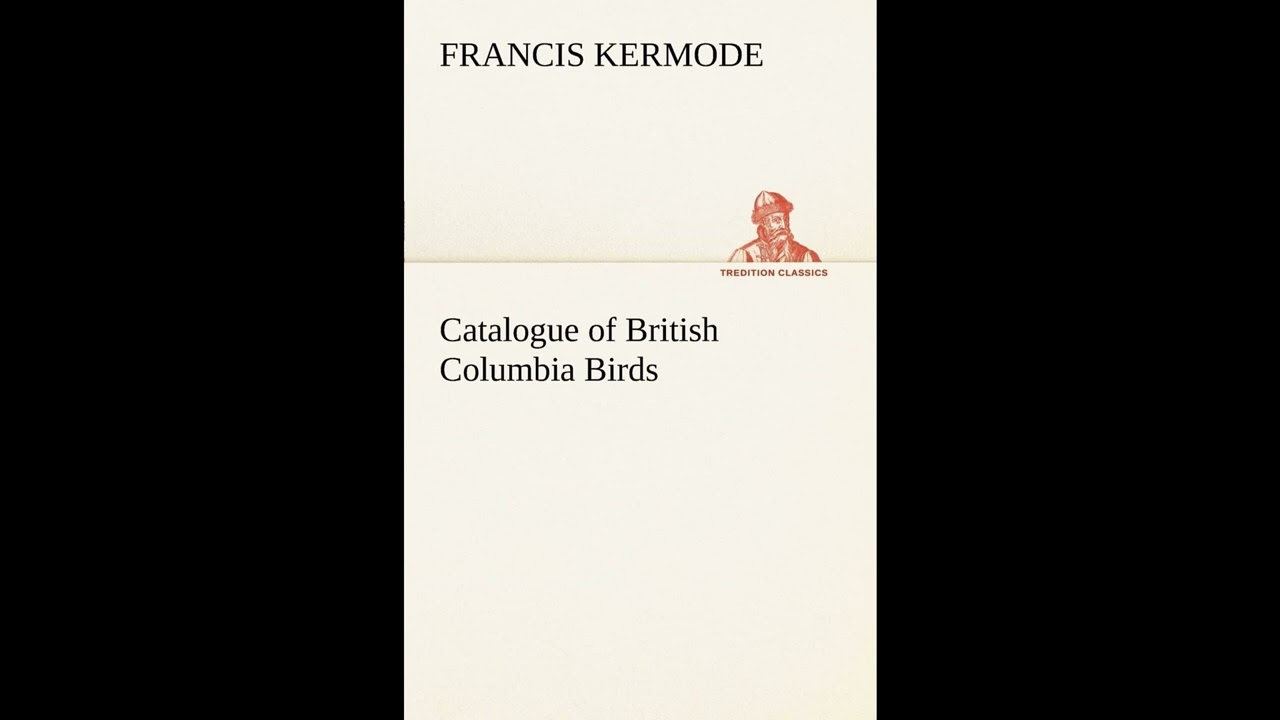
Catalogue of British Columbia Birds
Francis Kermode’s Catalogue of British Columbia Birds stands as far more than a simple list; it is a foundational text, a vibrant snapshot of a bygone era, and a testament to the profound human desire to observe, understand, and categorize the natural world. Though its title might suggest a purely scientific register, what unfolds across its pages is a rich, evocative portrait of British Columbia’s avian life at the turn of the twentieth century, rendered with an enthusiasm and meticulous detail that elevates it to a significant work of classic literature. For today’s listener, it offers a window into the province’s pristine past, an homage to the spirit of scientific discovery, and a poignant reminder of the enduring beauty and fragility of our planet’s diverse ecosystems, urging a deeper connection to the wild heart of nature that still beats, however faintly, around us. Imagine a solitary figure, binoculars in hand and notebook at the ready, trekking through the rain-soaked coastal forests of Vancouver Island, then scaling the rugged peaks of the Rockies, or patiently waiting by the serene waters of interior lakes. This is the implied narrative presence throughout Francis Kermode’s Catalogue of British Columbia Birds. The central character is, in essence, the naturalist himself – though never explicitly named – whose unwavering dedication to observation and documentation forms the spine of this extraordinary undertaking. The setting is British Columbia in its early days of natural history documentation, a vast and largely untamed wilderness, ripe for scientific exploration and classification. The story unfolds not through a conventional plotline of rising action and climax, but as a sweeping survey, a methodical yet deeply personal quest to map the avian life of an entire province. The "arc" of the story moves from the initial discovery of species, through their careful description – detailing plumage, habitat, nesting habits, and migratory patterns – to the final synthesis of this monumental collection of knowledge. The central "conflict" becomes the immense challenge of comprehensive documentation: the vastness of the landscape, the elusiveness of many species, and the sheer effort of travel and sustained fieldwork across diverse biomes, from the marine environments of the Pacific coast to the arid interiors and alpine zones. Each entry in the catalogue, while factual, carries the weight of a careful observation, a moment of connection between human and bird, building towards a singular vision of a dynamic, living world. Francis Kermode was a prominent Canadian naturalist, museum curator, and civil servant, born in 1875. His lifelong dedication to the natural sciences began early, leading him to a pivotal role at the Provincial Museum of Natural History in Victoria, British Columbia. He initially joined the museum staff in 1890 and steadily rose through its ranks, eventually serving as its director from 1904 until his retirement in 1947. This extended tenure meant Kermode was instrumental in shaping the museum’s collections, particularly in zoology, making it a vital institution for understanding the natural heritage of the Pacific Northwest. Beyond his directorial duties, Kermode was an active field naturalist, frequently undertaking expeditions across British Columbia to collect specimens and make detailed observations. This hands-on experience directly informed his scholarly publications. Catalogue of British Columbia Birds, published in 1909, was a significant milestone, building upon earlier lists and establishing a comprehensive record. He also authored "A Preliminary List of the Mammals of British Columbia" in 1904, further solidifying his reputation as a leading authority on the province's fauna. Kermode passed away in 1959, leaving behind a legacy of meticulous documentation and a profound contribution to Canadian natural history. At its core, Catalogue of British Columbia Birds enacts several enduring themes. One significant theme is the human impulse to categorize and understand nature. Kermode's work exemplifies the systematic approach of early naturalists, driven by a desire to bring order to the apparent chaos of the wilderness. For instance, his detailed classifications and notes on each species' specific behaviors – "The Western Meadowlark... prefers open grasslands and pastures, often perching on fence posts to deliver its clear, whistling song" – demonstrate the careful observation and intellectual rigor involved in this pursuit. This theme highlights the inherent human need to connect with and make sense of our surroundings. Another key theme is the appreciation of regional biodiversity and the celebration of the specific. While broad ecological principles underpin the work, Kermode's focus is intensely local, capturing the unique avian character of British Columbia. Descriptions of species like the "Marbled Murrelet, known for its elusive behavior in old-growth coastal forests and its nesting habits high in ancient trees," not only provide scientific data but also paint a vivid picture of the specific ecosystems and their inhabitants. This detailed attention to the particular fosters a deep admiration for the uniqueness of place and its living components, implicitly urging a recognition of nature's inherent value. When Francis Kermode published Catalogue of British Columbia Birds in 1909, British Columbia was a province in dynamic flux. The late 19th and early 20th centuries marked a period of rapid development and settlement across western North America. Resource industries such as logging, mining, and fishing were expanding, leading to significant alterations of the natural landscape. Culturally, there was a growing public interest in natural history, fueled by advancements in science and an increasing accessibility of knowledge through museums and publications. This era saw the rise of dedicated natural history societies and the strengthening of institutions like provincial museums. The work emerged from a confluence of factors: the scientific imperative to document the natural world before it was irrevocably changed, the establishment of robust provincial institutions, and the individual passion of dedicated naturalists like Kermode. It arrived at a time when the nascent conservation movement was gaining momentum, with concerns growing over the impact of human expansion on wildlife populations and habitats. Such a catalogue served not only as an academic resource but also as a quiet, authoritative argument for the value of the province's natural heritage, reflecting the growing awareness that knowledge was a crucial first step toward preservation. Listening to Catalogue of British Columbia Birds as an audiobook transforms a historical scientific document into an immersive experience. The narration brings a quiet authority and reverence to Kermode's meticulous observations, allowing the listener to absorb the intricate details of each bird's description – from the shimmer of a hummingbird's throat to the haunting call of a loon across a glacial lake. The run length of several hours makes it ideal for sustained, focused listening, perhaps during a contemplative walk in nature or as a calming companion during quiet study. Listen for the precise, almost poetic language Kermode employs to describe plumage and behavior, the subtle shifts in tone as he moves from common residents to rare visitors, and the underlying passion that elevates this work beyond mere data. The rhythm of the observations, delivered through a clear and measured voice, creates an atmospheric portrait of British Columbia’s wild beauty, inviting a deep engagement with its rich avian history.
Enjoyed Catalogue of British Columbia Birds? A few ways to support us
Audible & Amazon links are affiliate; we may earn a small commission at no extra cost.
About this production
Human narration by a volunteer reader from LibriVox.org, the public-domain audiobook project. LibriVox volunteers record literary works whose copyright has expired in the United States, releasing the resulting recordings into the public domain.
Catalogue of British Columbia Birds by Francis Kermode. The underlying text is in the U.S. public domain. We do not republish any modern copyrighted edition, translation, or commentary.
The 4K cinematic visuals accompanying this audiobook are generated by an AI image model from prompts derived from the source text. No copyrighted photos, paintings, or stock footage are used. AI generation is disclosed on every video on our YouTube channel as required by YouTube's altered/synthetic content policy.
English subtitles are transcribed from the LibriVox recording with OpenAI Whisper. Translations into the 11 other supported languages are produced by Meta's NLLB-200 neural translation model. No human translator's copyrighted translation is used.
Questions about sourcing or rights? See our DMCA & Sourcing policy or contact us.
Enjoyed this audiobook?
If you'd like to own a copy of Catalogue of British Columbia Birds or hear a professionally produced edition, the links below help support free audiobook production at no extra cost to you.
As an Amazon Associate we earn from qualifying purchases. Audible / print links are affiliate.