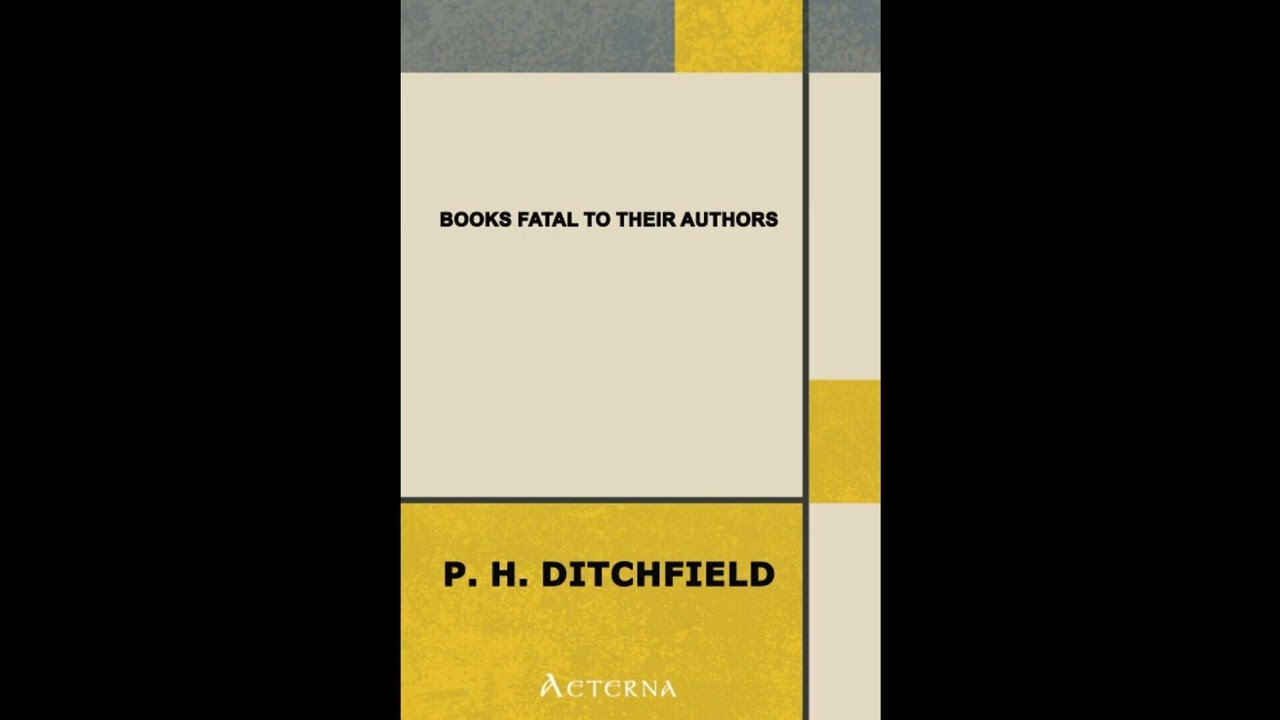
Books Fatal to Their Authors
Imagine a world where the act of writing, the mere putting of thoughts onto paper, could lead to your ruin—your imprisonment, your exile, or even your death. It sounds like the plot of a dystopian novel, yet for centuries, countless authors faced precisely this grim reality. P. H. Ditchfield’s compelling collection, Books Fatal to Their Authors, unearths these forgotten—and sometimes infamous—stories, reminding us that ideas, when expressed boldly, have always carried a potent, often dangerous, power. This book offers a chilling panorama of intellectual courage and societal repression, a historical record that resonates profoundly in any age where freedom of expression is debated or denied. It asks us to consider the ultimate price some have paid for the words they dared to share, and why, despite such perils, they persisted. Ditchfield’s Books Fatal to Their Authors is not a novel with a traditional plot, but rather a meticulously assembled chronicle of human drama, presented through a series of biographical sketches. The author takes us through a gallery of figures from various historical periods and cultures, each united by the tragic consequence of their written output. We encounter philosophers whose inquiries challenged established doctrines, poets whose verses satirized powerful figures, and scientists whose observations clashed with prevailing dogmas. Each chapter unfolds a new tale of an author whose pen proved to be a double-edged sword, bringing both notoriety and severe retribution. The arc of Ditchfield’s narrative is one of exposure and consequence. He presents the circumstances that led these individuals to write, the specific arguments or statements that provoked outrage, and the often brutal repercussions that followed. Whether it was a treatise deemed heretical by the Church, a political pamphlet challenging a monarch, or a scientific theory that overturned centuries of belief, Ditchfield illuminates the specific instances where words literally became a matter of life and death. The "conflict" is always between the individual's intellectual pursuit and the monolithic power structures of their time, with the outcome frequently weighted against the solitary writer. P. H. Ditchfield (Peter Hampson Ditchfield, 1854-1930) was an Anglican clergyman, historian, and prolific author known for his keen interest in antiquarian subjects and local history. Born in London, he received his education at Oriel College, Oxford, and served as rector in Barkham, Berkshire, for many years. His pastoral duties never dulled his scholarly appetite; instead, they often fueled his extensive research into the nooks and crannies of English life and letters. Ditchfield was a tireless chronicler, often focusing on the forgotten aspects of history and culture, bringing them to light with an accessible, engaging style. Beyond Books Fatal to Their Authors, Ditchfield produced a substantial body of work that cemented his reputation as an assiduous compiler of historical curiosities and social observations. His other notable works include The Parish Clerk, which affectionately details the history and duties of this venerable church office, and several volumes within the "Memorials of Old..." series, such as Memorials of Old London and Memorials of Old Oxfordshire, which preserve fascinating glimpses into regional heritage. His writings often blend diligent research with a storytelling flair, allowing readers to connect with the past on a personal level. Ditchfield occupied a unique space in the late Victorian and early Edwardian literary scene, not as an innovator of form or philosophy, but as a dedicated preserver of history, a scholar who understood the enduring human appeal of anecdote and the profound lessons hidden in forgotten lives. The book powerfully enacts several core themes. One prominent theme is the peril of independent thought and the history of censorship. Ditchfield provides concrete examples of thinkers who, by daring to question orthodoxy—whether theological, scientific, or political—found themselves facing dire punishment. Consider the countless anonymous scholars who faced ecclesiastical censure for proposals that diverged from accepted dogma, or the political commentators whose published criticisms led to their imprisonment under absolute monarchs. The book illustrates how power structures have historically sought to control narratives and suppress dissenting voices, often viewing new ideas as direct threats to their authority. Another central theme is the resilience of ideas and the enduring legacy of intellectual courage. Despite the horrific fates many authors endured, their words often outlived them, influencing subsequent generations and, in many cases, eventually triumphing over the very forces that sought to silence them. Ditchfield often highlights the ironic reversal of fortune, where a work once burned by the common hangman is later hailed as a foundational text. This reversal underscores the profound belief that truth, or at least a powerful argument, can persist even when its proponents cannot, making a powerful statement about the long arc of intellectual history and humanity's perennial struggle for enlightenment. When Ditchfield was writing, likely in the late 19th and early 20th centuries, the cultural and intellectual landscape was one of immense change and introspection. It was a period witnessing the expansion of literacy, the rise of mass media, and fierce debates about the nature of truth, authority, and freedom of expression. Industrialization had transformed society, and scientific advancements continued to challenge traditional beliefs. Ditchfield's project can be seen as a reflection of this era's fascination with history and its lessons, a time when scholars looked back at the past to understand the present and perhaps predict the future. The persistent tension between individual freedom and societal control, a topic very much alive in his own time, found resonance in these historical examples of authors facing fatal consequences for their writing. His work emerged from a climate that valued historical anecdote and biography as a means of moral and intellectual instruction. Listening to Books Fatal to Their Authors as an audiobook transforms Ditchfield’s historical accounts into an immersive experience. The length, several hours, makes it an ideal companion for a quiet afternoon of contemplation or extended walks where the mind can wander through history. A skilled narrator breathes life into the meticulous research, rendering each biographical sketch with a clarity and gravitas that might be missed in silent reading. The measured pacing allows the listener to absorb the details of each author's story and the gravity of their fate, creating a sense of being transported back to the times when these dangerous words were first uttered. Hearing the descriptions of trials, condemnations, and the quiet courage of these writers fosters a deeper connection to the human cost of intellectual freedom, making the lessons of history strikingly immediate.
Enjoyed Books Fatal to Their Authors? A few ways to support us
Audible & Amazon links are affiliate; we may earn a small commission at no extra cost.
About this production
Human narration by a volunteer reader from LibriVox.org, the public-domain audiobook project. LibriVox volunteers record literary works whose copyright has expired in the United States, releasing the resulting recordings into the public domain.
Books Fatal to Their Authors by P. H. Ditchfield. The underlying text is in the U.S. public domain. We do not republish any modern copyrighted edition, translation, or commentary.
The 4K cinematic visuals accompanying this audiobook are generated by an AI image model from prompts derived from the source text. No copyrighted photos, paintings, or stock footage are used. AI generation is disclosed on every video on our YouTube channel as required by YouTube's altered/synthetic content policy.
English subtitles are transcribed from the LibriVox recording with OpenAI Whisper. Translations into the 11 other supported languages are produced by Meta's NLLB-200 neural translation model. No human translator's copyrighted translation is used.
Questions about sourcing or rights? See our DMCA & Sourcing policy or contact us.
Enjoyed this audiobook?
If you'd like to own a copy of Books Fatal to Their Authors or hear a professionally produced edition, the links below help support free audiobook production at no extra cost to you.
As an Amazon Associate we earn from qualifying purchases. Audible / print links are affiliate.