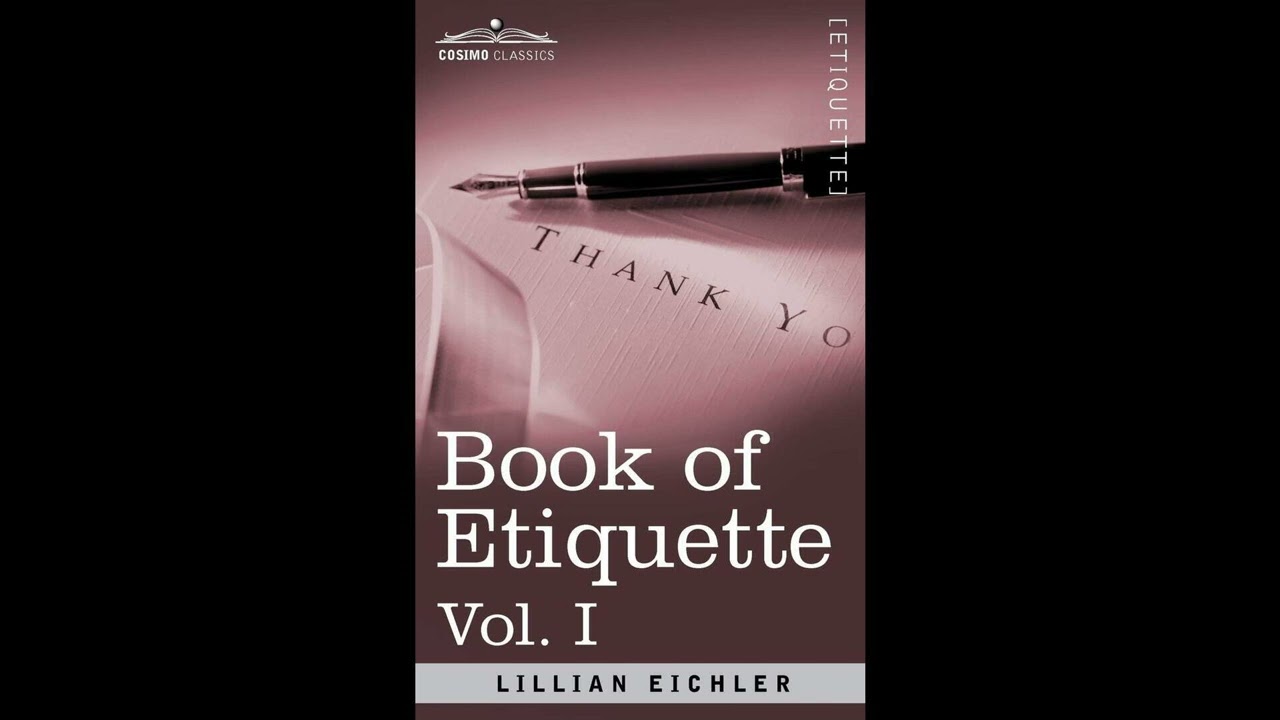
Book of Etiquette (1)
Lillian Eichler's Book of Etiquette stands as far more than a dusty manual of forgotten rules; it is a foundational text of self-improvement and social navigation, surprisingly relevant even in our rapidly changing contemporary world. Originally published to guide a society in flux, its core principles transcend specific eras, offering insight into the enduring human desire for connection, respect, and confidence in social settings. This audiobook invites listeners to discover the power of thoughtful conduct, not as a rigid set of arbitrary dictates, but as a pathway to genuine poise, self-assurance, and more harmonious interactions in every facet of life, whether at a formal dinner or a casual online gathering. The underlying wisdom—that manners are fundamentally about consideration for others—remains a cornerstone of successful human relationships, making this classic a remarkably practical guide for anyone seeking to move through the world with grace. The book’s structure itself is a kind of narrative, guiding the aspiring individual through a comprehensive curriculum of social literacy. It begins by establishing the bedrock of personal decorum, addressing everything from the intricacies of proper introductions and the art of conversation to the nuances of correspondence and the appropriate conduct in public spaces. The "story" then broadens its scope, moving from individual interactions to the complexities of larger social gatherings. Here, the reader learns how to host and attend dinners with confidence, navigate the dance floor, and manage the delicate protocols surrounding weddings, christenings, and funerals. There is no traditional character development, but the listener, through absorbing these lessons, undergoes a profound transformation, moving from a state of potential social anxiety to one of assured elegance. The central "conflict" is the universal struggle against awkwardness or missteps in unfamiliar situations, and the book presents a clear, actionable path to overcoming these internal hurdles. It provides a complete education in the unwritten rules that govern polite society, ensuring that the listener is equipped for virtually any social scenario they might encounter, fostering not just external polish but an internal sense of ease. Lillian Eichler, born Lillian Eichler Watson in New York City in 1902, was a remarkable figure who reshaped American perceptions of etiquette. Her career began as a copywriter for Funk & Wagnalls, the prominent encyclopedia publisher, where her keen observations of social trends led her to recognize a significant void in popular literature. She understood that the burgeoning middle class, alongside a rapidly modernizing society, yearned for accessible guidance on proper conduct. Her first major literary contribution, Book of Etiquette, originally appeared in two volumes in 1921 and was later revised into a single comprehensive edition. It catapulted her to national recognition, transforming her into a household name and an arbiter of modern American manners. Eichler distinguished herself from previous etiquette writers by adopting a direct, engaging, and remarkably democratic approach. She stripped away the stuffiness and elitism often associated with such manuals, making the principles of good breeding attainable for a broader audience, regardless of their background or previous social standing. Her writing was not merely prescriptive; it was often empathetic, recognizing the anxieties many people felt when navigating new social landscapes. Beyond her seminal work, Eichler also authored other influential texts, including Well-Bred English and The New Book of Etiquette, further cementing her reputation as a leading authority on social graces and communication. Her place in the literary canon resides firmly in the realm of popular non-fiction and self-help, a genre she helped to legitimize and popularize for a mass market. One of the book's core themes is social mobility and aspiration. Eichler recognized that a firm grasp of etiquette could serve as a powerful tool for individuals seeking to improve their station in life, allowing them to move confidently in circles they might otherwise find intimidating. For instance, her detailed instruction on table manners—explaining which fork to use, how to correctly hold a knife, and the proper way to conduct conversation during a meal—was not simply about outward show. It was about equipping someone to feel comfortable and competent at any dinner table, from a family gathering to a formal banquet, thereby removing a significant barrier to social or professional advancement. This confidence, she argued, was far more valuable than inherited wealth or status. Another significant theme is self-presentation and confidence through knowledge. Eichler posited that by understanding the accepted rules of conduct, individuals could reduce their anxiety and focus on genuine interaction rather than worrying about making a faux pas. She illustrates this by meticulously detailing the correct protocols for introductions: who to introduce to whom, the appropriate phrasing, and the accompanying gestures. By mastering these seemingly small details, a person could enter any room feeling prepared and capable, allowing their true personality to shine rather than being overshadowed by uncertainty. Her explanations of why certain rules exist, often rooted in consideration for others, further empower the reader, transforming rote memorization into a reasoned understanding of social dynamics. The book emerged during a period of profound transformation in American society, immediately following the end of World War I and ushering in the vibrant decade known as the Roaring Twenties. Culturally, the nation was experiencing rapid urbanization, the rise of new wealth, and a loosening of the more rigid Victorian social constraints. Technologies like the automobile, telephone, and radio were reshaping daily life, demanding new forms of social conduct. Women had recently gained the right to vote, and their roles in public and private spheres were expanding dramatically. Politically, the country was embracing modernity with an almost dizzying speed, leading to both excitement and a certain degree of social disorientation. In this context, Book of Etiquette became an indispensable guide. Many individuals, especially those new to city life or rising in economic status, felt unsure of the ever-evolving social codes. Traditional rules seemed outdated, yet new norms were still being established. Eichler's work specifically addressed this widespread need for guidance, providing clear, practical advice on navigating everything from telephone conversations to appropriate dating customs and business interactions. It offered a sense of stability and reassurance amidst the societal flux, democratizing access to what was once considered exclusive knowledge and helping a generation redefine what it meant to be "well-bred" in a modernizing America. Listening to Book of Etiquette as an audiobook offers a distinctly engaging experience, transforming what might otherwise be perceived as a textbook into a series of intimate lessons. The run length, spanning several hours, is ideal for both dedicated study and more casual, reflective listening; one can absorb an entire section on dinner party decorum during a commute, or revisit specific chapters on correspondence while performing household tasks. A skilled narrator can imbue Eichler’s plainspoken yet authoritative voice with a reassuring presence, making the advice feel like it’s coming from a thoughtful, understanding mentor rather than a distant authority. Listeners can pay close attention to the pacing, which might shift from brisk instructional guidance to more measured, philosophical reflections on the underlying spirit of good manners. The absence of traditional dialogue means the performance centers on the clarity and resonance of the instructional prose, allowing the atmosphere of gentle guidance and dignified self-improvement to truly settle with the listener.
Enjoyed Book of Etiquette (1)? A few ways to support us
Audible & Amazon links are affiliate; we may earn a small commission at no extra cost.
About this production
Human narration by a volunteer reader from LibriVox.org, the public-domain audiobook project. LibriVox volunteers record literary works whose copyright has expired in the United States, releasing the resulting recordings into the public domain.
Book of Etiquette (1) by Lillian Eichler. The underlying text is in the U.S. public domain. We do not republish any modern copyrighted edition, translation, or commentary.
The 4K cinematic visuals accompanying this audiobook are generated by an AI image model from prompts derived from the source text. No copyrighted photos, paintings, or stock footage are used. AI generation is disclosed on every video on our YouTube channel as required by YouTube's altered/synthetic content policy.
English subtitles are transcribed from the LibriVox recording with OpenAI Whisper. Translations into the 11 other supported languages are produced by Meta's NLLB-200 neural translation model. No human translator's copyrighted translation is used.
Questions about sourcing or rights? See our DMCA & Sourcing policy or contact us.
Enjoyed this audiobook?
If you'd like to own a copy of Book of Etiquette (1) or hear a professionally produced edition, the links below help support free audiobook production at no extra cost to you.
As an Amazon Associate we earn from qualifying purchases. Audible / print links are affiliate.