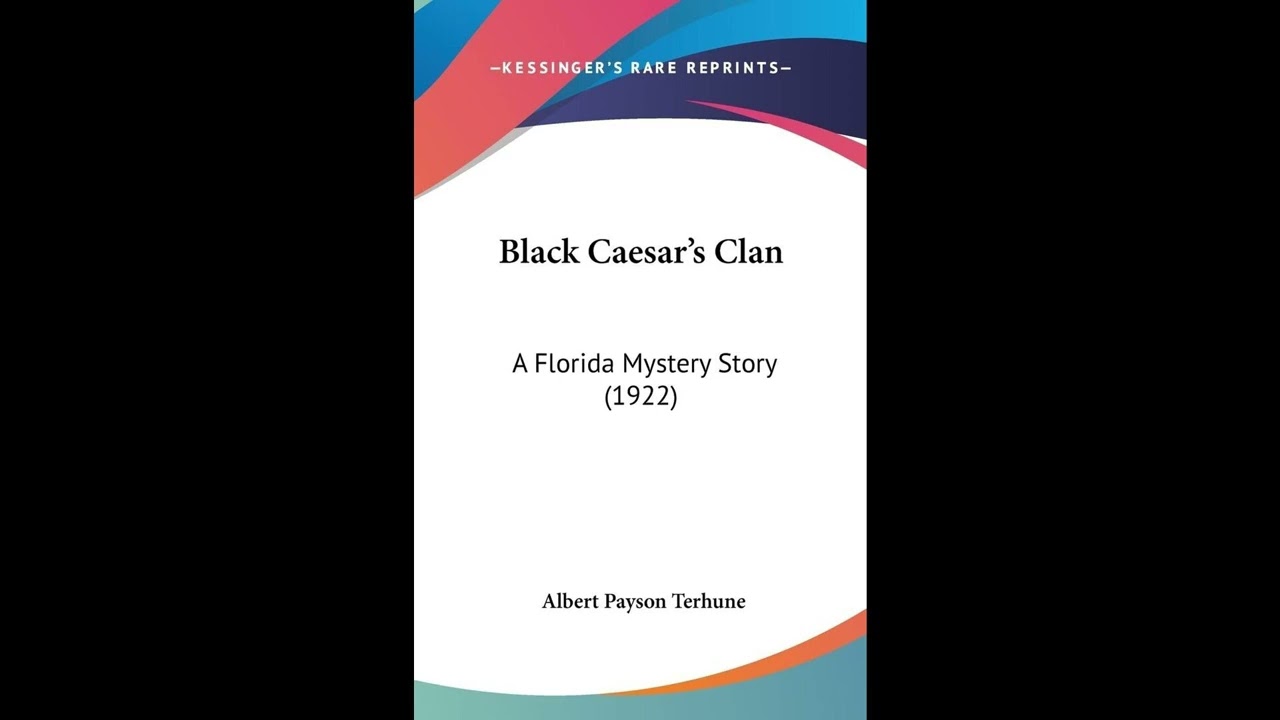
Black Caesar's Clan: A Florida Mystery Story (1922)
Step into a lost world of sun-drenched peril and shadowy secrets with Albert Payson Terhune’s 1922 Florida mystery, "Black Caesar's Clan." This isn't just another tale of suspense; it's a vibrant snapshot of America’s untamed south, a thrilling adventure that pits a young man against a formidable criminal enterprise and the lingering specter of history. While Terhune is perhaps best remembered for his beloved collie stories, this lesser-known work showcases his remarkable ability to craft a human-centric narrative filled with intrigue, danger, and a hint of romance. For listeners today, it offers a fascinating window into a bygone era of adventure fiction, inviting us to experience the primal thrill of discovery and the enduring pull of hidden legacies, all wrapped in a compelling whodunit. The story drops us into the wild, largely undeveloped Florida coast of the early 1920s, a landscape ripe with both natural beauty and deep-seated mystery. Our protagonist is Bruce Peril, a young man from the cooler climes of the North, who arrives in this subtropical wilderness to claim a peculiar inheritance: an old, supposedly cursed plantation. From the moment Bruce steps onto the property, he senses an unsettling atmosphere, a feeling that quickly escalates into genuine alarm as he encounters the cryptic local inhabitants and strange occurrences. Whispers of the legendary pirate Black Caesar, whose ghost is said to haunt these very shores, begin to intertwine with the very real threat of a modern-day criminal syndicate operating under the pirate’s fearsome name. This shadowy organization, known simply as "Black Caesar's Clan," appears determined to drive Bruce away from his new home, suggesting that his inherited land holds a secret far greater than its dilapidated appearance suggests. As Bruce tries to unravel the truth behind the clan's motives and the fate of the fabled pirate treasure they supposedly seek, he finds himself navigating a treacherous world where loyalties are uncertain and danger lurks behind every palm frond. He crosses paths with Nora, an enigmatic young woman whose presence simultaneously aids and complicates his investigation, drawing him further into the web of local lore and present-day villainy. The conflict intensifies as Bruce’s life is repeatedly threatened, forcing him to rely on his wits and courage to distinguish friend from foe. He must decipher coded messages, evade clever traps, and confront the very real possibility that the clan might be closer to him than he dares to imagine, all while the humid Florida air hums with unspoken threats and the promise of a thrilling, yet perilous, revelation. Albert Payson Terhune, born in 1872 in New Jersey, was a prolific American author, journalist, and dog breeder who passed away in 1942. The son of a clergyman and a novelist, he inherited a love for storytelling and a keen eye for detail. Before gaining widespread recognition as a writer, Terhune led a varied and adventurous life, working as a newspaper reporter for the New York Evening World, engaging in amateur boxing, and even traveling extensively. His experiences in journalism honed his narrative skills, teaching him how to construct compelling plots and engaging prose for a wide audience. Terhune’s literary output was vast, but he achieved enduring fame for his heartwarming and often dramatic stories centered around his beloved collies, particularly those set at his Sunnybank estate in Wayne, New Jersey. Titles like "Lad: A Dog" (1919), "Bruce" (1920), and "Lochinvar Luck" (1923) captivated readers with their tales of canine loyalty, intelligence, and bravery, solidifying his place as a master of animal fiction. However, Terhune also penned numerous adventure stories, historical fiction, and mysteries like "Black Caesar's Clan," showcasing a versatility that extended beyond his most famous genre. While not typically associated with the high literary modernism of his time, Terhune was a hugely popular and influential figure in American popular fiction, providing millions of readers with escapist entertainment that resonated with a sense of wholesome adventure and moral clarity. "Black Caesar's Clan" articulates several compelling themes that elevate it beyond a simple adventure yarn. One prominent theme is the allure of the unknown and the power of myth. Bruce Peril is drawn into the mystery not just by circumstance but by the very legends surrounding Black Caesar, which provide a potent, almost irresistible backdrop to the contemporary criminal activity. The text continually plays with this concept; for instance, the mysterious notes Bruce receives, the shadowy figures he glimpses, and the unexplained occurrences on his plantation all tap into a deep human fascination with what lies hidden, both in history and in the present. This sense of the unseen and the half-understood propels the narrative forward, making the Florida landscape feel not just wild, but inherently secretive. Another significant theme is human tenacity against overwhelming odds, underscored by the contrast between Bruce’s relative inexperience and the sophisticated, dangerous clan he faces. Bruce is a newcomer, yet he refuses to be intimidated or driven away. He consistently chooses to investigate rather than retreat, even when his life is threatened. A specific scene early in the story, where Bruce defiantly reclaims a piece of his property after a direct threat, exemplifies this. His quiet resolve in the face of an organized, seemingly ubiquitous threat speaks to an enduring belief in individual courage and the triumph of justice, even when the path to it is fraught with extreme danger. The story also touches on the tension between civilization and wilderness, presenting Florida as a place where modern society exists tenuously on the edge of a vast, untamed natural world, where ancient legends and contemporary lawlessness can thrive side by side. When "Black Caesar's Clan" was published in 1922, the United States was in the throes of the "Roaring Twenties," a decade of profound social and cultural transformation. Post-World War I optimism mingled with social unrest, the rise of consumer culture, and a burgeoning interest in new technologies and forms of entertainment. Culturally, there was a widespread appetite for escapist literature, adventure stories, and narratives that transported readers to exotic or thrilling locales. This was a heyday for popular fiction, with pulp magazines flourishing and authors like Zane Grey and Edgar Rice Burroughs dominating the bestseller lists with tales of the American West and African jungles, respectively. Against this backdrop, Florida itself was experiencing a boom, though much of the state, particularly its coastal and rural areas, remained wild and sparsely populated. The mystique of its subtropical wilderness, combined with its rich history of pirates and hidden treasures, made it a perfect setting for adventure writers like Terhune. "Black Caesar's Clan" emerged from this confluence of societal desire for excitement and the specific allure of a frontier-like American landscape. It capitalized on the romantic appeal of historical figures like Black Caesar while grafting a contemporary mystery onto ancient legends, thus providing a thrilling, accessible narrative that resonated with the popular imagination of its time. Listening to "Black Caesar's Clan" as an audiobook offers a unique opportunity to immerse yourself fully in Terhune's world. A skilled narrator will bring to life the distinct voices of Bruce Peril, the mysterious Nora, and the various local characters, creating a vivid sonic tapestry that enhances the narrative. The pacing of the spoken word naturally underscores the building suspense, from the quiet unease of Bruce's arrival to the heart-pounding moments of confrontation and escape. You can hear the humid Florida atmosphere come alive through descriptions of the rustling palmettoes, the distant sounds of the swamp, and the oppressive silence of an isolated dwelling. The unfolding dialogue, whether terse exchanges or dramatic declarations, gains immediacy and impact when delivered by an accomplished voice actor, pulling you directly into the unfolding enigma of Black Caesar's Clan and its dangerous secrets.
Enjoyed Black Caesar's Clan: A Florida Mystery Story (1922)? A few ways to support us
Audible & Amazon links are affiliate; we may earn a small commission at no extra cost.
About this production
Human narration by a volunteer reader from LibriVox.org, the public-domain audiobook project. LibriVox volunteers record literary works whose copyright has expired in the United States, releasing the resulting recordings into the public domain.
Black Caesar's Clan: A Florida Mystery Story (1922) by Albert Payson Terhune. The underlying text is in the U.S. public domain. We do not republish any modern copyrighted edition, translation, or commentary.
The 4K cinematic visuals accompanying this audiobook are generated by an AI image model from prompts derived from the source text. No copyrighted photos, paintings, or stock footage are used. AI generation is disclosed on every video on our YouTube channel as required by YouTube's altered/synthetic content policy.
English subtitles are transcribed from the LibriVox recording with OpenAI Whisper. Translations into the 11 other supported languages are produced by Meta's NLLB-200 neural translation model. No human translator's copyrighted translation is used.
Questions about sourcing or rights? See our DMCA & Sourcing policy or contact us.
Enjoyed this audiobook?
If you'd like to own a copy of Black Caesar's Clan: A Florida Mystery Story (1922) or hear a professionally produced edition, the links below help support free audiobook production at no extra cost to you.
As an Amazon Associate we earn from qualifying purchases. Audible / print links are affiliate.