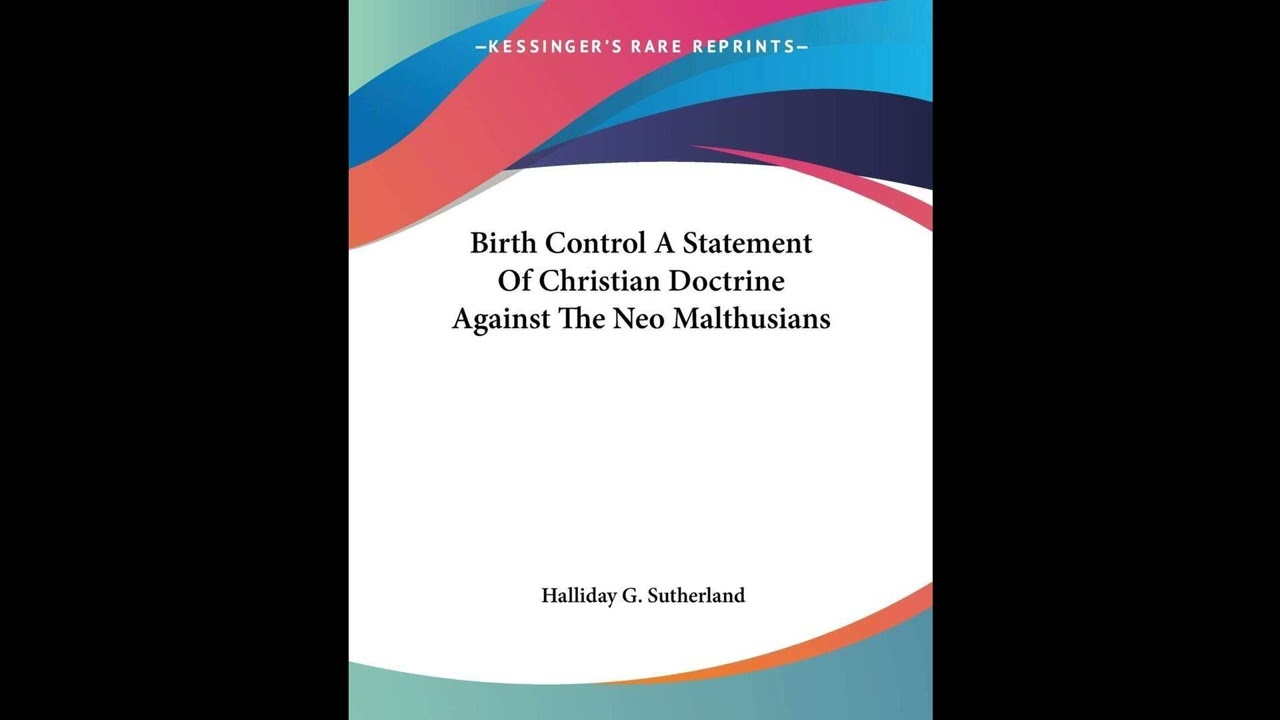
Birth Control A Statement Of Christian Doctrine Against The Neo Malthusians
The idea of birth control, a seemingly modern societal conversation, often surprises us with its deep historical roots, stretching back far beyond contemporary debates. "Birth Control: A Statement Of Christian Doctrine Against The Neo Malthusians" is not merely a relic of a bygone era; it is a powerful intellectual challenge, a foundational text from a time when theological principles clashed head-on with emerging scientific and economic theories regarding population. This audiobook resurrects a pivotal moment in social thought, presenting a meticulously reasoned argument that still resonates with urgency in today's world, where questions of reproduction, family planning, and religious ethics remain contentious. Listeners will encounter a robust defense of traditional Christian views against what was then considered a radical re-imagining of human procreation. The core contention of Halli's work stands firmly against the tenets of Neo-Malthusianism, a movement gaining traction in the author's time. Neo-Malthusian thought, inspired by Thomas Malthus's earlier warnings about population outgrowing resources, advocated for conscious limitations on family size, often through various forms of contraception, to prevent poverty and social decline. Halli positions Christian doctrine as an unyielding bulwark against these proposals, arguing that such interventions into human fertility contravene divine will and natural law, ultimately diminishing spiritual well-being. Halli builds the case by first establishing a theological framework, drawing upon scriptural interpretations and centuries of church teaching concerning marriage, procreation, and the divine mandate for human life. The work articulates a vision of human flourishing rooted not in demographic control, but in faithfulness to a higher order. Arguments progress from theological fundamentals to practical ethical considerations, examining the societal ramifications of widespread birth control practices from a Christian viewpoint. Halli dissects the implicit assumptions of Neo-Malthusian proponents, often highlighting what is perceived as a materialistic worldview that minimizes the spiritual dimension of human existence. The overall arc is a persistent reassertion of established religious truths against perceived intellectual novelty. While specific biographical details regarding "Halli" – the name associated with this pivotal text – are not readily available, the substance and scholarly depth of "Birth Control: A Statement Of Christian Doctrine Against The Neo Malthusians" speak to an author deeply versed in theological argumentation and acutely aware of contemporary social currents. The lack of precise dates or personal anecdotes for Halli allows the work itself to stand as its own powerful intellectual statement. We can infer from the thorough reasoning and comprehensive scope of the argument that Halli was a figure of significant theological conviction, likely a respected scholar or cleric within the Christian intellectual sphere of their era. Halli represents a voice within a larger, ongoing dialogue where religious authority and traditional ethics confronted the burgeoning fields of demography and social science. The text itself serves as a crucial primary document, illuminating the fierce intellectual battles fought over foundational questions of morality, family, and the role of faith in public life. It stands as a testament to the persistent vigor of Christian thought in responding to perceived threats to its doctrines and principles, highlighting how significant contributions to thought can outlast the personal histories of their creators. One central theme permeating Halli's statement is the sanctity of human life and its inherent connection to divine creation. The author consistently underscores the belief that human procreation is not merely a biological process but a sacred act, divinely ordained. Arguments against contraception are often framed around deliberately frustrating the natural outcome of marital union as an interference with God's design. Halli refers to biblical injunctions to "be fruitful and multiply," interpreting them as fundamental commands reflecting a higher purpose for humanity beyond economic or social concerns. Another significant theme is the tension between human agency and divine providence. Halli critiques the Neo-Malthusian project for placing excessive faith in human rationalism and control, suggesting such efforts betray a lack of trust in God's provision. The text warns against hubristic attempts to manage the world solely through human ingenuity, positing that a Christian worldview necessitates humble acceptance of divine will even amidst social challenges. This is illustrated by Halli's contrasting secular predictions of scarcity with a theological assurance of God's sustaining power. The work also asserts the Church's long-established role as the arbiter of ethical principles in matters of life and family, challenging secular attempts to usurp this domain. Halli's work emerged from the tumultuous intellectual and social landscape of the late nineteenth and early twentieth centuries. This period saw rapid urbanization and population growth, fueling anxieties about poverty and resource scarcity. Thomas Malthus's earlier theories, suggesting population could outstrip food supply, found renewed resonance, giving rise to the "Neo-Malthusian" movement. This movement, unlike Malthus, championed birth control as a practical solution to perceived societal crises, with prominent figures often facing legal and social opposition for their views. Against this backdrop, traditional Christian institutions confronted a direct challenge to doctrines concerning marriage, sexuality, and the sanctity of life. Halli's "Birth Control" represents a robust response from within the Christian intellectual tradition to this specific cultural moment. It was a time when science, economics, and social reform increasingly shaped public discourse, prompting religious viewpoints to defend their foundational principles. The book serves as a vital snapshot of a society grappling with rapid change, where fundamental moral questions were fiercely contested, pitting theological certainties against novel secular proposals. Listening to "Birth Control: A Statement Of Christian Doctrine Against The Neo Malthusians" as an audiobook offers an immersive way to engage with a text designed for intellectual debate. The spoken word brings Halli's arguments to life, allowing the listener to absorb the nuances of theological and philosophical points as they unfold. A skilled narrator's measured pacing ensures clarity, enabling listeners to follow the detailed logic and counter-arguments. Hear the precise diction as Halli systematically builds a case, each point layered upon the last, creating an atmosphere of intellectual gravitas. This format is well-suited for sustained argumentation, making complex ideas accessible during commutes, study, or reflection.
Enjoyed Birth Control A Statement Of Christian Doctrine Against The Neo Malthusians? A few ways to support us
Audible & Amazon links are affiliate; we may earn a small commission at no extra cost.
About this production
Human narration by a volunteer reader from LibriVox.org, the public-domain audiobook project. LibriVox volunteers record literary works whose copyright has expired in the United States, releasing the resulting recordings into the public domain.
Birth Control A Statement Of Christian Doctrine Against The Neo Malthusians by Halli. The underlying text is in the U.S. public domain. We do not republish any modern copyrighted edition, translation, or commentary.
The 4K cinematic visuals accompanying this audiobook are generated by an AI image model from prompts derived from the source text. No copyrighted photos, paintings, or stock footage are used. AI generation is disclosed on every video on our YouTube channel as required by YouTube's altered/synthetic content policy.
English subtitles are transcribed from the LibriVox recording with OpenAI Whisper. Translations into the 11 other supported languages are produced by Meta's NLLB-200 neural translation model. No human translator's copyrighted translation is used.
Questions about sourcing or rights? See our DMCA & Sourcing policy or contact us.
Enjoyed this audiobook?
If you'd like to own a copy of Birth Control A Statement Of Christian Doctrine Against The Neo Malthusians or hear a professionally produced edition, the links below help support free audiobook production at no extra cost to you.
As an Amazon Associate we earn from qualifying purchases. Audible / print links are affiliate.