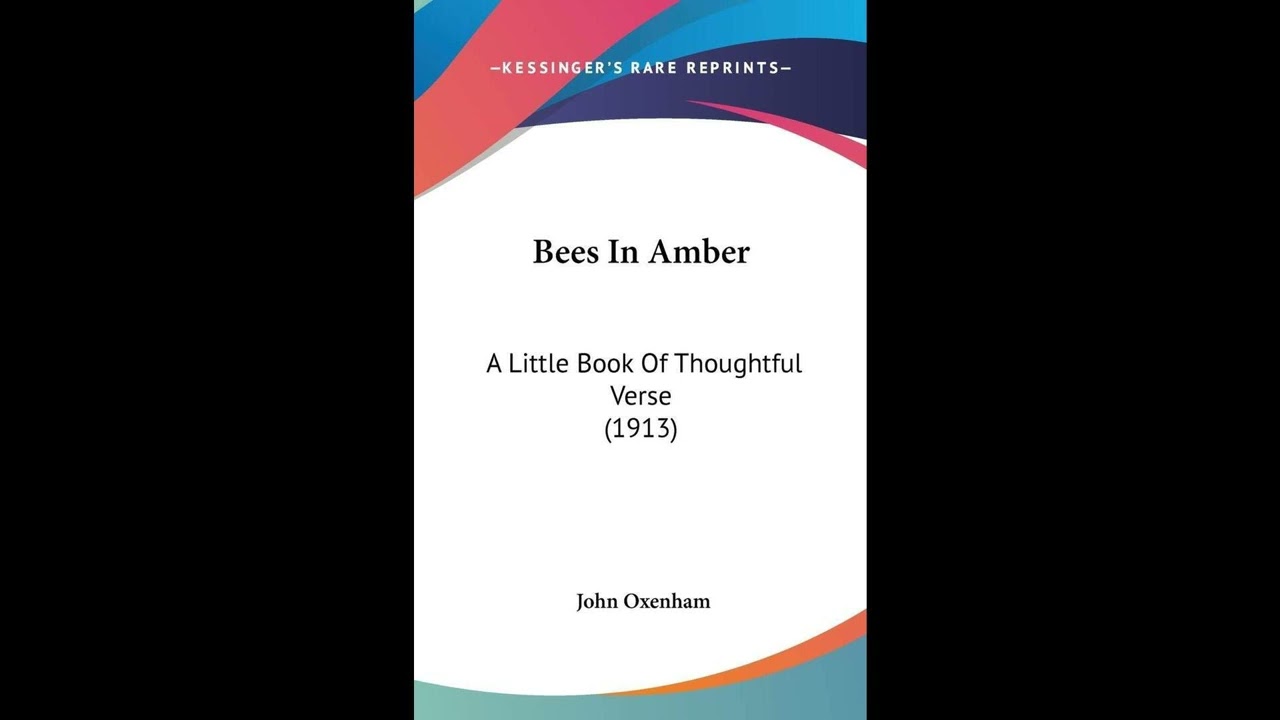
Bees In Amber: A Little Book Of Thoughtful Verse
In a world often loud and relentless, where constant demands vie for our attention, there exists a profound yearning for moments of quiet reflection, for thoughts that offer solace and perspective. "Bees In Amber: A Little Book Of Thoughtful Verse" by John Oxenham steps forward as a gentle balm for this modern spirit. This collection of poetry, first published in the early years of the twentieth century, is far more than mere antiquated verse; it is an invitation to pause, to breathe, and to consider the enduring truths of life, faith, and the human condition. Here, in verse both accessible and profound, listeners will find echoes of their own questions and discover comforting answers, rendered with a sincerity that transcends the passage of decades. It is a work that reminds us of the power of simplicity, the beauty of the natural world, and the quiet strength of an unwavering spirit, offering a much-needed respite from contemporary complexities. Rather than a singular narrative, "Bees In Amber" presents a carefully curated sequence of meditations, each poem a unique facet of a larger gem. The setting is primarily the inner landscape of thought and feeling, often sparked by observations of the external world—the quiet hum of nature, the changing seasons, the small, seemingly insignificant details of daily existence. Listeners will encounter a contemplative speaker, whose voice becomes a guide through various emotional and philosophical states. The collection does not feature main characters in a traditional sense, but rather universal human experiences take center stage: the quiet joy of discovery, the ache of longing, the peace of acceptance, the enduring light of hope. Each poem acts as a brief, self-contained scene, building towards an overarching sense of spiritual and emotional coherence. The "conflict" within this book of verse is the age-old human struggle to find meaning and solace amidst life's uncertainties and challenges. Oxenham's poems gently navigate these internal battles, offering perspectives that encourage resilience and a deeper trust in the unseen forces that shape our lives. The arc of "Bees In Amber" can be seen as a thoughtful progression from moments of simple observation and wonder, through periods of quiet introspection and questioning, eventually arriving at declarations of faith and an almost serene acceptance of life's larger patterns. Listeners will find themselves moving through poems that celebrate the beauty of creation, others that ponder the purpose of existence, and still others that offer words of encouragement during times of doubt. The collection, much like a wander through a peaceful garden, invites contemplation at every turn, never rushing the listener, but rather encouraging a slow, deliberate engagement with each sentiment. The man behind the pseudonym John Oxenham was William Arthur Dunkerley, born in Manchester, England, in 1861. His early career saw him involved in the mercantile world, even living for a time in France. This exposure to business and international life, however, did not diminish his innate inclination towards literature and verse. By the 1890s, Dunkerley had fully committed to writing, quickly establishing himself as a prolific novelist, poet, and hymn writer. He produced a steady stream of works that resonated deeply with the public, particularly those seeking comfort and inspiration. Among his many other works are the popular novel "Barbe of Grand Bayou," which showcased his storytelling abilities, and numerous hymns that have become mainstays in congregational singing, perhaps most notably "Mid All the Traffic of the Town" and the deeply moving "In Christ There Is No East or West." Dunkerley's writing spanned the late Victorian and Edwardian eras, a period of immense social and intellectual change, yet his style remained rooted in accessibility and clear expression. He possessed a remarkable ability to articulate common feelings and spiritual aspirations with a directness that endeared him to a wide readership. While not aligned with the burgeoning modernist movements that were beginning to challenge traditional forms and themes, Oxenham carved out a significant place for himself as a voice of popular piety and thoughtful reflection. He died in 1941, leaving behind a substantial body of work that continued to provide solace and upliftment through the tumultuous years of the early twentieth century. His contribution lies in making spiritual and philosophical contemplation available and engaging for a broad audience, securing his legacy as a cherished figure in English letters. "Bees In Amber" enacts several prominent themes that lend it enduring power. One central theme is the solace found in nature and simplicity. Many poems draw inspiration from the natural world—the quiet buzzing of bees, the changing light of a morning, the resilience of a small flower. These natural observations become conduits for deeper truths, suggesting that in the unadorned beauty of the world, one can find peace and a sense of divine order. For instance, a small bird's song or the steady rhythm of the seasons often prompts the speaker to consider the constancy of hope and the cycles of life and renewal. Another significant theme is enduring faith and spiritual optimism. Even when confronted with life's difficulties, Oxenham's verse consistently points towards a hopeful outlook, a trust in a benevolent power, and the belief that light will always follow darkness. This is often expressed through imagery of guidance, protection, and the promise of future blessings, offering comfort without being overly dogmatic. A third theme woven throughout the collection is the wisdom inherent in quiet reflection and introspection. The poems encourage the listener to step away from the clamor of the world and engage in internal dialogue, to consider their own experiences and beliefs. The very act of reading or listening to the verse becomes an exercise in mindfulness, promoting a deeper understanding of self and purpose. Finally, the book subtly addresses the theme of the passage of time and the preservation of memory. The title itself, "Bees In Amber," alludes to moments, thoughts, and experiences preserved, much like ancient insects in fossilized resin. This imagery suggests that while time moves onward, certain truths, certain beauties, and certain moments of understanding can be held and cherished, retaining their significance long after their immediate occurrence. This collection emerged at a pivotal moment in history, published in 1913, just on the precipice of the First World War. The Edwardian era was drawing to a close, a period characterized by lingering Victorian sensibilities, industrial expansion, and a growing sense of social and political unrest beneath a veneer of stability. Culturally, there was a public appetite for literature that offered moral guidance, spiritual comfort, and emotional resonance. The literary world, while beginning to feel the stirrings of modernism with its radical new forms and perspectives, still held a strong appreciation for traditional verse that maintained clear meter, rhyme, and easily digestible themes. Oxenham's work perfectly fit this prevailing taste, providing a reassuring voice of clarity and traditional values in an increasingly complex and uncertain world. His poems offered a much-needed spiritual and emotional anchor for a populace facing unprecedented global changes. Listening to "Bees In Amber" as an audiobook offers a uniquely immersive experience, allowing the inherent music and rhythm of the verse to fully resonate. The several-hour run length is perfectly suited for quiet evenings, contemplative walks, or moments of focused calm, allowing listeners to absorb the thoughtful sentiments at their own pace. A skilled narrator's pacing will be crucial in conveying the quiet dignity and reflective mood of the poems, ensuring that each carefully chosen word and phrase has its proper weight. The nuances of voice, the gentle cadences, and the subtle inflections will bring the verse to life, highlighting the sincerity and warmth that define Oxenham's writing. This auditory presentation transforms the book into a personal conversation with a wise and comforting companion, fostering an atmosphere of profound tranquility and introspection, making it an ideal companion for anyone seeking a measure of peace in their day.
Enjoyed Bees In Amber: A Little Book Of Thoughtful Verse? A few ways to support us
Audible & Amazon links are affiliate; we may earn a small commission at no extra cost.
About this production
Human narration by a volunteer reader from LibriVox.org, the public-domain audiobook project. LibriVox volunteers record literary works whose copyright has expired in the United States, releasing the resulting recordings into the public domain.
Bees In Amber: A Little Book Of Thoughtful Verse by John Oxenham. The underlying text is in the U.S. public domain. We do not republish any modern copyrighted edition, translation, or commentary.
The 4K cinematic visuals accompanying this audiobook are generated by an AI image model from prompts derived from the source text. No copyrighted photos, paintings, or stock footage are used. AI generation is disclosed on every video on our YouTube channel as required by YouTube's altered/synthetic content policy.
English subtitles are transcribed from the LibriVox recording with OpenAI Whisper. Translations into the 11 other supported languages are produced by Meta's NLLB-200 neural translation model. No human translator's copyrighted translation is used.
Questions about sourcing or rights? See our DMCA & Sourcing policy or contact us.
Enjoyed this audiobook?
If you'd like to own a copy of Bees In Amber: A Little Book Of Thoughtful Verse or hear a professionally produced edition, the links below help support free audiobook production at no extra cost to you.
As an Amazon Associate we earn from qualifying purchases. Audible / print links are affiliate.