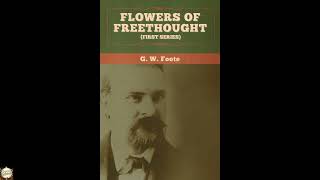
Arrows of Freethought
"Arrows of Freethought" stands as a foundational collection of critical essays from a bygone era, yet its intellectual fire remains strikingly relevant for anyone navigating modern thought. These writings by G. W. Foote present a vigorous defense of reason, skepticism, and independent inquiry against dogma. In an age saturated with information, the ability to question assumptions, challenge authority, and forge one's own understanding is crucial. Foote's articulate arguments, aimed at the rigid orthodoxies of his time, offer a bracing reminder of rational discourse and intellectual courage. Listening today provides a potent toolkit for critical thinking that resonates with contemporary debates about science, faith, and societal progress. Rather than a traditional narrative, "Arrows of Freethought" invites listeners into an intellectual arena – the battleground of ideas in late Victorian England. The stage is set with a prevailing societal reverence for religious authority. Foote, as the dominant voice, champions intellectual liberation. His central conflict pits logical argument and scientific evidence against superstition, biblical literalism, and uncritical faith. Each essay is a distinct encounter, a focused assault on established religious thought, concerning scriptural accuracy or philosophical inconsistencies. The work progresses from incisive critiques of specific religious claims to broader assertions about reason's role in human flourishing. Listeners witness Foote systematically dismantle arguments he perceives as fallacious or harmful. The "arc" is one of escalating intellectual confrontation, as the author pushes boundaries, urging re-evaluation of how individuals perceive the world. His goal is not merely to provoke, but to enlighten, clearing away antiquity's cobwebs for rational inquiry to illuminate new paths for understanding. The "story" is therefore a compelling narrative of intellectual awakening, a call to shed inherited biases and pursue truth. George William Foote (1850-1915) was a formidable figure in the British freethought movement, a tireless polemicist, and a staunch advocate for secularism during an era heavily influenced by religious conservatism. Born in Plymouth, England, Foote dedicated his life to promoting rationalism and challenging religious dogma, often at considerable personal cost. His most significant legacy stems from his role as editor of The Freethinker, a weekly secularist newspaper launched in 1881. Under his editorship, the publication became a vital platform for atheistic and anti-clerical commentary. Foote’s outspoken criticisms brought him into direct conflict with the law. In 1883, he and other The Freethinker staff were prosecuted for blasphemy, resulting in Foote’s imprisonment for twelve months with hard labor. This experience hardened his resolve and cemented his reputation as a courageous defender of free speech. He continued to edit The Freethinker for over three decades. Beyond his editorial work, Foote was a prolific writer and orator, producing numerous pamphlets and books, including Crimes of Christianity and Bible Romances. He was a key proponent of the late 19th-century British Secularist movement, laying much groundwork for modern secular humanist thought. Several potent themes run through "Arrows of Freethought," chief among them Reason and Empirical Evidence as the sole arbiters of truth. Foote consistently argues against appeals to faith, tradition, or supernatural revelation, championing the scientific method and logical deduction. Listeners will hear him dissecting scriptural inconsistencies with forensic precision, laying bare what he perceives as historical inaccuracies or moral contradictions. He might cite geological findings contradicting creation accounts, or highlight ethical dilemmas within religious texts that clash with evolving humanistic values. Another significant theme is the fervent advocacy for Freedom of Thought and Speech. Foote understood that without the liberty to question and express dissenting opinions, intellectual progress would stagnate. His personal struggles, including imprisonment for blasphemy, underscore his deep conviction. He passionately defends the right to publicly critique religious doctrines as an essential service to intellectual honesty. Furthermore, the collection promotes Humanism and Secular Morality, asserting that ethical conduct and social well-being derive from human empathy, reason, and a shared understanding of collective good. "Arrows of Freethought" emerged from a period of profound intellectual and social ferment in Victorian and Edwardian Britain. The late 19th century witnessed the dramatic aftershocks of Darwin's theory of evolution, which profoundly challenged traditional religious narratives of creation and humanity's place in the universe. This scientific upheaval coincided with the rise of industrialization, increasing urbanization, and growing social reform movements, all contributing to a questioning of established institutions, including the Church of England. During this era, prominent freethinkers like Foote, Charles Bradlaugh, and Annie Besant openly debated religious leaders, advocating for secular education, women's rights, and social justice. Blasphemy laws remained a significant legal threat, demonstrating the lingering power of religious authority, even as public skepticism grew. Foote's writings were a direct response to this climate, serving as a powerful voice for those who sought to push back against outdated dogma and clerical influence. His work provided intellectual ammunition for a burgeoning secular movement. Listening to "Arrows of Freethought" as an audiobook offers an immediate and impactful way to engage with G. W. Foote's potent arguments. The carefully modulated narration allows Foote's rhetorical brilliance to truly shine, bringing to life the passion and conviction behind his words. You can discern subtle shifts in his tone – from incisive critique to impassioned advocacy – as the narrator embodies his intellectual fervor. The several hours of listening time make this collection ideal for focused engagement during commutes or moments of quiet reflection. Pay attention to the clarity of Foote's logic, the compelling rhythm of his prose, and the intellectual courage that permeated his advocacy. You will feel the direct force of his "arrows," delivered directly, forcefully, and with undeniable intent to provoke thought and inspire change.
Enjoyed Arrows of Freethought? A few ways to support us
Audible & Amazon links are affiliate; we may earn a small commission at no extra cost.
About this production
Human narration by a volunteer reader from LibriVox.org, the public-domain audiobook project. LibriVox volunteers record literary works whose copyright has expired in the United States, releasing the resulting recordings into the public domain.
Arrows of Freethought by G. W. Foote. The underlying text is in the U.S. public domain. We do not republish any modern copyrighted edition, translation, or commentary.
The 4K cinematic visuals accompanying this audiobook are generated by an AI image model from prompts derived from the source text. No copyrighted photos, paintings, or stock footage are used. AI generation is disclosed on every video on our YouTube channel as required by YouTube's altered/synthetic content policy.
English subtitles are transcribed from the LibriVox recording with OpenAI Whisper. Translations into the 11 other supported languages are produced by Meta's NLLB-200 neural translation model. No human translator's copyrighted translation is used.
Questions about sourcing or rights? See our DMCA & Sourcing policy or contact us.
Enjoyed this audiobook?
If you'd like to own a copy of Arrows of Freethought or hear a professionally produced edition, the links below help support free audiobook production at no extra cost to you.
As an Amazon Associate we earn from qualifying purchases. Audible / print links are affiliate.