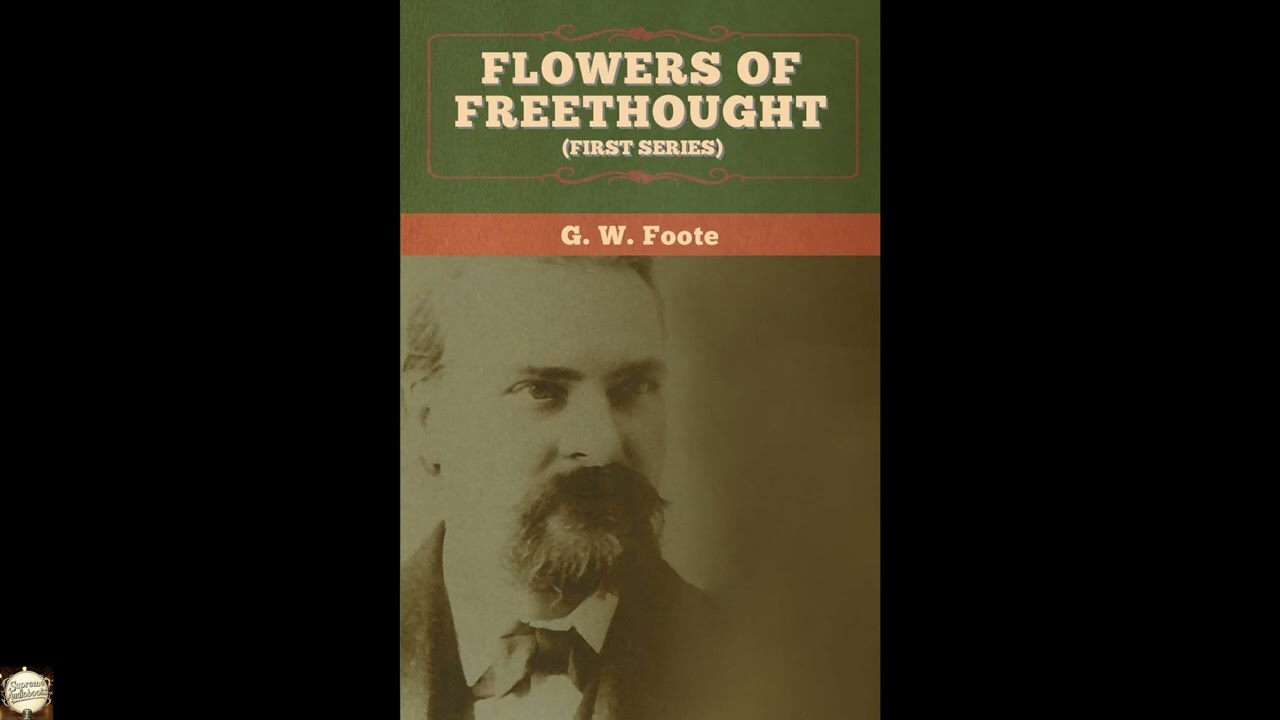
Flowers of Freethought (First Series)
"Flowers of Freethought (First Series)" collects the sharp, unapologetic writings of G.W. Foote, one of the most significant and combative voices of the British secularist movement. This collection is far more than a historical curiosity; it is a vital declaration of intellectual independence, a direct challenge to the dogmas and superstitions that Foote believed stifled human progress. For anyone who has ever questioned established authority, sought a rational basis for morality, or grappled with the tension between faith and reason, Foote’s clear-sighted arguments resonate with striking relevance even today. He dissects the prevailing orthodoxies of his era with wit and conviction, urging listeners to cultivate a garden of ideas where reason, not tradition, is the guiding light. Within these pages, the listener is invited into the intellectual arena of the late Victorian and Edwardian periods, a time when established religious authority faced unprecedented challenges from scientific advancement and burgeoning humanism. G.W. Foote, through his compelling prose, takes on the role of both prosecutor and passionate advocate. The collection opens with Foote’s unflinching examinations of religious doctrines, particularly those embedded in Christian scripture. He scrutinizes biblical narratives with a historian’s eye and a logician’s precision, pointing out inconsistencies, anachronisms, and moral quandaries that often went unaddressed by orthodox interpretations. He doesn’t merely dismiss; he dissects, inviting the reader to follow his reasoned arguments point by point as he chips away at foundational myths. As the collection progresses, Foote widens his scope beyond scriptural critique. He turns his formidable intellect to the broader societal implications of religious belief, particularly its influence on education, morality, and the administration of justice. He champions a morality rooted in human experience, empathy, and collective well-being, rather than divine decree or the promise of heavenly reward. He argues passionately for the separation of church and state, for secular education that fosters critical thinking, and for a society where individual liberty of conscience is paramount. The conflict at the heart of these essays is the age-old struggle between intellectual freedom and inherited dogma, between the courage to question and the comfort of unquestioning belief. Foote’s goal is not merely to tear down, but to clear the ground for a more enlightened, humane society built upon the bedrock of reason. George William Foote, born in Plymouth, England, in 1850, was a self-educated dynamo who rose to become one of the most fearless and impactful figures in the history of British secularism. His life was a testament to his convictions, marked by an unwavering commitment to free speech and rational inquiry. A tireless activist and polemicist, Foote is best known as the editor of The Freethinker magazine, which he founded in 1881. This publication became a powerful platform for challenging religious orthodoxy, often with satirical and provocative content that stirred considerable controversy. Foote’s dedication to his principles came at a personal cost. In 1883, he, along with two associates, was famously prosecuted and imprisoned for blasphemy due to material published in The Freethinker. This event, known as the Freethinker Trial, solidified his reputation as a martyr for free expression and galvanized support for the secularist cause across Britain. Despite legal battles and public outcry, Foote continued to write, publish, and lecture with fervent resolve until his death in 1915. He was a prolific author of pamphlets, essays, and other collections, constantly defending the right to dissent and advocating for a society grounded in scientific understanding and humanistic values. His position within the literary and intellectual canon is that of a pivotal figure in the late Victorian rationalist movement, a fierce advocate who helped lay the groundwork for a more secular and tolerant public discourse. The essays comprising "Flowers of Freethought (First Series)" offer a powerful articulation of several enduring themes. Central among them is the primacy of rationalism over faith. Foote consistently demonstrates how an appeal to logical consistency, empirical evidence, and historical scholarship can dismantle even the most deeply held religious assertions. For instance, he might take a biblical miracle story, not to mock it, but to methodically examine its plausibility against known laws of nature or historical accounts, showing how credulity, rather than evidence, sustains belief. This unwavering commitment to reason is the engine of his entire output. Another crucial theme is the absolute necessity of freedom of speech and the press. Foote’s own experience with legal persecution for blasphemy underscores his passionate defense of unhindered expression. He saw the suppression of thought, particularly religious thought, as a direct impediment to societal advancement, arguing that only through open debate, where even the most sacred cows can be questioned, can humanity arrive at truth. Furthermore, Foote champions the concept of a secular morality, positing that ethics do not depend on divine commandment but emerge from human reason, empathy, and the pursuit of collective welfare. He illustrates this by contrasting the often-punitive and arbitrary moral codes found in religious texts with a humanitarian ethics focused on real-world suffering and the common good. Finally, the collection implicitly, and often explicitly, champions social progress through enlightenment, envisioning a future where superstition’s chains are broken, allowing humanity to flourish intellectually and socially. "Flowers of Freethought (First Series)" emerged from a period of profound intellectual and social upheaval in Britain, roughly spanning the late nineteenth and early twentieth centuries. This was an age grappling with the monumental implications of Charles Darwin’s theory of evolution, which had fundamentally challenged literal interpretations of creation. The relentless march of scientific discovery – in geology, astronomy, and biology – increasingly clashed with traditional religious narratives, fostering a climate of skepticism and critical inquiry. Beyond scientific challenges, rapid industrialization was transforming British society, creating new social problems and prompting calls for reform that often ran counter to established institutions, including the Church of England. In this ferment, various movements gained traction: philosophical naturalism, agnosticism, and militant atheism coalesced under the broader banner of "freethought." Intellectuals and activists like Foote saw themselves as spearheading a necessary intellectual revolution, clearing away the debris of centuries of religious dominance to make way for a more rational, humane future. Politically, the era saw debates over national education, women’s rights, and working-class conditions, all of which often intersected with questions of religious influence and secular governance. Foote’s writings, therefore, were not isolated academic exercises but direct interventions in the lively, often acrimonious, public conversations shaping modern Britain. They stand as a powerful record of the battles fought in the name of reason and liberty during this transformative time. Listening to "Flowers of Freethought (First Series)" as an audiobook offers a uniquely direct engagement with G.W. Foote’s potent arguments. The sheer intellectual force and rhetorical skill of Foote come alive through a well-paced narration that allows each carefully constructed point to land with maximum impact. The several hours of listening time provide ample opportunity to absorb the nuances of his critiques and ponder the significant questions he raises, transforming the act of listening into a sustained, immersive debate. Pay attention to the narrator’s delivery of Foote’s often-pointed prose – the clarity of voice that carries his conviction, the judicious pacing that highlights logical progression, and the subtle variations in tone that capture the earnestness, and sometimes the indignation, of a man fighting for intellectual freedom. It's an auditory experience that places you directly in the intellectual atmosphere of a pivotal historical moment, making Foote’s persuasive powers felt anew.
Enjoyed Flowers of Freethought (First Series)? A few ways to support us
Audible & Amazon links are affiliate; we may earn a small commission at no extra cost.
About this production
Human narration by a volunteer reader from LibriVox.org, the public-domain audiobook project. LibriVox volunteers record literary works whose copyright has expired in the United States, releasing the resulting recordings into the public domain.
Flowers of Freethought (First Series) by G W Foote. The underlying text is in the U.S. public domain. We do not republish any modern copyrighted edition, translation, or commentary.
The 4K cinematic visuals accompanying this audiobook are generated by an AI image model from prompts derived from the source text. No copyrighted photos, paintings, or stock footage are used. AI generation is disclosed on every video on our YouTube channel as required by YouTube's altered/synthetic content policy.
English subtitles are transcribed from the LibriVox recording with OpenAI Whisper. Translations into the 11 other supported languages are produced by Meta's NLLB-200 neural translation model. No human translator's copyrighted translation is used.
Questions about sourcing or rights? See our DMCA & Sourcing policy or contact us.
Enjoyed this audiobook?
If you'd like to own a copy of Flowers of Freethought (First Series) or hear a professionally produced edition, the links below help support free audiobook production at no extra cost to you.
As an Amazon Associate we earn from qualifying purchases. Audible / print links are affiliate.