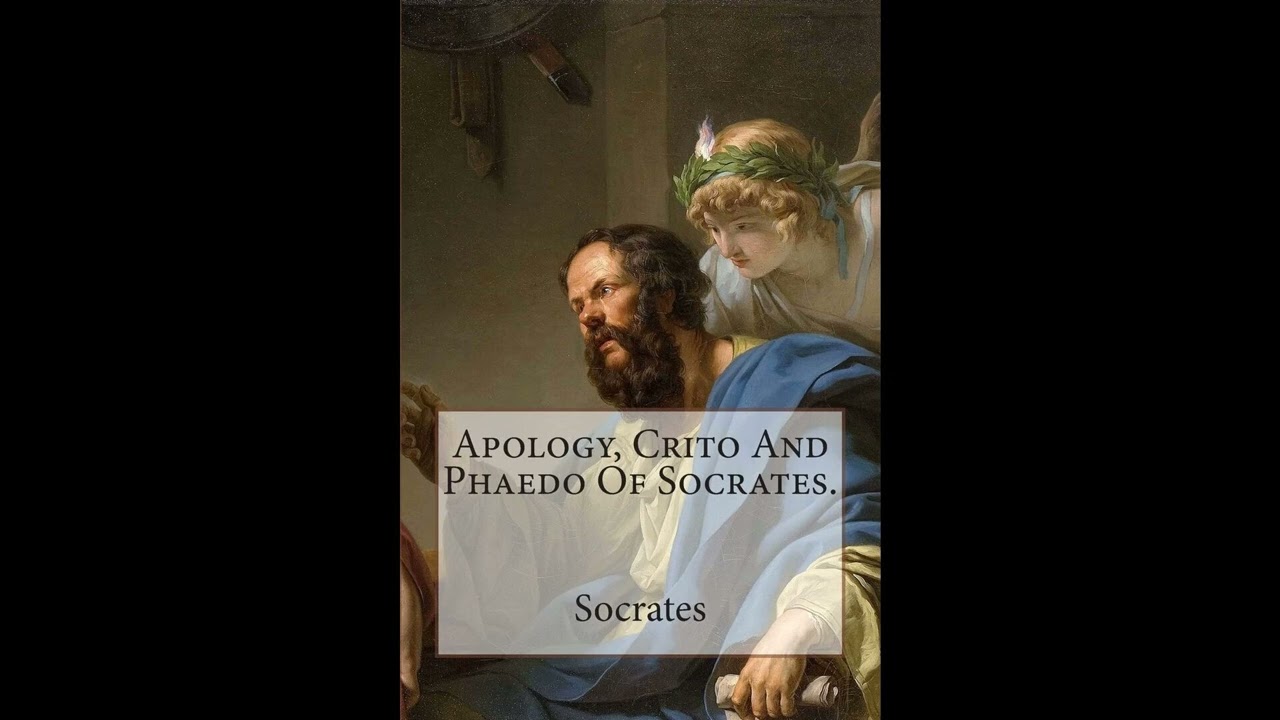
Apology, Crito And Phaedo Of Socrates
Imagine a single individual standing against the entire might of the state, not with weapons or political power, but with nothing more than reason and unyielding conviction. This is the arresting image at the heart of Apology, Crito And Phaedo Of Socrates, a collection of profoundly influential texts that bring to life the final days of one of history's most pivotal thinkers. While listed under the name of Socrates, these foundational dialogues are, in fact, the meticulous records and philosophical elaborations penned by his most famous student, Plato. More than two millennia after they were first conceived, these accounts continue to resonate, offering a stark examination of integrity, justice, civic duty, and the ultimate courage required to face one’s fate guided by principle. They ask us to consider: What is the true meaning of a good life? And what price are we willing to pay for our beliefs? The first dialogue, Apology, thrusts listeners into the heart of an Athenian courtroom in 399 BCE. Here, an elderly Socrates faces charges of impiety and corrupting the youth, accusations leveled against him by three prominent citizens: Meletus, Anytus, and Lycon. Rather than begging for clemency or offering a conventional defense, Socrates uses his trial as a final opportunity to explain his life's philosophical mission. He recounts how the Oracle at Delphi proclaimed him the wisest man, leading him to question everyone he met—politicians, poets, artisans—to expose their false wisdom, all in service of a greater truth. His defense is not an apology in the modern sense, but a defiant, lucid exposition of why he cannot abandon his practice of critical examination, even if it means his death. The narrative captures the tension of the proceedings, the initial condemnation, and Socrates’ calm acceptance of his sentence, all while steadfastly upholding the pursuit of wisdom as his highest calling. Following the trial, Crito finds Socrates imprisoned, awaiting his execution. His wealthy and devoted friend, Crito, visits him with an elaborate plan for escape, arguing that it would be unjust for Socrates to submit to an unfair sentence, that his friends would be shamed, and that he would abandon his children. The dialogue unfolds as a powerful debate between the two men. Socrates, employing his characteristic method of questioning, systematically dismantles Crito's arguments, asserting that one must never commit injustice, even in response to injustice. He argues that having lived under the laws of Athens his entire life, he implicitly agreed to abide by them, and to flee now would be to betray those very principles that allow a society to function. This exchange presents a profound meditation on the individual’s relationship to the state, the nature of justice, and the duty to uphold moral principles regardless of personal consequence. Finally, Phaedo transports us to Socrates' last hours, spent in prison with a circle of grieving friends. Far from despairing, Socrates engages them in a final, sustained philosophical discussion about the nature of the soul and its immortality. He presents several intricate arguments suggesting that the soul is distinct from the body, that it pre-exists and survives physical death, and that philosophy is, in essence, a preparation for dying. The atmosphere is one of profound calm and intellectual rigor, even as the shadow of his impending execution looms. Through logical deductions and evocative myths, Socrates offers solace and a rational basis for hope in the face of mortality, preparing his friends for his inevitable departure with wisdom and serenity, making his ultimate fate not a tragedy but a final act of philosophical courage. Socrates himself, a towering figure in ancient Greek philosophy, lived from approximately 470/469 BCE to 399 BCE. Unlike many philosophers, he never wrote down his ideas, believing that true wisdom was found through spoken dialogue and direct inquiry. Our understanding of him comes primarily through the writings of his students, most notably Plato and Xenophon. Born in Alopece, an Athenian deme, to a stonemason father and a midwife mother, Socrates served as a hoplite soldier in several important battles, demonstrating physical courage. Yet, his primary focus became the pursuit of ethical understanding and moral truth, which he carried out through relentless questioning on the streets and in the marketplaces of Athens. This method, now known as the Socratic method, involved a process of cooperative argumentative dialogue between individuals, asking and answering questions to stimulate critical thinking and illuminate ideas. His intellectual legacy is immense, positioning him as a foundational figure for Western philosophy, influencing thinkers for millennia. The accounts presented by Plato in these dialogues are not merely historical records; they are profound philosophical treatises that grapple with perennial questions. A central theme woven through all three texts is the pursuit of truth and wisdom, which Socrates champions above all else. In Apology, his very defense is an explanation of how he dedicated his life to uncovering ignorance, demonstrating that true wisdom lies in recognizing the limits of one's own knowledge. He refuses to abandon this mission, even when it leads to his death sentence. Another prominent theme is civic duty and the social contract. In Crito, Socrates powerfully articulates his belief that having benefited from Athenian laws and society throughout his life, he has an unbreakable obligation to obey its judgments, even when they are unjust towards him personally. He views escape as a betrayal of the state and a violation of the very principles that ensure social order, thus emphasizing the citizen's profound responsibility. The dialogues also explore the nature of the soul and death. Phaedo is almost entirely devoted to Socrates’ arguments for the immortality of the soul, presenting death not as an end, but as a separation of the soul from the body. He offers intricate proofs, suggesting that the soul is akin to divine and immortal forms, constantly striving for purity and knowledge. This allows him to face his death with remarkable tranquility, believing it is a release for his soul to attain true understanding. Furthermore, personal integrity and moral courage stand out as a guiding light. Throughout his trial and imprisonment, Socrates consistently refuses to compromise his principles, whether by offering a feigned defense, agreeing to exile, or escaping. His steadfastness in the face of death, driven by an unwavering commitment to his philosophical ideals, serves as a powerful testament to the strength of conviction. These accounts emerged from a specific and turbulent period in Athenian history. The late 5th century BCE saw Athens reeling from its defeat in the Peloponnesian War against Sparta, a conflict that brought significant political and social upheaval. The city had endured a brief but brutal oligarchical rule by the Thirty Tyrants, followed by a re-establishment of democracy, but one marked by suspicion and a desire for stability. In this volatile environment, established traditions and religious beliefs were being questioned by a new wave of intellectuals, the Sophists, who often taught rhetoric and argument for a fee. Socrates, though distinct from the Sophists, was perceived by some as a dangerous figure who challenged conventional wisdom and piety, potentially undermining the social order during a fragile time. Plato’s writing of these dialogues, likely composed years after Socrates' death, served not only to vindicate his revered teacher but also to critique the flaws he saw in Athenian democracy and to preserve Socrates’ unique philosophical contributions for posterity, establishing a paradigm for intellectual pursuit. Listening to these foundational texts as an audiobook offers a singular opportunity to engage directly with the rhythm of Socratic dialogue. The very essence of Socrates’ philosophy was conversational, a dynamic exchange of questions and answers. An accomplished narrator can bring these exchanges to life, differentiating voices and capturing the nuances of the arguments, from Socrates’ gentle yet relentless questioning to the varied responses of his accusers and disciples. The duration, spanning several hours, makes it an ideal companion for focused listening—perhaps during a contemplative walk or a commute—allowing ample time to absorb the intricate philosophical points without the visual distractions of reading. Pay close attention to the deliberate pacing of Socrates’ arguments, how he builds his case step by step, and the atmosphere that shifts from the charged tension of the courtroom to the intimate, reflective tone of his final conversations. It is an experience that illuminates the enduring power of ideas, presented through the words of the man who arguably set the course for Western thought.
Enjoyed Apology, Crito And Phaedo Of Socrates? A few ways to support us
Audible & Amazon links are affiliate; we may earn a small commission at no extra cost.
About this production
Human narration by a volunteer reader from LibriVox.org, the public-domain audiobook project. LibriVox volunteers record literary works whose copyright has expired in the United States, releasing the resulting recordings into the public domain.
Apology, Crito And Phaedo Of Socrates by Socrates. The underlying text is in the U.S. public domain. We do not republish any modern copyrighted edition, translation, or commentary.
The 4K cinematic visuals accompanying this audiobook are generated by an AI image model from prompts derived from the source text. No copyrighted photos, paintings, or stock footage are used. AI generation is disclosed on every video on our YouTube channel as required by YouTube's altered/synthetic content policy.
English subtitles are transcribed from the LibriVox recording with OpenAI Whisper. Translations into the 11 other supported languages are produced by Meta's NLLB-200 neural translation model. No human translator's copyrighted translation is used.
Questions about sourcing or rights? See our DMCA & Sourcing policy or contact us.
Enjoyed this audiobook?
If you'd like to own a copy of Apology, Crito And Phaedo Of Socrates or hear a professionally produced edition, the links below help support free audiobook production at no extra cost to you.
As an Amazon Associate we earn from qualifying purchases. Audible / print links are affiliate.