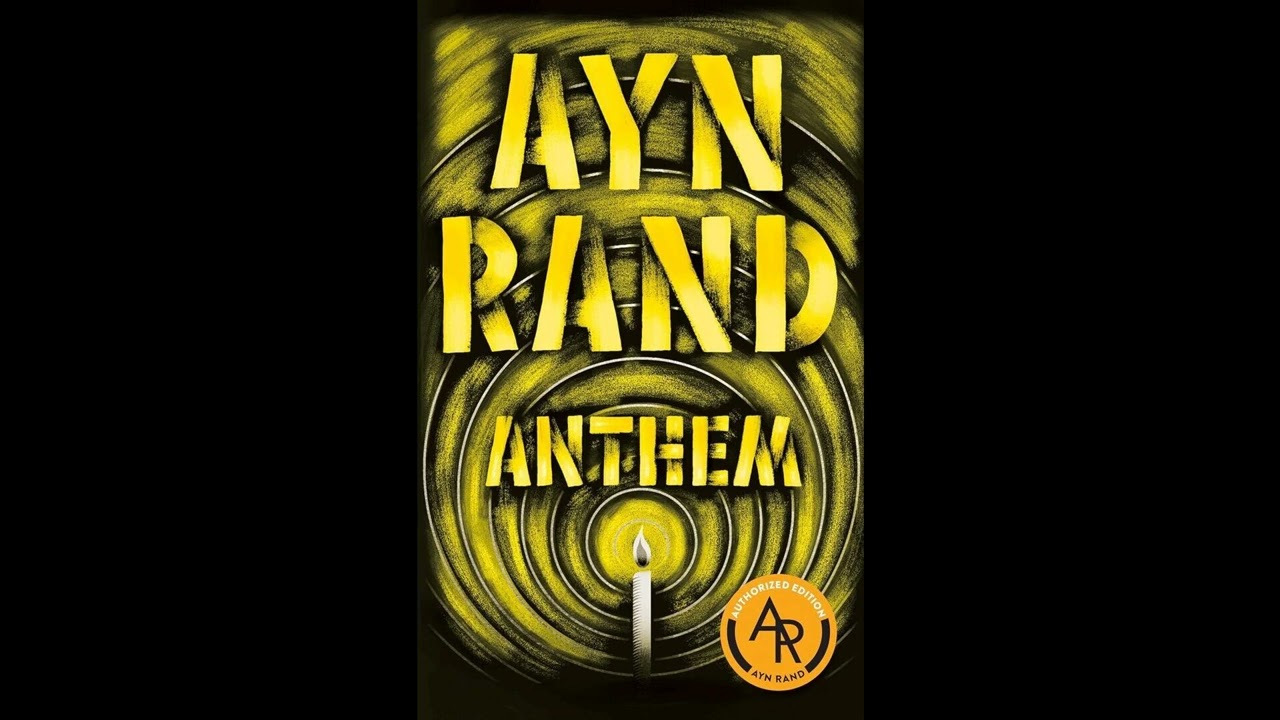
Anthem
Ayn Rand's Anthem arrives as a stark, compelling novella, a crystalline warning cry that resonates with uncanny power even decades after its first publication. This isn't just a dystopian tale of a future gone wrong; it’s a profound meditation on the very essence of human identity. It challenges listeners to consider what happens when the individual is entirely subsumed by the collective, when "I" becomes a forbidden word, and self-sacrifice is the highest virtue. In an era often wrestling with questions of personal freedom versus societal obligation, of individual achievement against communal effort, Anthem stands as a fierce testament to the unyielding spirit of self, asking whether true progress and happiness can ever exist without the sovereign human mind at its core. The story drops us into a grim, unspecified future where humanity has regressed to a new Dark Age, ruled by the absolute tyranny of a collectivist society. Technology is forgotten, history erased, and every aspect of life is meticulously controlled by councils. From birth, individuals are assigned numbers instead of names, and professions are dictated without personal choice. We meet Equality 7-2521, a street sweeper who, despite his assigned mediocrity, possesses an unquenchable intellect and an insatiable curiosity that mark him as different. He is taller, smarter, and asks more questions than his brothers. These forbidden traits—his quick mind and the dangerous concept of preference—are considered a curse, a transgression against the sacred "we" that governs all thought. Equality’s secret life unfolds in a forgotten tunnel beneath the city, a place he discovers while sweeping. Here, he conducts clandestine scientific experiments, driven by an innate desire to understand the world and create. His forbidden studies lead him to rediscover electricity, a monumental innovation in a world lit by candles. Alongside this intellectual awakening, he encounters Liberty 5-3000, a woman working in the fields, whom he dares to rename "The Golden One" in his private thoughts. Their illicit connection, a silent rebellion of affection, further underscores the burgeoning individualism within Equality. When he finally brings his invention to the World Council of Scholars, hoping to share his light with humanity, he faces not praise, but terror and condemnation for daring to think and create alone. Forced to flee, he escapes into the desolate Uncharted Forest, a place no one is permitted to enter, carrying his new light and the forbidden, burgeoning sense of self. Ayn Rand, born Alisa Zinovyevna Rosenbaum in St. Petersburg, Russia, in 1905, bore witness to the seismic political and social shifts of the early 20th century. Her formative years were spent under the shadow of the Russian Revolution and the subsequent rise of Soviet Communism. This firsthand experience of a collectivist state, where individual rights were abolished in favor of the state, profoundly shaped her philosophical and literary convictions. She saw the crushing of the individual spirit and the suppression of free thought, observations that would later form the bedrock of her unique worldview. Rand immigrated to the United States in 1926, seeking the freedom and opportunities she believed were absent in her homeland. She began her career in Hollywood as a screenwriter before turning to novels, where she truly found her voice. Her major works, including We the Living, The Fountainhead, and Atlas Shrugged, cemented her reputation as a formidable, if often controversial, literary figure. Throughout her writing and later her philosophical essays, she championed rational individualism, egoism, and laissez-faire capitalism, arguing that the pursuit of one's own happiness is the highest moral purpose. Her body of work carved out a distinct and influential place in 20th-century American letters, inspiring generations of readers and thinkers. Anthem powerfully enacts several core themes, perhaps none more central than the stark conflict between individualism and collectivism. Equality 7-2521's very existence is an act of rebellion against a society that demands absolute conformity. His internal monologue, often wrestling with the imposed "we" while his own mind thinks "I," vividly illustrates this struggle. For instance, when he secretly writes in his journal, the act itself is a radical assertion of self, defying the communal will that forbids private thought and action. The text demonstrates how a society that denies individual achievement ultimately stagnates, as seen in the World Council's fear of Equality's rediscovered electricity, preferring darkness and control over progress and light. Another powerful theme is the value of independent thought and scientific innovation. Equality’s persistent questioning and his secret laboratory reveal the fundamental human drive to understand and create, a drive that the collective society has tried to extinguish. His invention of the light bulb, a beacon of progress and knowledge, stands in direct opposition to the Council's decree that all inventions must come from the collective, highlighting how suppression of the individual mind leads to regression. Finally, the story examines the power of language as a tool of control. By eliminating the word "I" from their vocabulary, the society aims to eradicate the concept of self, forcing everyone to identify only as part of a larger whole. Equality's eventual discovery and embrace of the singular pronoun marks his ultimate liberation and the re-emergence of his personal identity. When Anthem was first published in the late 1930s, the world stage was dominated by the rising specters of totalitarianism. Fascism was consolidating power in Italy and Germany, while Stalin's brutal collectivization and purges devastated the Soviet Union. The economic hardships of the Great Depression also led many in democratic nations to question the efficacy of individual liberty and to consider collectivist solutions. Ayn Rand, having directly experienced the Soviet experiment, viewed these global trends with alarm. The novella thus emerged as a direct response and a prophetic warning. It was a fictionalized extrapolation of the dangers she perceived in any ideology that prioritized the group over the individual, or the state over the citizen. Anthem was, for Rand, a crucial statement against the prevailing intellectual currents of her time, an impassioned argument for the sanctity of the individual human spirit against overwhelming odds. It arrived as a call to remember the importance of personal freedom and the dangers of allowing the self to be extinguished for the sake of an abstract collective. Listening to Anthem as an audiobook offers a uniquely intimate experience of Equality 7-2521’s awakening. The novella, a concise several hours in length, lends itself perfectly to a focused listening session, allowing the listener to become fully immersed in its stark, introspective world. A skilled narrator can amplify the oppressive atmosphere of the collectivist society, giving weight to the monotone pronouncements and the subtle terror of a world without choice. Listen for the gradual shift in Equality’s internal voice – from the hesitant, guilt-ridden "we" to the dawning, defiant "I." The pacing can build tension as Equality’s forbidden experiments progress, his every secret action a thrilling act of rebellion. The quiet moments of self-discovery, punctuated by the narrator's nuanced delivery, underscore the profound significance of each step in his journey towards individual identity, making his eventual pronouncements of selfhood powerfully resonant and deeply moving.
Enjoyed Anthem? A few ways to support us
Audible & Amazon links are affiliate; we may earn a small commission at no extra cost.
About this production
Human narration by a volunteer reader from LibriVox.org, the public-domain audiobook project. LibriVox volunteers record literary works whose copyright has expired in the United States, releasing the resulting recordings into the public domain.
Anthem by Ayn Rand. The underlying text is in the U.S. public domain. We do not republish any modern copyrighted edition, translation, or commentary.
The 4K cinematic visuals accompanying this audiobook are generated by an AI image model from prompts derived from the source text. No copyrighted photos, paintings, or stock footage are used. AI generation is disclosed on every video on our YouTube channel as required by YouTube's altered/synthetic content policy.
English subtitles are transcribed from the LibriVox recording with OpenAI Whisper. Translations into the 11 other supported languages are produced by Meta's NLLB-200 neural translation model. No human translator's copyrighted translation is used.
Questions about sourcing or rights? See our DMCA & Sourcing policy or contact us.
Enjoyed this audiobook?
If you'd like to own a copy of Anthem or hear a professionally produced edition, the links below help support free audiobook production at no extra cost to you.
As an Amazon Associate we earn from qualifying purchases. Audible / print links are affiliate.