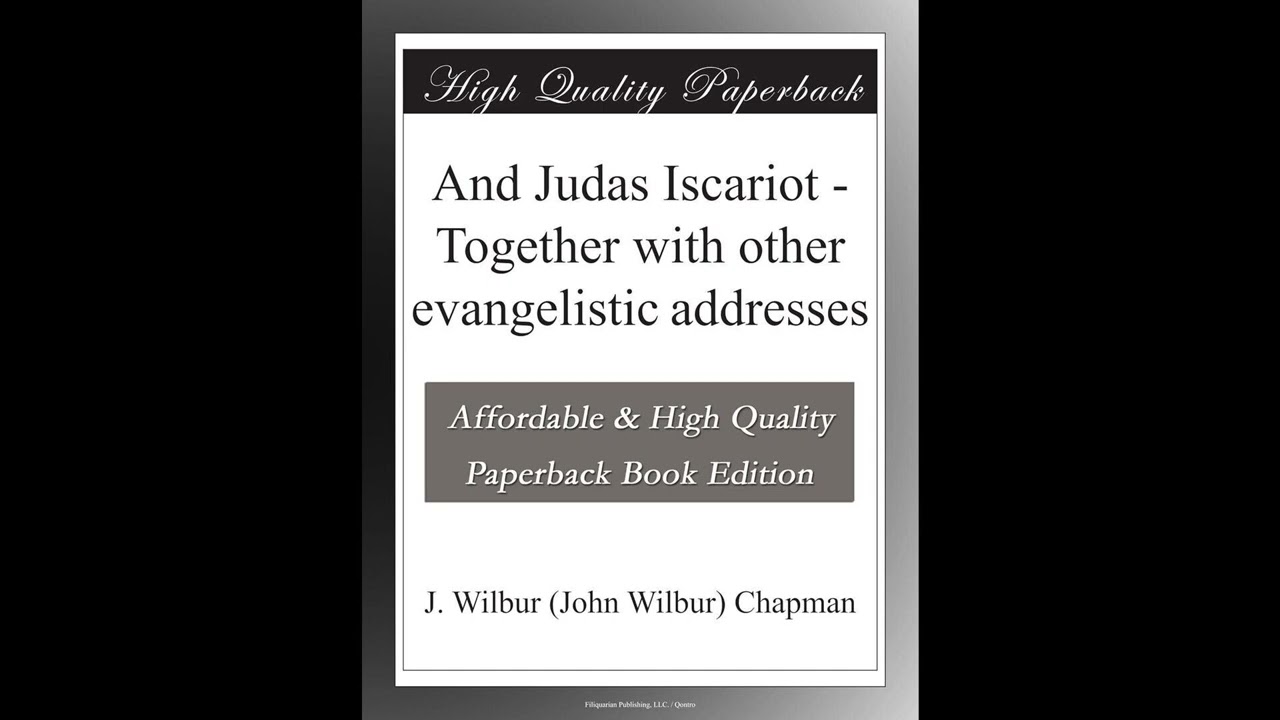
And Judas Iscariot - Together with other evangelistic addresses
The figure of Judas Iscariot has haunted the collective imagination for millennia, a potent symbol of betrayal, consequence, and the complex interplay between human will and divine purpose. In "And Judas Iscariot - Together with other evangelistic addresses," J. Wilbur offers listeners more than just a historical or theological exposition; this collection presents a profound window into an era where oratorical power shaped public discourse on faith and morality. It invites contemporary audiences to grapple with perennial questions of loyalty, sin, forgiveness, and the very nature of evil, delivered with the passionate conviction that defined a particular style of religious address, providing both spiritual reflection and a fascinating historical document. The central address, "And Judas Iscariot," meticulously unpacks the narrative surrounding the disciple who betrayed Jesus. Wilbur does not merely recount the well-known events, but rather probes the motivations, the internal struggles, and the ultimate fate of Judas with an intensity that seeks to understand rather than simply condemn. Listeners are guided through the biblical accounts, examining the moments leading up to the betrayal in the Garden of Gethsemane, the thirty pieces of silver, and the subsequent despair. The address paints vivid portraits of the key figures—Jesus in his profound solitude, the earnest but often bewildered disciples, and Judas himself, rendered not as a simple villain, but as a tragic figure whose choices set in motion an irreversible chain of events. The discourse poses searching questions about free will versus predestination, the psychological weight of guilt, and the possibilities—or impossibilities—of repentance in the face of such a monumental transgression, holding back from definitive answers to foster deeper personal reflection. Beyond the titular address, the collection expands its scope to encompass other evangelistic addresses, each designed to stir the conscience and guide listeners toward spiritual introspection and commitment. These additional addresses frequently turn to common themes of sin, salvation, the nature of faith, and the call to Christian living. While specific narratives vary across these sermons, they consistently feature a dramatic presentation of spiritual truths, employing parables, scriptural examples, and vivid analogies to illustrate moral points. The cumulative effect is an overarching examination of the human condition in the light of divine revelation, all delivered with an urgent, persuasive tone characteristic of evangelism from a particular historical period, encouraging listeners to consider their own spiritual standing without ever revealing a specific resolution to the ultimate questions posed within each sermon. J. Wilbur, the author of these compelling addresses, represents a significant voice within the tradition of evangelistic preaching. While specific biographical details may be less widely known today, figures like Wilbur were foundational to the religious landscape of their time, often traveling extensively, speaking in churches, revival tents, and public halls to disseminate their message. The life of such an evangelist was typically one of fervent dedication, marked by countless hours of sermon preparation, intense study of scripture, and a commitment to direct, emotionally resonant communication. Their primary aim was not academic theology but the conversion and spiritual renewal of individuals, employing rhetorical techniques designed to appeal to both intellect and heart. Wilbur's work can be seen as part of a larger movement of popular religious outreach, where powerful oratory was a chief instrument for shaping moral and spiritual convictions, and where the preacher's personality often became synonymous with the message itself. These addresses carry considerable literary and thematic weight. One central theme is the nature of betrayal and its consequences, powerfully enacted through the figure of Judas. Wilbur meticulously dissects the motivations—whether avarice, disillusionment, or a misguided attempt to force Jesus's hand—and shows how these individual choices cascade into profound spiritual and historical outcomes. Another recurring theme is the question of redemption: is it universally available, or are some acts beyond its reach? The addresses grapple with this by presenting the despair of Judas as a stark counterpoint to the Christian message of hope, inviting listeners to weigh the limits of human forgiveness and divine mercy. A third theme is the power of choice and individual responsibility, underscoring that even within a divinely ordained narrative, human agency holds significant weight, with concrete scenes of decision-making and their immediate aftermath frequently highlighted. Finally, the addresses illustrate the persuasive power of rhetoric itself, demonstrating how carefully constructed arguments, vivid imagery, and direct appeals to emotion can shape belief and inspire action. The period in which these evangelistic addresses likely emerged, stretching from the late nineteenth century into the early twentieth, was a transformative time in Western society. Industrialization, urbanization, and rapid social change created a sense of dislocation for many, fostering a spiritual hunger and a search for moral anchors. This era saw the flourishing of revival movements and public evangelism, as figures like J. Wilbur sought to provide guidance and spiritual comfort amidst the upheaval. These addresses were a direct response to a cultural climate that valued direct, accessible religious instruction and moral exhortation. Before the widespread advent of radio and television, the spoken word, delivered with conviction from a pulpit or platform, was a primary means of mass communication and cultural influence, making works like "And Judas Iscariot" vital expressions of the era's spiritual concerns and its methods of addressing them. Listening to "And Judas Iscariot - Together with other evangelistic addresses" as an audiobook offers a unique and particularly fitting experience. These texts were designed to be heard, not merely read, and the narration breathes life into Wilbur's potent prose and oratorical style. For several hours, the listener is immersed in the cadences of a bygone era of public speaking, where dramatic pauses, shifts in tone, and the careful building of argument were crucial tools of persuasion. The narrator's voice becomes the vessel for Wilbur's original intent, allowing the power of the original delivery to resonate. Listen for the deliberate pacing, the way emotional appeals are built through the text, and how complex theological concepts are rendered accessible through vivid storytelling and direct address, providing a tangible connection to the historical and spiritual experience these addresses originally offered.
Enjoyed And Judas Iscariot - Together with other evangelistic addresses? A few ways to support us
Audible & Amazon links are affiliate; we may earn a small commission at no extra cost.
About this production
Human narration by a volunteer reader from LibriVox.org, the public-domain audiobook project. LibriVox volunteers record literary works whose copyright has expired in the United States, releasing the resulting recordings into the public domain.
And Judas Iscariot - Together with other evangelistic addresses by J. Wilbur. The underlying text is in the U.S. public domain. We do not republish any modern copyrighted edition, translation, or commentary.
The 4K cinematic visuals accompanying this audiobook are generated by an AI image model from prompts derived from the source text. No copyrighted photos, paintings, or stock footage are used. AI generation is disclosed on every video on our YouTube channel as required by YouTube's altered/synthetic content policy.
English subtitles are transcribed from the LibriVox recording with OpenAI Whisper. Translations into the 11 other supported languages are produced by Meta's NLLB-200 neural translation model. No human translator's copyrighted translation is used.
Questions about sourcing or rights? See our DMCA & Sourcing policy or contact us.
Enjoyed this audiobook?
If you'd like to own a copy of And Judas Iscariot - Together with other evangelistic addresses or hear a professionally produced edition, the links below help support free audiobook production at no extra cost to you.
As an Amazon Associate we earn from qualifying purchases. Audible / print links are affiliate.