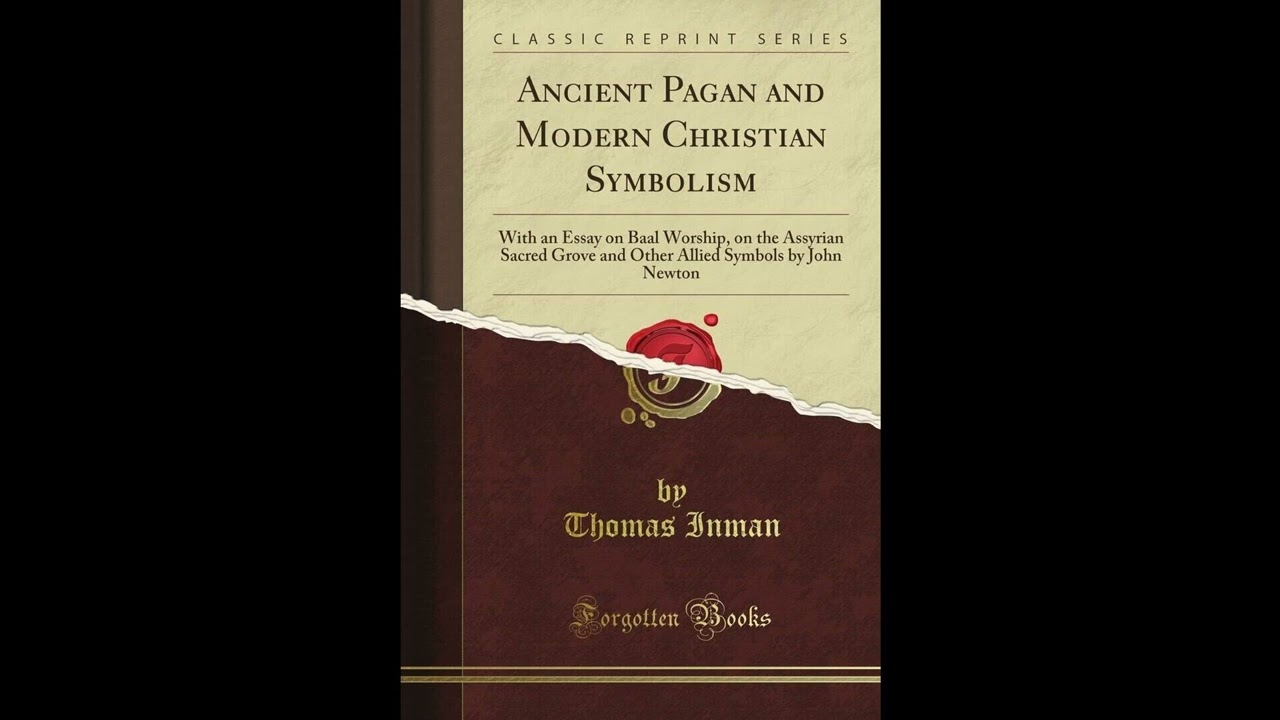
Ancient Pagan and Modern Christian Symbolism: With an Essay on Baal Worship- Full Audiobook
Have you ever considered the true meaning behind the symbols that permeate our daily lives, from the ancient world to the present day? Ancient Pagan and Modern Christian Symbolism: With an Essay on Baal Worship offers a profound invitation to look beyond the surface, to uncover the hidden connections and surprising continuities between seemingly disparate belief systems. This seminal text challenges assumptions about originality and influence in religious iconography, revealing how powerful visual motifs and conceptual frameworks migrated, evolved, and were reinterpreted across millennia and cultures. It asks listeners to ponder the universal impulse to symbolize and how those ancient expressions continue to shape our understanding of the divine, making it an essential listen for anyone curious about the deeper currents flowing beneath the surface of religious history and human consciousness. The central argument of this insightful work unfolds systematically, beginning with an examination of widely recognized religious emblems. Listeners are guided through an intellectual landscape where familiar shapes and figures — the cross, the halo, the fish, the serpent — are stripped of their conventional interpretations and traced back to their earliest known appearances in pre-Christian civilizations. The text meticulously presents evidence from ancient Egypt, Greece, Rome, and various Eastern traditions, juxtaposing their symbolic representations with those later adopted or adapted by Christianity. This careful comparison establishes a compelling narrative thread, suggesting that many elements we consider uniquely "modern" or "Christian" possess deep roots in pagan antiquity. As the narrative progresses, the focus sharpens on specific categories of symbols, such as those related to celestial bodies, fertility rites, and the cycles of nature. The "story" here is the revelation of interconnectedness, as the argument builds, linking seemingly independent religious practices through shared symbolic language. The book culminates in a detailed essay on Baal worship, using this specific ancient cult as a comprehensive case study. It demonstrates how certain symbolic tropes associated with Baal—a deity often demonized in later monotheistic traditions—nevertheless found subtle echoes or direct parallels in subsequent religious expressions. This section offers a particularly concentrated look at how a foundational understanding of ancient practices can illuminate the complex, often obscured, origins of later religious thought and custom, without fully revealing every specific conclusion drawn. While the author of this particular edition remains uncredited, the work itself stands as a significant contribution to the broader field of comparative mythology and religious studies, likely originating from the late nineteenth or early twentieth century. This period was a time of immense intellectual ferment, marked by a burgeoning scientific approach to understanding human culture and belief systems. Scholars during this era—often drawing upon newly translated ancient texts and archaeological discoveries—sought to categorize, compare, and explain the origins of religious phenomena in a systematic way. This book reflects that spirit of inquiry, belonging to a tradition of scholarship that includes figures who meticulously documented the similarities between diverse mythologies and ritual practices, laying groundwork for future anthropological and historical studies of religion. It has earned its place as a classic because it exemplifies a particular mode of academic investigation into the shared foundations of human spirituality. One of the prominent themes running through Ancient Pagan and Modern Christian Symbolism is the concept of religious syncretism, or the blending of different religious beliefs and practices. For instance, the text might meticulously detail how the solar disc, a central symbol in ancient Egyptian and Mesopotamian worship, gradually transformed or influenced the iconography surrounding divine figures in subsequent Roman or early Christian art, suggesting a continuity in the veneration of light and life-giving power. Another crucial theme is the universality of human spiritual experience; despite vast geographical and temporal distances, certain core human needs—for protection, fertility, understanding the cosmos—manifest in remarkably similar symbolic expressions across disparate cultures. The careful examination of an emblem like the tree of life, found in mythologies from Sumeria to the Norse sagas, illustrates this fundamental shared symbolic language, even if the specific deities or narratives change. This work emerged during a fascinating epoch in intellectual history, a time when increasing global contact and the academic rigor of the burgeoning sciences spurred scholars to look beyond traditional theological explanations for religious origins. The Victorian and Edwardian eras witnessed an intense public and academic fascination with anthropology, archaeology, and the comparative study of religion. Figures like James George Frazer, with his monumental The Golden Bough, exemplified this drive to uncover the common threads linking human myth and ritual across cultures. Imperial expansion had brought Western scholars into closer contact with a vast array of non-European belief systems, challenging established notions of religious uniqueness and progress. This created an environment ripe for a text that would systematically dissect and compare the symbolic languages of ancient paganism and modern Christianity, reflecting a broader societal shift towards a more critical and comparative understanding of religious history. Listening to Ancient Pagan and Modern Christian Symbolism as an audiobook offers a singular opportunity to absorb its complex arguments and detailed examples. With several hours of narration, it allows for a sustained, immersive experience, where the carefully constructed parallels and historical derivations can truly sink in. The pacing of the narration often lends itself to thoughtful reflection, providing space to consider the implications of each symbolic comparison presented. A clear, articulate voice guiding listeners through the dense historical and comparative material makes the potentially challenging subject matter accessible. Listeners can fully concentrate on the interconnectedness of ideas and images, freeing their eyes to ponder the visual evidence described, fostering a deeper engagement with the profound questions the text poses about the origins and transformations of human belief.
Enjoyed Ancient Pagan and Modern Christian Symbolism: With an Essay on Baal Worship- Full Audiobook? A few ways to support us
Audible & Amazon links are affiliate; we may earn a small commission at no extra cost.
About this production
Human narration by a volunteer reader from LibriVox.org, the public-domain audiobook project. LibriVox volunteers record literary works whose copyright has expired in the United States, releasing the resulting recordings into the public domain.
Ancient Pagan and Modern Christian Symbolism: With an Essay on Baal Worship- Full Audiobook by Thomas Inman. The underlying text is in the U.S. public domain. We do not republish any modern copyrighted edition, translation, or commentary.
The 4K cinematic visuals accompanying this audiobook are generated by an AI image model from prompts derived from the source text. No copyrighted photos, paintings, or stock footage are used. AI generation is disclosed on every video on our YouTube channel as required by YouTube's altered/synthetic content policy.
English subtitles are transcribed from the LibriVox recording with OpenAI Whisper. Translations into the 11 other supported languages are produced by Meta's NLLB-200 neural translation model. No human translator's copyrighted translation is used.
Questions about sourcing or rights? See our DMCA & Sourcing policy or contact us.
Enjoyed this audiobook?
If you'd like to own a copy of Ancient Pagan and Modern Christian Symbolism: With an Essay on Baal Worship- Full Audiobook or hear a professionally produced edition, the links below help support free audiobook production at no extra cost to you.
As an Amazon Associate we earn from qualifying purchases. Audible / print links are affiliate.