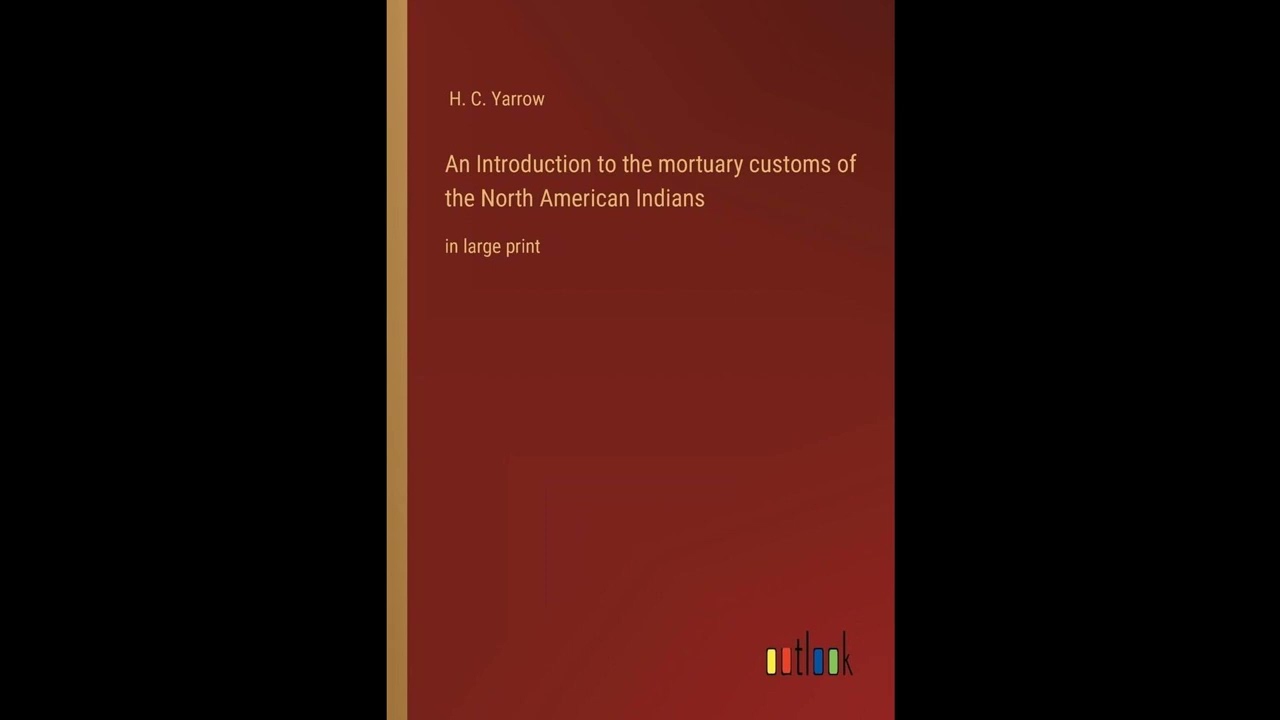
An Introduction to the mortuary customs of the North American Indians
Among the vast libraries of human inquiry, some books stand as essential cornerstones, laying the groundwork for entire fields of study. H. C. Yarrow's "An Introduction to the mortuary customs of the North American Indians" is precisely such a text, a foundational ethnographic survey that, even today, offers a compelling window into the profound diversity of Indigenous cultures and their approaches to the ultimate human mystery: death. This isn't merely a dusty historical artifact; it is a meticulously compiled compendium, now brought to life through audio, which challenges listeners to look beyond simplistic narratives and to appreciate the intricate beauty and logical coherence of belief systems vastly different from their own. Its continued relevance lies in its power to inform our understanding of anthropology, cultural preservation, and the universal human quest to make sense of mortality, offering a perspective as vital now as when it was first penned. This extraordinary volume unfolds not as a traditional story with a linear plot, but as a grand, continent-spanning investigation, presenting a comprehensive account of Indigenous American responses to death and mourning. The "setting" is the entirety of North America, encompassing a multitude of nations and linguistic groups, each contributing to a collective understanding of human experience. Yarrow takes the listener on a systematic survey, moving from the general principles underpinning various mortuary rites to specific, illustrative examples drawn from dozens of different tribal groups. He details everything from the initial treatment of the deceased—including burial, cremation, and the less common practices of scaffold and tree interments—to the complex array of associated ceremonies, mourning rituals, and beliefs concerning the afterlife. What might be considered the "main characters" in this scholarly epic are the myriad Indigenous peoples themselves, whose distinct traditions are carefully cataloged and compared. Yarrow introduces the listener to the diverse methods of spirit appeasement, the often elaborate secondary burial practices, the keeping of relics or effigies, and the varying durations and expressions of grief. He acts as a diligent guide, presenting a panorama of human ingenuity and spiritual depth. The central "conflict," if one were to frame it as such, arises from the sheer scale of the observed cultural variations, juxtaposed against the shared human encounter with loss, and the challenge of accurately documenting these practices in a period of rapid societal change without imposing external biases. The arc of this "narrative" progresses from broad categorizations to vivid descriptions of specific rites, allowing the listener to perceive the underlying patterns of human thought while never losing sight of the distinctiveness of each cultural expression. The author, H. C. Yarrow, born Henry Crécy Yarrow in 1840, was a distinguished American surgeon and naturalist whose life trajectory led him from medicine to a significant career in ethnology. After serving with distinction as a surgeon during the American Civil War, Yarrow's scientific curiosity turned increasingly toward the natural world and, crucially, to the human cultures inhabiting it. He became associated with the U.S. Geographical Surveys West of the One Hundredth Meridian, often referred to as the Wheeler Survey, during which he gained firsthand experience observing and documenting Indigenous communities. This field experience proved formative, ultimately drawing him to the nascent field of American anthropology. Yarrow's professional dedication eventually found a prominent home within the Smithsonian Institution's Bureau of Ethnology (later the Bureau of American Ethnology), established in 1879. It was during his tenure there, working alongside pioneering figures like John Wesley Powell, that he synthesized years of personal observation and collected reports from other fieldworkers into the comprehensive study now presented. Published in 1880 as "Introduction to the Study of Mortuary Customs Among the North American Indians," his work solidified his place as an important early contributor to American ethnography. While he may not be a household name in the way of some later literary figures, Yarrow's meticulous documentation and systematic approach mark him as a key architect in the scientific study and preservation of Indigenous cultures, laying essential groundwork for future generations of anthropologists until his passing in 1929. Several core themes emerge with striking clarity throughout Yarrow's detailed survey, offering much more than a mere listing of practices. One prominent theme is the profound cultural diversity that existed among Native American nations, powerfully debunking any monolithic or simplistic view of Indigenous peoples. For instance, while some groups practiced rapid burial, often with utilitarian grave goods, others engaged in prolonged periods of mourning, secondary reburials, or complex scaffold burials where the deceased's remains were placed aloft. These specific examples highlight how death, a universal experience, was interpreted and managed through vastly different cultural lenses, demonstrating a rich array of human responses and spiritual beliefs across the continent. Another compelling theme centers on the universality of grief and the human desire for meaning in the face of mortality. Despite the widely varying customs – from the elaborate ceremonial burning of property among certain Plains tribes to the quiet, dignified interments in shell mounds along the coasts – a shared impulse to honor the dead, ease their transition, and comfort the living resonates throughout. The text also underscores the theme of cultural preservation and documentation, revealing the deep urgency of recording these practices at a time when many Indigenous lifeways were under immense pressure from westward expansion and federal policies. Yarrow's efforts, though framed within a late 19th-century scientific paradigm, inadvertently created an invaluable historical record, preserving details that might otherwise have been lost to time and circumstance. The late nineteenth century, the period when Yarrow compiled and published this groundbreaking work, was a time of immense change and academic ferment in the United States. Following the Civil War, the nation experienced rapid industrialization and aggressive westward expansion, leading to increased contact and conflict with Indigenous populations. Simultaneously, new scientific disciplines were emerging and solidifying, including anthropology and ethnology. Institutions like the Smithsonian's Bureau of Ethnology were specifically founded to collect, preserve, and study information about Native American cultures, driven by a mix of scientific curiosity, governmental interest in "managing" Indigenous affairs, and a dawning awareness that many traditional ways of life were rapidly transforming. Yarrow's book thus emerged from a nexus of scientific inquiry, national expansion, and a burgeoning desire to systematically document the diverse cultural landscapes of North America before, many feared, they might entirely disappear. Listening to "An Introduction to the mortuary customs of the North American Indians" as an audiobook offers a unique and particularly resonant experience. The narrator's clear, measured voice provides a sense of academic authority, guiding the listener through complex observations and comparative analyses without overwhelming the senses. With a run length of several hours, this audio presentation allows for an immersive, sustained engagement with the material, fostering a deeper understanding than a quick read might provide. Listen for the careful pacing, which allows ample time for reflection on the nuances of each custom described, and for the respectful tone that transforms what might otherwise be dry academic prose into an engaging historical and anthropological account. The auditory medium truly brings a sense of immediacy and presence to Yarrow's meticulous observations, making this vital historical document accessible and thought-provoking for a contemporary audience.
Enjoyed An Introduction to the mortuary customs of the North American Indians? A few ways to support us
Audible & Amazon links are affiliate; we may earn a small commission at no extra cost.
About this production
Human narration by a volunteer reader from LibriVox.org, the public-domain audiobook project. LibriVox volunteers record literary works whose copyright has expired in the United States, releasing the resulting recordings into the public domain.
An Introduction to the mortuary customs of the North American Indians by H C Yarrow. The underlying text is in the U.S. public domain. We do not republish any modern copyrighted edition, translation, or commentary.
The 4K cinematic visuals accompanying this audiobook are generated by an AI image model from prompts derived from the source text. No copyrighted photos, paintings, or stock footage are used. AI generation is disclosed on every video on our YouTube channel as required by YouTube's altered/synthetic content policy.
English subtitles are transcribed from the LibriVox recording with OpenAI Whisper. Translations into the 11 other supported languages are produced by Meta's NLLB-200 neural translation model. No human translator's copyrighted translation is used.
Questions about sourcing or rights? See our DMCA & Sourcing policy or contact us.
Enjoyed this audiobook?
If you'd like to own a copy of An Introduction to the mortuary customs of the North American Indians or hear a professionally produced edition, the links below help support free audiobook production at no extra cost to you.
As an Amazon Associate we earn from qualifying purchases. Audible / print links are affiliate.