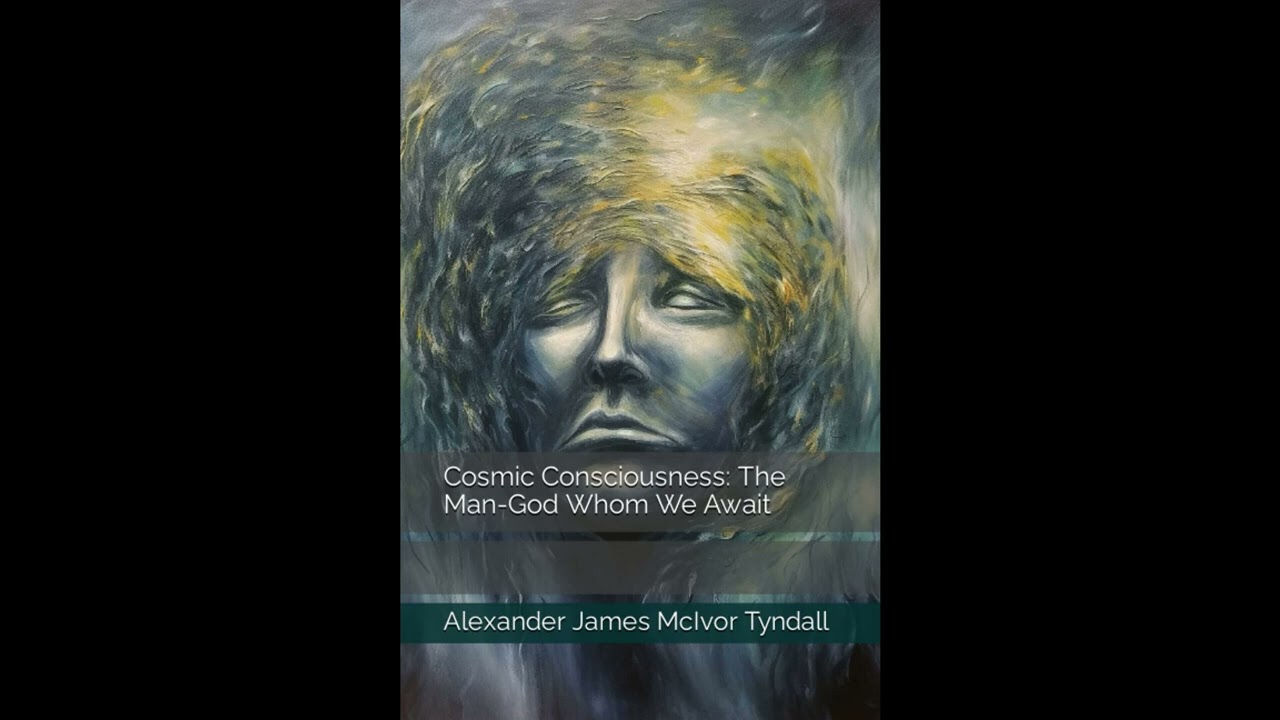
Cosmic Consciousness: The Man-God Whom We Await
What if humanity’s ultimate destiny isn’t just technological advancement or social reform, but a profound internal transformation, a leap in consciousness that redefines our very existence? Alexander James McIvor Tyndall’s "Cosmic Consciousness: The Man-God Whom We Await" stands as a foundational text in the perennial human quest to understand our fullest potential. This isn't a theological treatise in the conventional sense, nor a simple self-help manual. Instead, it’s a rigorous, often daring, intellectual expedition into the nature of awareness itself, proposing that there exists a higher state of consciousness—a "Cosmic Consciousness"—accessible to humanity, capable of integrating knowledge, empathy, and a profound sense of unity. Listeners today will find its arguments startlingly relevant as we navigate an increasingly complex world, grappling with questions of identity, purpose, and the future of human evolution. McIvor Tyndall begins by carefully outlining what he considers ordinary human consciousness, the familiar realm of ego, perception through the five senses, and intellectual reasoning. He establishes this baseline to then present a stark contrast, introducing the concept of Cosmic Consciousness as a qualitatively different state. His intellectual exposition then unfolds by presenting evidence and characteristics of this elevated awareness. He doesn't merely theorize; he meticulously constructs his argument by drawing upon a variety of sources and examples, analyzing individuals throughout history whom he believes exhibited traits of this higher state. The book is not a narrative of fictional characters, but rather an argumentative progression, where the primary "players" are human consciousness itself, and the historical figures McIvor Tyndall brings forward to illustrate his points. The central intellectual challenge the work presents is a fundamental re-evaluation of what it means to be fully human. McIvor Tyndall systematically defines the attributes of Cosmic Consciousness, portraying it not as a mystical, unreachable ideal, but as a natural, albeit extraordinary, next stage in human mental evolution. He meticulously differentiates it from simple genius, prophetic visions, or religious ecstasy, highlighting its unique qualities of enlightenment, moral elevation, and an overwhelming sense of the interconnectedness of all things. The progression of his argument aims to persuade the reader that this "man-god"—a symbol for humanity's ultimate, perfected self—is not a distant deity, but an inherent potential within each individual, waiting to be awakened. While specific biographical details regarding Alexander James McIvor Tyndall remain somewhat elusive, his written legacy in "Cosmic Consciousness" firmly places him as a significant voice within a distinct intellectual current. He was clearly a thinker deeply engaged with the philosophical and psychological inquiries of his period, possessing a voracious appetite for synthesizing diverse fields of knowledge. His approach suggests a mind keenly interested in the intersection of spiritual revelation, scientific observation, and human psychology. One can infer a life dedicated to study and contemplation, driven by an overarching curiosity about the boundaries of human experience and potential. McIvor Tyndall’s intellectual work is characterized by a bold willingness to challenge conventional understanding and propose radical new frameworks for interpreting human consciousness. He can be seen as operating in a sphere alongside other independent scholars and spiritual philosophers who sought to move beyond purely materialistic explanations for life. His method, which blends analytical rigor with profound spiritual insights, distinguishes him as a serious proponent for an expansive view of human capabilities, leaving behind a legacy that continues to resonate with those seeking deeper meaning and understanding. "Cosmic Consciousness" acts out several profound themes. Foremost is the evolution of consciousness, portraying human development not as solely biological, but as possessing a mental and spiritual trajectory leading to a grander state of awareness. McIvor Tyndall illustrates this by contrasting the limitations of ordinary ego-centric perception with the expansive, integrated understanding of Cosmic Consciousness, suggesting a species-wide awakening as a natural next step. Another key theme is the concept of unity and interconnectedness. The book posits that achieving this higher state reveals a fundamental coherence underlying all existence, where individual perception merges with an awareness of the universal. For instance, he describes individuals experiencing Cosmic Consciousness as suddenly grasping profound truths about the universe without prior learning, feeling a deep, empathetic connection to all beings, and perceiving reality as a harmonious whole rather than disparate parts. A third central theme is human potential and inherent divinity. McIvor Tyndall asserts that the capacity for this elevated consciousness is not an external gift but an intrinsic quality within humanity, a latent power waiting to be unlocked. This isn't about worshipping external gods, but recognizing the "god-like" capacities of wisdom, love, and creative power within ourselves, thereby transforming the individual into a more complete, enlightened being. The book, therefore, serves as a powerful testament to the boundless capabilities of the human spirit, urging a reconsideration of our perceived limitations and inspiring a reach for higher states of being. This seminal work emerged during a fascinating period characterized by immense change and profound intellectual ferment. The late nineteenth and early twentieth centuries saw significant advancements in science and technology, which simultaneously spurred both a growing scientific materialism and, as a counter-current, an intense yearning for spiritual understanding. Movements like New Thought, Theosophy, and an increased interest in various forms of spiritualism and Eastern philosophies gained traction, all seeking to reconcile the scientific understanding of the physical world with the perennial human search for meaning and transcendence. Against this backdrop, works like "Cosmic Consciousness" provided intellectual frameworks for understanding spiritual experiences and human potential outside traditional religious dogma. They offered a vision of human evolution that went beyond Darwinian biology, suggesting a parallel development of the mind and spirit. McIvor Tyndall’s book, therefore, stands as a testament to the era's intellectual boldness—a period where thinkers wrestled with the implications of an expanding universe, re-examining humanity’s place within it, and daring to imagine a future shaped by inner transformation. Listening to "Cosmic Consciousness" as an audiobook offers a unique and intimate way to engage with its complex ideas. The sustained run length of several hours allows for a deep, uninterrupted immersion into McIvor Tyndall's carefully constructed arguments, encouraging a contemplative state often elusive in a fast-paced world. A skilled narrator, with a calm and measured voice, can truly illuminate the nuanced distinctions and profound insights presented in the text, allowing listeners to absorb the philosophical points without the visual distraction of reading. The pacing of the spoken word can enhance the contemplative atmosphere, giving listeners space to ponder each concept, making the intellectual arc of the book feel less like an academic study and more like an unfolding revelation. The spoken presentation fosters a personal connection to the work, turning McIvor Tyndall’s philosophical inquiry into a resonant, internal experience.
Enjoyed Cosmic Consciousness: The Man-God Whom We Await? A few ways to support us
Audible & Amazon links are affiliate; we may earn a small commission at no extra cost.
About this production
Human narration by a volunteer reader from LibriVox.org, the public-domain audiobook project. LibriVox volunteers record literary works whose copyright has expired in the United States, releasing the resulting recordings into the public domain.
Cosmic Consciousness: The Man-God Whom We Await by Alexander James McIvor Tyndall. The underlying text is in the U.S. public domain. We do not republish any modern copyrighted edition, translation, or commentary.
The 4K cinematic visuals accompanying this audiobook are generated by an AI image model from prompts derived from the source text. No copyrighted photos, paintings, or stock footage are used. AI generation is disclosed on every video on our YouTube channel as required by YouTube's altered/synthetic content policy.
English subtitles are transcribed from the LibriVox recording with OpenAI Whisper. Translations into the 11 other supported languages are produced by Meta's NLLB-200 neural translation model. No human translator's copyrighted translation is used.
Questions about sourcing or rights? See our DMCA & Sourcing policy or contact us.
Enjoyed this audiobook?
If you'd like to own a copy of Cosmic Consciousness: The Man-God Whom We Await or hear a professionally produced edition, the links below help support free audiobook production at no extra cost to you.
As an Amazon Associate we earn from qualifying purchases. Audible / print links are affiliate.