A Voyage to Arcturus
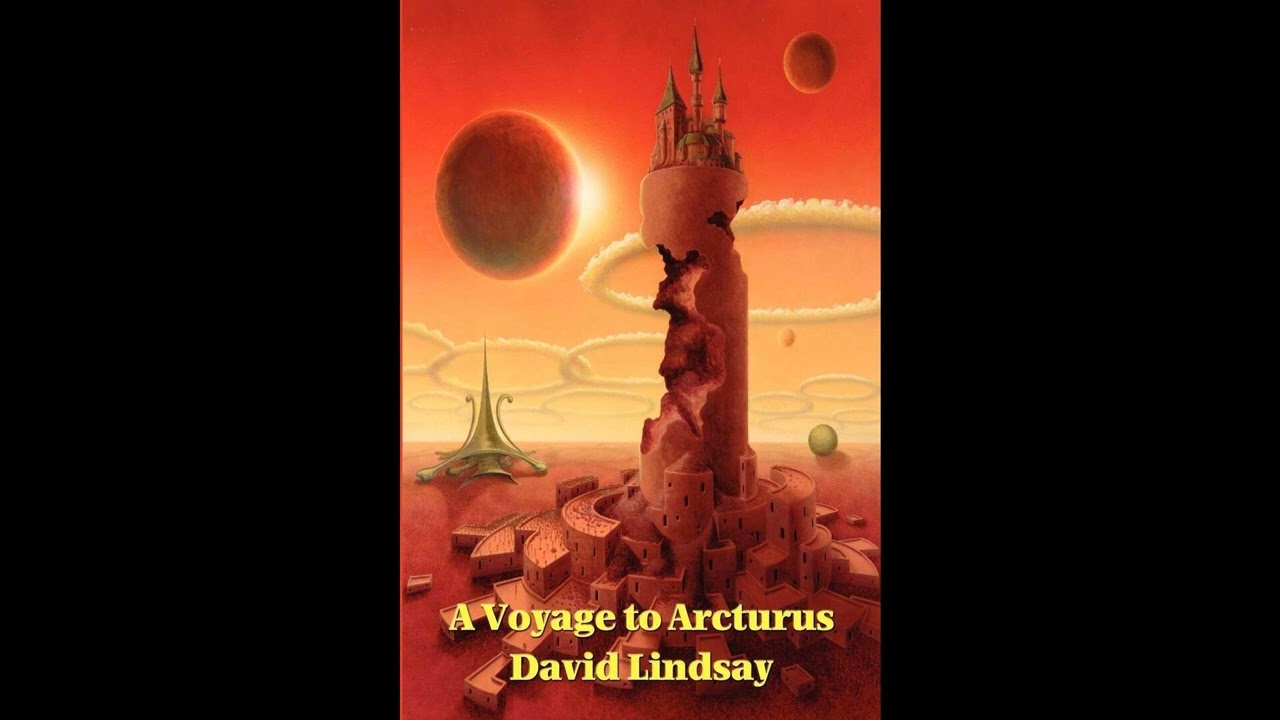
Step into a realm unlike any other, where the very fabric of reality bends to a singular, relentless quest for meaning. David Lindsay’s A Voyage to Arcturus, first published in 1920, stands as a literary comet, blazing a unique trail across the firmament of speculative fiction and philosophical fantasy. It is not merely a story but an experience—a demanding, dazzling, and ultimately profound expedition into the deepest questions of existence, good, and evil. For a listener today, this novel offers a thrilling challenge to conventional thought, pushing the boundaries of imagination and delivering a narrative so original it feels as fresh and unsettling as when it first appeared, beckoning those who crave literature that dares to confront the absolute. Our story begins in a relatively mundane English setting, as a curious young man named Maskull attends a seance. An inexplicable force draws him and a mysterious companion, Nightspore, aboard a fantastical, transparent boat that then rockets them across the vast expanse of interstellar space. Their destination: Tormance, a planet orbiting the double star Arcturus. From the moment Maskull sets foot on this alien world, the familiar dissolves. Tormance is a place of breathtaking, often terrifying, strangeness, where the very landscape—its colors, its flora, its geological formations—defies earthly logic. The suns, Alppain and Muspel, cast shifting, dualistic light, shaping not only the environment but also the philosophical underpinnings of the beings Maskull encounters. Maskull's passage across Tormance is a relentless series of encounters and transformations. He meets a succession of extraordinary beings, each with unique physiological characteristics and corresponding philosophies. These individuals, from the gentle Joiwind to the fierce Oceaxe, challenge Maskull’s every preconception about morality, perception, and purpose. As he moves from one bizarre situation to the next, Maskull undergoes startling physical changes himself—developing new organs that grant him entirely different sensory perceptions, often at the cost of his previous ones. These transformations are not arbitrary; they are crucial to his understanding, or misunderstanding, of Tormance’s fundamental truths and the omnipresent, enigmatic figure known as Crystalman, whose influence seems to permeate the entire planet, distorting all life with a pervasive, beautiful illusion. Maskull’s driving motivation becomes the search for Muspel, the true source of light, a force he believes holds the key to the ultimate revelation, hoping to pierce through the pervasive illusions and reach genuine understanding. David Lindsay, the singular mind behind this creation, was born in London in 1876. He lived a life marked by quietude and an inner intensity that belied his outward existence. For many years, he worked as an insurance clerk, a profession far removed from the cosmic dramas he would later pen. It was only in his later years that his literary career truly began. Remarkably, at the age of 40, he volunteered for service in World War I, enduring the horrors of the trenches, an experience that undoubtedly shaped his worldview, imbuing his subsequent fiction with a deep sense of moral urgency and a confrontation with the darker aspects of human, or alien, nature. After the war, he moved to Cornwall with his wife, where he dedicated himself to writing. Despite his genius, Lindsay remained largely unknown during his lifetime, with A Voyage to Arcturus being his most recognized work, though even that initially found only a small, dedicated readership. He wrote several other novels, including The Haunted Ranche and Devil's Tor, each bearing his distinctive stamp of philosophical speculation and a keen interest in the supernatural, but none achieved the cult status of Arcturus. He passed away in 1945, leaving behind a body of work that would slowly, over decades, gain recognition for its originality and profound influence. Lindsay is a difficult author to categorize, sitting somewhat outside conventional literary movements, yet he is recognized as a significant precursor to modern science fiction, a practitioner of philosophical fantasy, and a writer whose vision profoundly affected authors like C.S. Lewis, J.R.R. Tolkien, and later, Philip K. Dick, cementing his unique place in the canon as a bold visionary. One of the central themes permeating A Voyage to Arcturus is the nature of reality and perception. Tormance is a planet where senses are not fixed but fluid, where new organs literally grant new understandings of the world. For example, Maskull develops a third eye on his forehead that allows him to perceive unseen light and energy fields, or a pair of breasts on his chest that are not for nourishment but for sensing fundamental vibrations and emotional states. Each new sense reorients his entire worldview, demonstrating how deeply our understanding of truth is tied to our physiology and the filters through which we experience the cosmos. Another dominant theme is dualism, specifically the eternal struggle between good and evil, personified by the radiant Muspel and the deceptive Crystalman. Characters on Tormance constantly grapple with these opposing forces, often without fully comprehending their origins or true nature, reflecting Maskull’s own internal battles and his relentless drive to distinguish genuine goodness from seductive illusion. This brings us to the themes of identity and self-transformation. Maskull’s physical alterations are not merely cosmetic; they fundamentally change who he is, challenging the very notion of a stable, consistent self. He sheds one identity after another, each transformation accompanied by a new perspective and often a tragic loss. This constant flux underscores the idea that identity is not a fixed point but a continuous, often painful, process of becoming. Finally, the book is a relentless philosophical inquiry into the meaning of life, suffering, and the purpose of existence. Through Maskull’s dialogues with the various inhabitants of Tormance—who represent distinct philosophical positions ranging from hedonism to stoicism, from nihilism to a form of spiritual purity—Lindsay stages a grand intellectual drama. The strange landscape itself, with its peculiar trees that sing and its alien creatures, becomes a physical manifestation of these abstract ideas, drawing the listener into an almost psychedelic debate on the very foundations of being. A Voyage to Arcturus was published in 1920, emerging from the turbulent aftermath of World War I. This was a period of profound cultural and political upheaval, marked by widespread disillusionment with established institutions, a questioning of traditional religious beliefs, and a deep skepticism towards scientific progress that had, after all, facilitated unprecedented destruction. The Victorian era’s certainties had crumbled, giving rise to modernism in the arts and a fervent interest in spiritualism, mysticism, and various esoteric philosophies as people sought new frameworks for understanding a shattered world. Lindsay's novel, with its questioning of reality, its stark dualism, and its spiritual quest, reflects these profound societal anxieties and the yearning for transcendent meaning in an age of confusion. It arrived as a bold statement in a literary landscape that was just beginning to grapple with the possibilities of speculative fiction, positioning itself as a visionary work that channeled the era's intellectual ferment into an intensely personal and cosmic narrative. Listening to A Voyage to Arcturus as an audiobook offers a singular opportunity to fully immerse oneself in its dense, often challenging prose and its extraordinary vision. The narrative’s dreamlike quality, its complex philosophical discussions, and its numerous, uniquely named characters are particularly well-suited to the spoken word. A skilled narrator can guide the listener through Lindsay’s elaborate descriptions of Tormance's alien landscapes and its bizarre inhabitants, using subtle shifts in voice and pacing to distinguish between the many characters and their distinct, sometimes contradictory, worldviews. The run length, several hours long, allows for a substantial, uninterrupted engagement with the material, making it ideal for thoughtful listening during commutes, quiet evenings, or dedicated study. Hearing the lyrical yet precise language, the nuanced dialogue, and the pervasive, otherworldly atmosphere brought to life by a human voice can significantly enhance the experience, allowing the philosophical weight and imaginative power of Lindsay’s creation to resonate with even greater depth and clarity.
Enjoyed A Voyage to Arcturus? A few ways to support us
Audible & Amazon links are affiliate; we may earn a small commission at no extra cost.
About this production
Human narration by a volunteer reader from LibriVox.org, the public-domain audiobook project. LibriVox volunteers record literary works whose copyright has expired in the United States, releasing the resulting recordings into the public domain.
A Voyage to Arcturus by David Lindsay. The underlying text is in the U.S. public domain. We do not republish any modern copyrighted edition, translation, or commentary.
The 4K cinematic visuals accompanying this audiobook are generated by an AI image model from prompts derived from the source text. No copyrighted photos, paintings, or stock footage are used. AI generation is disclosed on every video on our YouTube channel as required by YouTube's altered/synthetic content policy.
English subtitles are transcribed from the LibriVox recording with OpenAI Whisper. Translations into the 11 other supported languages are produced by Meta's NLLB-200 neural translation model. No human translator's copyrighted translation is used.
Questions about sourcing or rights? See our DMCA & Sourcing policy or contact us.
Enjoyed this audiobook?
If you'd like to own a copy of A Voyage to Arcturus or hear a professionally produced edition, the links below help support free audiobook production at no extra cost to you.
As an Amazon Associate we earn from qualifying purchases. Audible / print links are affiliate.