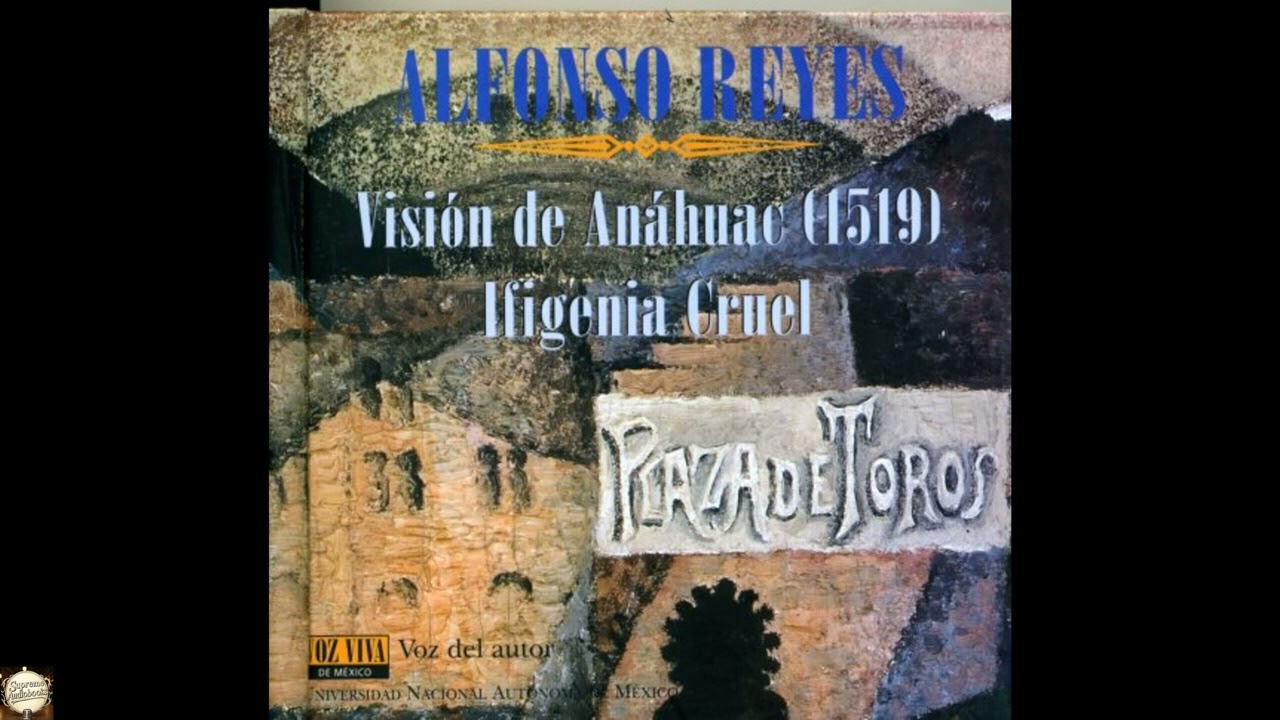
Visión de Anáhuac (1519) Alfonso Reyes
Alfonso Reyes’s Visión de Anáhuac (1519) is not merely a historical account; it is a profound meditation on the birth of modern Mexico, a lyrical prose poem that transports the listener to a pivotal moment in human history. Published in 1917, this seminal work reflects on the Valley of Mexico just as Hernán Cortés and his conquistadors stood on its periphery in 1519, poised to irrevocably alter its destiny. It is a work that asks us to consider how history is perceived, how a landscape holds memory, and how identity is forged in the crucible of conquest and cultural collision. For anyone seeking to understand the complex origins of Mexican identity, the enduring legacy of indigenous civilizations, or simply to witness a writer at the zenith of his craft, Reyes offers a window into a world both ancient and eternally relevant. Its reflections on change, heritage, and the meeting of worlds speak with startling clarity to our own age of global transformation. The book unfurls as an imagined panoramic view from the heights surrounding the Valley of Mexico, much as Cortés himself might have beheld it for the first time. From this vantage point, Reyes—through his elegant prose—reconstructs the sprawling majesty of Tenochtitlan, the capital of the Aztec Empire, often referred to as Anáhuac. The central character here is the valley itself: a shimmering expanse of lakes, crisscrossed by canals, dotted with thriving island cities, and framed by towering volcanoes like Popocatépetl and Iztaccíhuatl. We are introduced to a civilization at its peak, observing its intricate social structures, its advanced urban planning, its profound cosmology, and the daily rhythms of its people. Reyes brings to life the markets, the temples, the causeways, and the bustling life of a metropolis that rivaled any in Europe, all built upon a sophisticated understanding of engineering and astronomy. The conflict, though not a traditional narrative confrontation, resides in the impending clash between this highly developed indigenous world and the technologically superior, ideologically driven European invaders. Reyes meticulously details the signs and portents, the myths and prophecies that permeated the indigenous consciousness—a sense of an ending, a premonition of radical change. The book’s arc moves from a pristine, almost Edenic vision of Anáhuac, through the subtle, gathering storm clouds of European arrival, to the moment of contact. It is a vision steeped in a reverence for what was, contemplating the fragile beauty of a civilization unaware of the cataclysm about to descend, pausing just before the irreversible moment when two worlds, previously unknown to each other, collide with devastating force. Alfonso Reyes (1889-1959) was one of Mexico's most eminent men of letters, a polymath whose influence extended across poetry, essay, literary criticism, and diplomacy. Born in Monterrey, Nuevo León, he was the son of General Bernardo Reyes, a powerful political figure during the Porfiriato era and a significant player in the early years of the Mexican Revolution. This familial background provided Reyes with a unique perspective on his nation's political upheavals, a theme he often subtly addressed in his intellectual output. Educated in Mexico City, he was a key member of the "Ateneo de la Juventud," a group of young intellectuals who, in the early 20th century, championed a return to classical and humanistic studies, rejecting the prevailing positivism of their time. Reyes’s career saw him serve as a diplomat in Spain, France, Brazil, and Argentina, periods that profoundly shaped his cosmopolitan outlook and broadened his literary horizons. Despite his extensive time abroad, his intellectual heart remained firmly rooted in Mexico, constantly seeking to understand its identity and place in the world. His prolific output includes works like the poetic drama Ifigenia cruel (1924), the theoretical essay La experiencia literaria (1942), and the critical study El deslinde: Prolegómenos a la teoría literaria (1944). He perfected the genre of the short essay, infusing it with poetic sensibility and historical insight, earning him a reputation as a stylist of the highest order and a central figure in 20th-century Latin American literature. Visión de Anáhuac enacts several crucial themes, foremost among them the question of Mexican identity. Reyes does not simply recount history; he participates in a national introspection, seeking the roots of a complex mestizo identity in the clash of indigenous grandeur and European imposition. One vivid example is his depiction of the indigenous peoples' profound connection to their land and cosmos, visible in their architecture and rituals. He shows how their sense of belonging was not merely territorial but spiritual, setting the stage for how this connection would be irrevocably altered. Another significant theme is the power of language and literature to preserve and interpret the past. Reyes’s precise, evocative prose resurrects a lost world, demonstrating how writing can reconstruct fragmented memories and articulate the inexpressible grief and wonder of historical change. A further theme is the concept of history as a living entity, not a static collection of facts. Reyes presents the past as something that continues to shape the present, a palpable presence in the landscape and the collective consciousness. He illustrates this by describing the physical remains of ancient cultures, the very earth bearing witness to prior epochs, suggesting that the spirit of Anáhuac endures beneath layers of subsequent history. The aestheticization of conquest is also present; while acknowledging the brutality, Reyes often focuses on the sheer spectacle of the initial encounter, the cultural shock and awe, rather than the immediate violence. He uses precise imagery to convey the magnificent, if doomed, beauty of the pre-Hispanic world, presenting its downfall as a kind of epic tragedy rather than a mere historical event, thus grappling with the paradox of creation through destruction that characterizes the founding of New Spain. When Visión de Anáhuac was published in 1917, Mexico was still reeling from the tumultuous years of its Revolution. The country was deeply engaged in a period of self-definition, searching for a unifying national narrative amidst political instability and social upheaval. Intellectuals and artists were looking back to the nation's origins, particularly to its indigenous heritage, to forge a post-revolutionary identity that moved beyond the Eurocentric biases of the past. Reyes, though writing primarily from Madrid during his diplomatic posting, was acutely aware of this profound cultural moment. His membership in the Ateneo de la Juventud meant he was part of a movement that championed humanistic studies and a re-evaluation of Mexico's pre-Hispanic and colonial past. The work emerged from a specific need to reconcile the diverse strands of Mexican heritage—indigenous, European, and mestizo—into a coherent, proud identity. It was a period when the essay, as a literary form, gained immense prominence in Latin America, serving as a powerful vehicle for intellectual discourse, historical reflection, and cultural critique. Reyes’s Visión de Anáhuac perfectly captured this spirit, offering a meticulously researched yet deeply personal and poetic interpretation of Mexico's foundational trauma and triumph. It was an act of intellectual nation-building, creating a foundational text that offered both a lament for a lost world and a proud recognition of the enduring spirit that would shape a new one. Listening to Visión de Anáhuac as an audiobook offers a unique way to absorb the intellectual rigor and poetic beauty of Reyes's prose. Its "several hours" run length is perfectly suited for contemplative listening, allowing the listener to truly immerse themselves in the meticulously crafted vision. A skilled narrator can bring out the inherent musicality of Reyes’s Spanish, his precise word choices, and the rhythm of his sentences, transforming the reading experience into a meditative act. Pay close attention to the pacing, which often mirrors the solemn, reflective tone of the text, slowly building the landscape and atmosphere before introducing the moment of historical rupture. The narration becomes a guide, allowing the listener to fully appreciate the blend of historical detail and lyrical invention, making Reyes's profound observations resonate long after the final word is spoken.
Enjoyed Visión de Anáhuac (1519) Alfonso Reyes? A few ways to support us
Audible & Amazon links are affiliate; we may earn a small commission at no extra cost.
About this production
Human narration by a volunteer reader from LibriVox.org, the public-domain audiobook project. LibriVox volunteers record literary works whose copyright has expired in the United States, releasing the resulting recordings into the public domain.
Visión de Anáhuac (1519) Alfonso Reyes by Alfonso Reyes. The underlying text is in the U.S. public domain. We do not republish any modern copyrighted edition, translation, or commentary.
The 4K cinematic visuals accompanying this audiobook are generated by an AI image model from prompts derived from the source text. No copyrighted photos, paintings, or stock footage are used. AI generation is disclosed on every video on our YouTube channel as required by YouTube's altered/synthetic content policy.
English subtitles are transcribed from the LibriVox recording with OpenAI Whisper. Translations into the 11 other supported languages are produced by Meta's NLLB-200 neural translation model. No human translator's copyrighted translation is used.
Questions about sourcing or rights? See our DMCA & Sourcing policy or contact us.
Enjoyed this audiobook?
If you'd like to own a copy of Visión de Anáhuac (1519) Alfonso Reyes or hear a professionally produced edition, the links below help support free audiobook production at no extra cost to you.
As an Amazon Associate we earn from qualifying purchases. Audible / print links are affiliate.
More Audiobooks
Legends And Romances Of Spain (1920)
The Philippine Islands (Classic Books)
Mexico and Its Religion: With Incidents of Travel in That Country During Parts of th- Full Audiobook
Illustrated Catalogue Of The Collections Obtained From The Indians Of New Mexico An