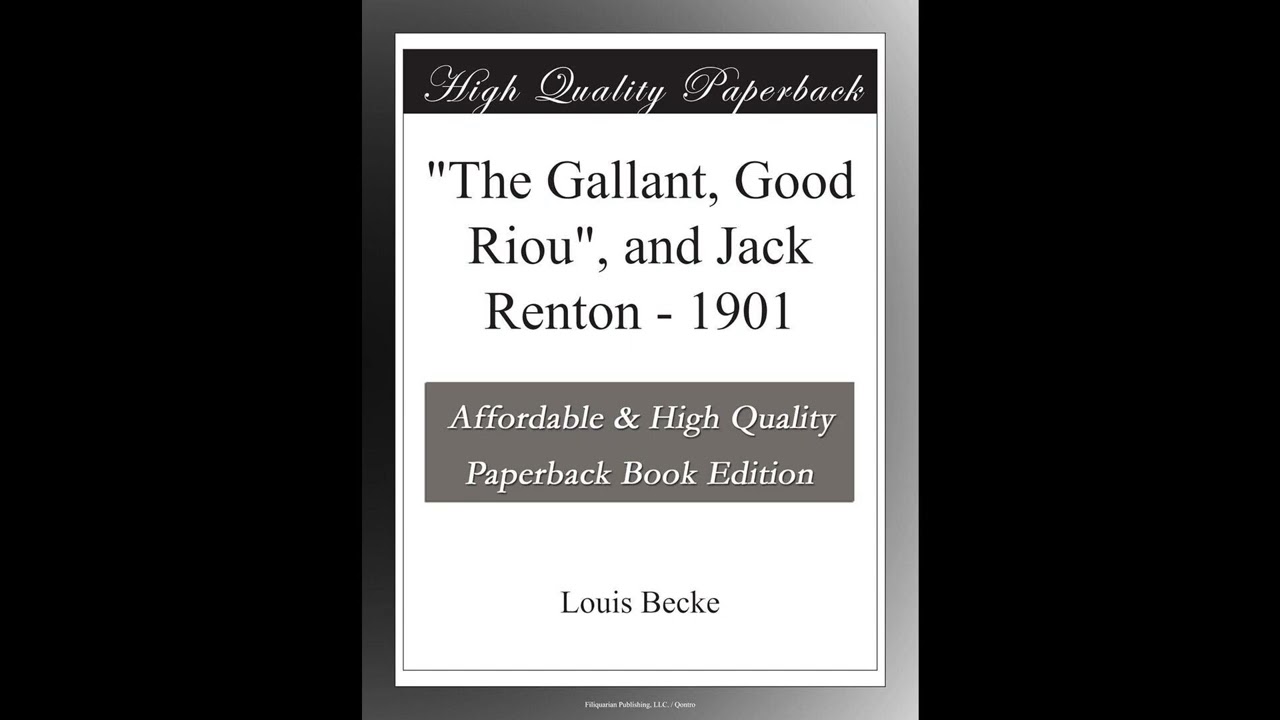
"The Gallant, Good Riou", and Jack Renton - 1901
The vast, shimmering expanse of the Pacific Ocean has long been a canvas for human drama—tales of survival, duty, and the collision of worlds. Louis Becke’s "The Gallant, Good Riou", and Jack Renton - 1901 draws from this rich history, presenting two compelling accounts of real men whose lives were shaped by the capricious nature of the sea and the remote islands it cradles. Far from simple adventure stories, these narratives offer a stark, unvarnished look at the realities of maritime life, the extraordinary courage demanded by desperate situations, and the often-fraught interactions between European seafarers and indigenous communities during a pivotal era of global expansion. To listen to these stories today is to step back into a world where vast distances and unforgiving elements tested the very limits of human endurance and ingenuity, reminding us of the enduring power of human spirit against overwhelming odds. The book unfurls across two distinct yet thematically linked narratives. The first recounts the remarkable ordeal of Captain Edward Riou, a figure of true British naval heroism. His story centers around the catastrophic damage sustained by HMS Guardian, a storeship under his command, after striking an iceberg in the South Atlantic in late 1789. The scene is set with vivid clarity: the ship, laden with provisions and convicts bound for the nascent colony of New South Wales, suffers a mortal blow to its hull. Riou, faced with a sinking vessel and a panicked crew, makes the agonizing decision to send away lifeboats while he and a skeleton crew remain behind, battling against impossible odds to save the ship. Their struggle against the encroaching sea, the failing pumps, and the demoralized spirits of the men forms the core of this gripping account, highlighting Riou's exceptional leadership and seamanship under the most dire circumstances. The second narrative introduces us to Jack Renton, a Scottish seaman whose life took an unexpected turn in the mid-19th century. Shipwrecked on a remote island in the Solomon chain, Renton found himself stranded among an indigenous community with vastly different customs and a language he didn't understand. His initial struggle for survival slowly gives way to a long period of adaptation, as he learns the local ways, participates in daily life, and navigates the complex social structures of his new hosts. Becke meticulously details Renton's day-to-day existence, the challenges of integration, and his longing for return to his own world. This account is less about naval heroics and more about the quiet, persistent resilience of an individual forced to make a life in an entirely alien environment, offering a rare glimpse into the intimate details of cultural exchange and personal transformation. The author, Louis Becke, born George Lewis Becke in Port Macquarie, Australia in 1855, was uniquely positioned to tell such tales. Becke spent the better part of his young adult life—from his late teens through his mid-thirties—immersed in the very world he wrote about. He served as a supercargo, a trader, and a recruiter across the vast island networks of the South Pacific, including parts of the Solomon Islands, Samoa, and Micronesia. This direct, often gritty, experience shaped his entire literary output. Unlike many of his contemporaries who might have relied on second-hand accounts or romanticized notions of the exotic, Becke wrote with an unparalleled authenticity, drawing from personal observations, the stories of those he met, and his own lived struggles with the sea, islanders, and colonial commerce. Becke's literary career truly took off in the 1890s, catalyzed by the encouragement of Robert Louis Stevenson, whom he met in Samoa. He published prolifically, with works like By Reef and Palm, The Ebbing of the Tide, and Pacific Tales establishing him as the preeminent chronicler of the South Seas during this period. He passed away in Sydney in 1913. His work occupies a significant, if often underappreciated, place in the canon of Australian and Pacific literature. He is considered a crucial realist voice, depicting the harsh realities of colonial life, the complexities of indigenous cultures, and the often brutal conditions faced by sailors and traders, standing apart from the more romanticized adventure writers of his time due to his deep, firsthand knowledge. Central to both Riou's and Renton's stories are profound themes of survival and human resilience. Riou’s steadfast command of the sinking Guardian exemplifies the will to live and the refusal to yield even when surrounded by despair and a disintegrating vessel. His decision to remain with the dying ship and his subsequent success in keeping it afloat for weeks, nursing it back towards civilization, is a testament to extraordinary human grit. Similarly, Renton's ability to not only survive shipwreck but to adapt to, and eventually thrive within, a foreign culture for an extended period highlights the remarkable flexibility of the human spirit when faced with isolation and the complete disruption of one’s known world. His journey underscores the inherent drive to connect and adapt. Another prominent theme is that of duty and leadership, particularly evident in Riou’s narrative. His unwavering commitment to his ship and crew, even when confronted by mutinous whispers and the overwhelming force of nature, portrays a powerful ideal of naval command. He leads not just by order, but by example, his calm resolve inspiring those around him to continue the seemingly hopeless fight. Conversely, Renton's story, while less about command, illuminates the theme of cultural clash and adaptation. His transformation from a castaway to an integrated member of a tribal society—learning their language, customs, and even participating in their conflicts—provides a nuanced perspective on the intricate dance between differing ways of life and the capacity for individuals to bridge vast cultural divides. Published in 1901, Becke’s narratives emerge from a specific historical moment at the dawn of the 20th century. This was a period when the British Empire still commanded vast global influence, though the Age of Sail was steadily giving way to steam. There was a burgeoning public appetite for tales of exploration, distant lands, and the heroism of maritime endeavor. Becke's work tapped into this interest, but with a grounded realism that often countered the more romanticized or purely jingoistic narratives of the time. His firsthand perspective on the Pacific, a region still largely mysterious to the average European, offered a window into a world undergoing rapid change due to colonial expansion, missionary efforts, and trade. The book reflects a wider cultural fascination with human limits and the frontier experiences that defined an era of unprecedented global connectivity and contact. Listening to "The Gallant, Good Riou", and Jack Renton - 1901 as an audiobook truly enhances the experience of these historical accounts. A skilled narrator can bring to life the distinctive voices and atmospheres of each narrative—the urgent, tense atmosphere aboard the damaged Guardian, contrasted with the slow, observational rhythm of Renton’s island life. The listener can appreciate Becke’s direct, unadorned prose, which gains a visceral power when spoken aloud, allowing the gravity of Riou’s command or the subtleties of Renton’s cultural immersion to fully resonate. The several hours of listening provide ample time to be transported, to visualize the vastness of the ocean, the isolation of the islands, and to feel the weight of history in the words of a writer who lived and breathed the world he described.
Enjoyed "The Gallant, Good Riou", and Jack Renton - 1901? A few ways to support us
Audible & Amazon links are affiliate; we may earn a small commission at no extra cost.
About this production
Human narration by a volunteer reader from LibriVox.org, the public-domain audiobook project. LibriVox volunteers record literary works whose copyright has expired in the United States, releasing the resulting recordings into the public domain.
"The Gallant, Good Riou", and Jack Renton - 1901 by Louis Becke. The underlying text is in the U.S. public domain. We do not republish any modern copyrighted edition, translation, or commentary.
The 4K cinematic visuals accompanying this audiobook are generated by an AI image model from prompts derived from the source text. No copyrighted photos, paintings, or stock footage are used. AI generation is disclosed on every video on our YouTube channel as required by YouTube's altered/synthetic content policy.
English subtitles are transcribed from the LibriVox recording with OpenAI Whisper. Translations into the 11 other supported languages are produced by Meta's NLLB-200 neural translation model. No human translator's copyrighted translation is used.
Questions about sourcing or rights? See our DMCA & Sourcing policy or contact us.
Enjoyed this audiobook?
If you'd like to own a copy of "The Gallant, Good Riou", and Jack Renton - 1901 or hear a professionally produced edition, the links below help support free audiobook production at no extra cost to you.
As an Amazon Associate we earn from qualifying purchases. Audible / print links are affiliate.