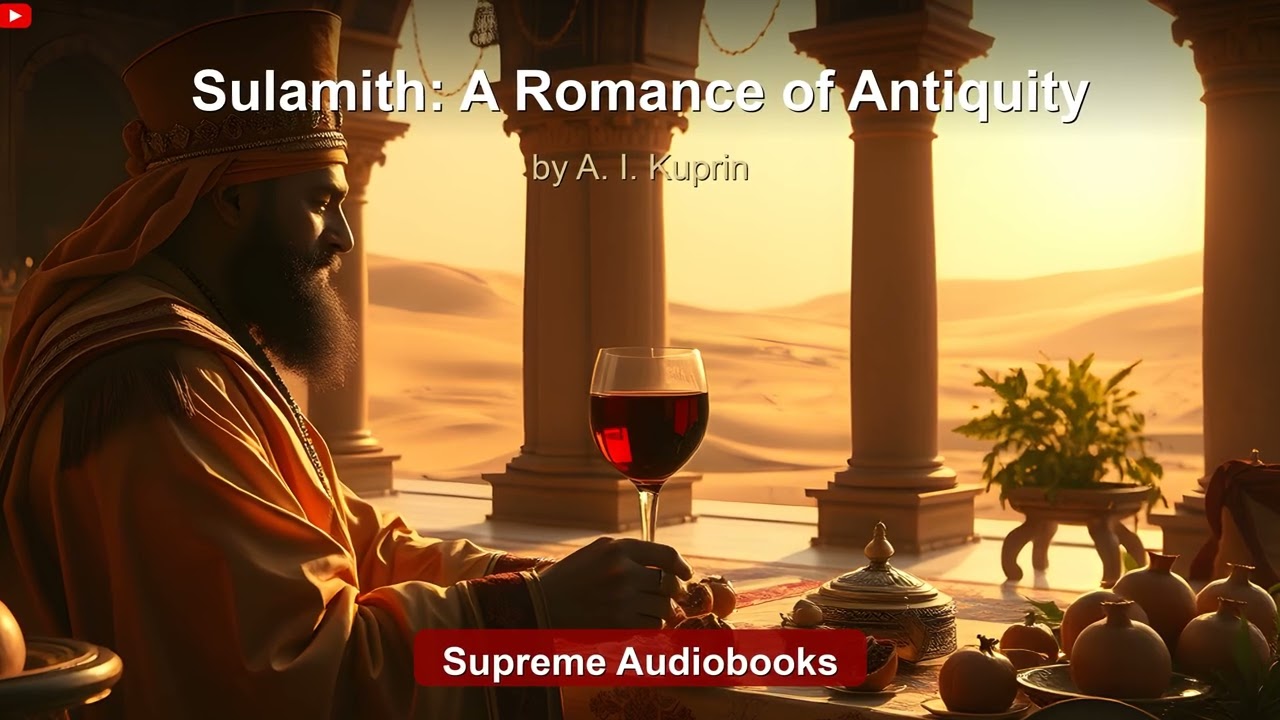
Sulamith: A Romance of Antiquity
Amidst the vast and often turbulent landscape of Russian literature, certain works stand out for their singular beauty and unique vision. A. I. Kuprin’s Sulamith: A Romance of Antiquity, penned in 1908, is precisely one such gem – a luminous prose poem that re-imagines the most passionate and enigmatic book of the Old Testament, the Song of Songs. It is a story that transcends its ancient setting, speaking directly to the enduring human experiences of love, desire, and the intoxicating, yet often fleeting, nature of profound connection. Why should a listener care today? Because Kuprin, with his remarkable ability to render emotion and atmosphere in vivid strokes, offers not merely an echo of biblical text, but a fully realized, deeply sensual, and emotionally resonant narrative that reminds us of the power of singular passion in a world constantly striving for more. It is a testament to the timeless allure of beauty, wisdom, and the heartbreaking intensity of a love unlike any other. The story unfolds in the opulent courts and sun-drenched landscapes of ancient Judea, where King Solomon, renowned for his unparalleled wisdom, immense wealth, and a multitude of wives and concubines, presides over a kingdom of splendor. Despite his unparalleled power and the endless procession of beauty that passes before him, a profound emptiness gnaws at his soul. He yearns for a love untainted by ambition, a beauty unmarred by courtly artifice. This longing finds its focus when he encounters Sulamith, a young, innocent country girl from the Galilean hills, whose pure, natural grace and unblemished beauty strike him with the force of revelation. Captivated by her, Solomon brings Sulamith to his magnificent palace in Jerusalem. There, amidst the intricate gardens and gilded chambers, their love story blossoms, depicted with a lyrical intensity that blurs the lines between prose and poetry. The narrative charts their precious days and nights together, focusing on their intimate conversations, their shared observations of nature, and the sensual awakening of Sulamith in the King’s presence. Kuprin crafts a world where every detail—the scent of myrrh, the gleam of Solomon’s jewels, the warmth of Sulamith’s skin—contributes to an overwhelming atmosphere of love and passionate devotion. The central conflict lies in the fragile nature of this idyllic bond, threatened by the demands of Solomon’s vast empire, the jealousy of his court, and the inherent impossibility of holding such perfect, untamed beauty within the confines of power and possession. Aleksandr Ivanovich Kuprin, born in 1870 in Penza, Russia, led a life as varied and colorful as the characters he created, a life that profoundly informed his literary output. Orphaned early, he spent his youth in military schools, an experience that provided material for his powerful anti-militarist novel, The Duel, published in 1905, which brought him widespread recognition. After leaving the army, Kuprin pursued an astonishing array of professions – fisherman, surveyor, actor, dentist, even circus performer – immersing himself in the lives of ordinary Russians, from peasants to prostitutes, aristocrats to adventurers. This incredible breadth of experience gave his writing an unmatched authenticity and a deep empathy for human struggle and joy. Kuprin was a prolific writer, producing short stories, novellas, and novels that captured the nuanced realities of early 20th-century Russia. His other notable works include Olesya (1898), a romantic tale of love between a sophisticated city man and an innocent forest girl, and The Garnet Bracelet (1911), a poignant story of unrequited love. He is often associated with the Russian Realist and Naturalist traditions, though his work frequently displays a lyrical quality and a profound interest in spiritual and romantic themes that set him apart from some of his more strictly sociological contemporaries. Kuprin, despite his later emigration after the Russian Revolution, remained a significant figure in Russian letters, celebrated for his vivid characterizations, his clear, powerful prose, and his keen observation of the human condition. He returned to his homeland shortly before his death in 1938. Within Sulamith, Kuprin masterfully expresses several profound themes. First among them is the transformative power of love and desire. Solomon, for all his wisdom and power, is incomplete until Sulamith enters his life, turning his vast kingdom into a mere backdrop for their intimate connection. His pronouncements on governance and philosophy pale beside his declarations of love for her, demonstrating how pure affection can reorder a king's entire world. Another key theme is the purity of natural beauty and innocence against the artificiality of civilization. Sulamith’s unadorned grace and connection to the earth stand in stark contrast to the perfumed, jewel-laden women of the court, highlighting how true beauty emanates from within and from a harmony with the natural world, rather than from manufactured splendor. Further, the novella poignantly illustrates the fragility of happiness and the transient nature of intense beauty. The love between Solomon and Sulamith is depicted as a perfect, almost ethereal state, but one that is inherently delicate and susceptible to external forces. There is a persistent undercurrent of pathos, a sense that such a sublime union cannot, and perhaps should not, last forever in the temporal world. This emphasis on the ephemeral quality of their bond serves to heighten its preciousness, making every shared glance and whispered word intensely significant. Kuprin’s prose, rich in sensory details, evokes this delicate balance, showing how a single perfect moment can contain both boundless joy and the shadow of its inevitable end. When Sulamith was published in 1908, Russia stood on the precipice of immense change. The aftermath of the 1905 Revolution had ushered in a period of intense social and political ferment, marked by burgeoning intellectual movements and a sense of impending transformation. Artistically, it was an era of experimentation, with Symbolism dominating much of the literary and aesthetic discourse, even as the last great Realists continued to publish. Against this backdrop of social unrest and artistic modernism, Kuprin’s Sulamith offered something distinctly different: a retreat into an idealized, ancient past, a search for timeless beauty and universal emotions. While many of his contemporaries were grappling with the immediate political and social concerns of contemporary Russia, Kuprin chose to look back, to reinterpret an ancient text through a lens of lyrical romanticism. This choice can be understood as both an artistic statement and a spiritual one – a quest for enduring human truths and the solace of pure emotion in a world that often seemed chaotic and devoid of genuine connection. It represented a longing for the fundamental, unadulterated passion that lies at the heart of human experience, away from the complexities and often bleak realities of modern life. Listening to Sulamith: A Romance of Antiquity as an audiobook offers a particularly immersive and enriching experience. Kuprin’s language is inherently poetic, filled with lush descriptions and deeply felt emotions, making it exceptionally suited for spoken performance. The careful cadence of a skilled narrator can bring forth the sensuousness of the prose, allowing the listener to truly savor the intricate imagery of ancient Jerusalem and the Galilean hills. At just over two hours, its run length makes it ideal for a focused listening session, perhaps during a quiet evening or a reflective walk, allowing the narrative to unfold without interruption. A good narrator will highlight the lyrical pacing, letting Solomon’s philosophical musings and Sulamith’s innocent expressions resonate, while also building the atmosphere of profound, singular love. The subtle shifts in voice for dialogue, the careful emphasis on Kuprin’s evocative descriptions of the natural world, and the overall rhythm of the storytelling combine to transport the listener, transforming a written romance into a vibrant, auditory tapestry of passion and longing.
Enjoyed Sulamith: A Romance of Antiquity? A few ways to support us
Audible & Amazon links are affiliate; we may earn a small commission at no extra cost.
About this production
Human narration by a volunteer reader from LibriVox.org, the public-domain audiobook project. LibriVox volunteers record literary works whose copyright has expired in the United States, releasing the resulting recordings into the public domain.
Sulamith: A Romance of Antiquity, first published in 1908 by A. I. Kuprin. The underlying text is in the U.S. public domain. We do not republish any modern copyrighted edition, translation, or commentary.
The 4K cinematic visuals accompanying this audiobook are generated by an AI image model from prompts derived from the source text. No copyrighted photos, paintings, or stock footage are used. AI generation is disclosed on every video on our YouTube channel as required by YouTube's altered/synthetic content policy.
English subtitles are transcribed from the LibriVox recording with OpenAI Whisper. Translations into the 11 other supported languages are produced by Meta's NLLB-200 neural translation model. No human translator's copyrighted translation is used.
Questions about sourcing or rights? See our DMCA & Sourcing policy or contact us.
Enjoyed this audiobook?
If you'd like to own a copy of Sulamith: A Romance of Antiquity or hear a professionally produced edition, the links below help support free audiobook production at no extra cost to you.
As an Amazon Associate we earn from qualifying purchases. Audible / print links are affiliate.