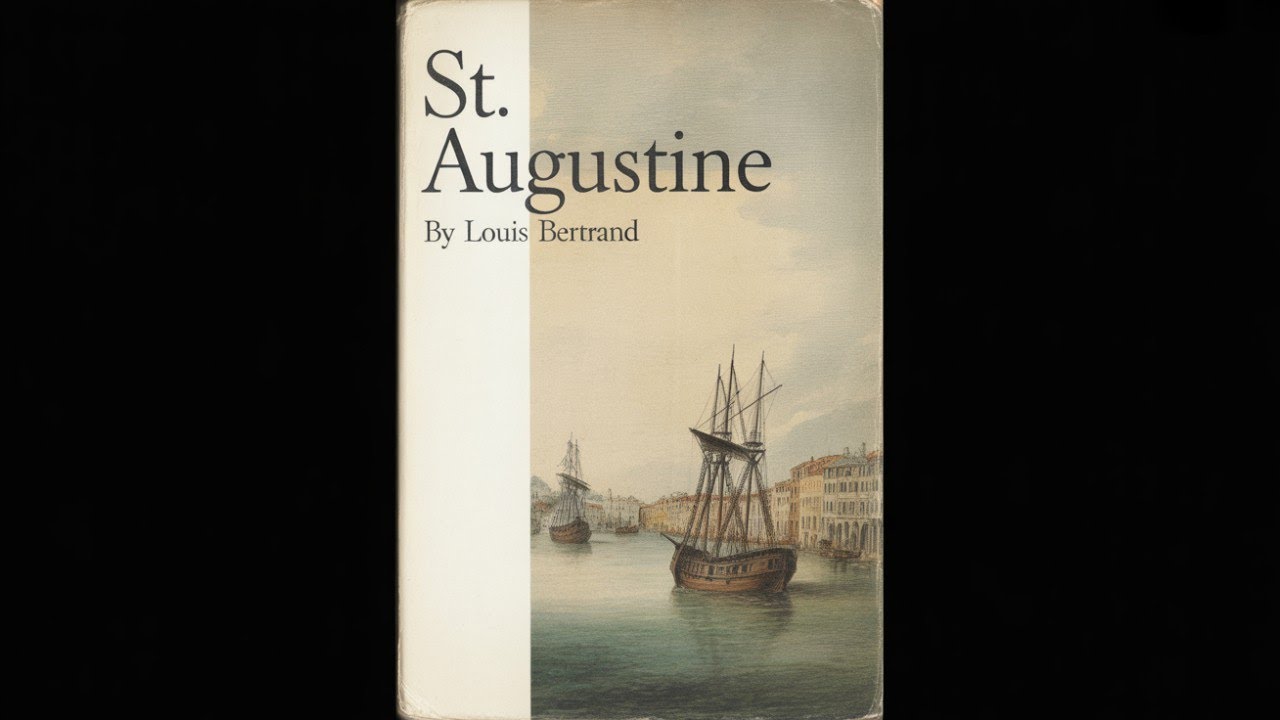
St. Augustine
When we speak of figures who have utterly reshaped the landscape of Western thought, few names resonate with the singular power of St. Augustine. His intellect, his struggles, his eventual illuminations continue to challenge and inform us, centuries after his mortal life. Louis Bertrand’s acclaimed biography, St. Augustine, offers more than a historical account; it presents a vivid portrait of a man wrestling with the fundamental questions of existence, faith, and meaning. This is a story of a mind in constant motion, a soul in profound search, whose answers to ancient dilemmas still echo in our modern world, providing insight into the human condition that remains strikingly relevant. To listen to this narrative is to witness the birth of ideas that define our civilization, to understand the foundational arguments that shaped Christianity and Western philosophy, and to recognize within Augustine’s tumultuous life a reflection of our own perpetual quest for purpose amidst shifting sands. Bertrand’s narrative begins in the provincial North African city of Thagaste, within the waning Roman Empire, introducing us to a brilliant young man named Aurelius Augustinus. Born into a world where classical paganism still held sway but Christianity was gaining ground, Augustine’s early life is marked by precocious intelligence and a passionate, restless spirit. We follow him from his modest beginnings to the bustling academic centers of Carthage, Rome, and eventually Milan, where he pursues a career as a rhetorician, a master of words and persuasion. His journey is not merely geographical; it is an intense intellectual and spiritual odyssey. Early on, Augustine falls under the influence of Manichaeism, a dualistic religion that offers seemingly logical answers to the problem of evil. He lives a life deeply engaged with worldly pleasures, forming a long-term relationship and fathering a son, Adeodatus, all while his formidable intellect hungers for a more satisfying truth. His personal struggles with ambition, desire, and intellectual certainty form the core of his conflict. Despite his worldly successes, a profound unease gnaws at him. Bertrand meticulously details Augustine’s disillusionment with Manichaeism, his flirtation with Skepticism, and his eventual discovery of Neoplatonism, which offered a pathway to understanding spiritual realities beyond the purely material. Throughout these intellectual shifts, a steady, unwavering force in his life is his mother, Monica, a devout Christian whose fervent prayers and persistent hopes for her son’s conversion form a poignant counterpoint to his intellectual wanderings. The story builds toward a pivotal moment in a Milanese garden, a profound personal awakening that fundamentally alters the trajectory of his life, turning him from an ambitious scholar and sensualist toward a life dedicated entirely to God. This transformative experience, recounted with biographical precision and psychological depth by Bertrand, marks the dramatic spiritual turning point of the narrative. Louis Bertrand, a prominent French writer born in 1866, was a novelist, essayist, and biographer whose work often centered on historical themes and the landscapes of the Mediterranean and North Africa. His personal connection to North Africa, where he lived for a significant period, profoundly influenced his literary output, lending a particular resonance to his portrayal of St. Augustine, a native of that same region. Bertrand was elected to the Académie française in 1925, a testament to his significant contributions to French letters. His writing style is characterized by its meticulous historical detail, evocative descriptions, and a deep engagement with the human element of grand historical narratives. Beyond St. Augustine, Bertrand penned numerous other works, including Le Sang des Races and La Concession de Madame Baret, historical novels that often dealt with the clash of cultures and the legacy of ancient civilizations in modern contexts. His literary sensibilities aligned with a late 19th and early 20th-century movement that sought to blend rigorous historical research with compelling narrative artistry, making history accessible and emotionally resonant for a wide readership. Bertrand’s place in the literary canon rests upon his ability to animate the past, transforming dusty facts into vibrant human stories, and his biography of St. Augustine stands as a prime example of this talent, revealing a profound empathy for his subject’s intellectual and spiritual odyssey. Bertrand’s St. Augustine enacts several profound themes that give it enduring literary significance. One central theme is the arduous search for truth. Augustine's restless mind cannot settle for superficial answers, moving from the Manichaean sect's explanation of good and evil to the philosophical abstractions of Neoplatonism, always seeking a more comprehensive and satisfying understanding of reality. Bertrand illustrates this intellectual pilgrimage through Augustine's debates and studies, showing how his analytical mind continually questioned and re-evaluated the doctrines he encountered. Another powerful theme is the nature of conversion and spiritual transformation. Augustine’s journey is not merely an intellectual assent but a complete reorientation of his being, a shift depicted vividly in the moments leading up to his garden conversion, where the weight of his past life confronts the call to a new path. The biography also compellingly presents the conflict between the flesh and the spirit. Augustine’s struggles with concupiscence and ambition, his long-standing relationship with his mistress, and his pride in his rhetorical abilities are balanced against his deep yearning for a transcendent ideal. This internal battle is not presented as a simple dichotomy but as a complex interplay of human desire and spiritual aspiration. Furthermore, the unwavering devotion of Augustine’s mother, Monica, highlights the theme of persistent love and intercession. Her years of prayer and tearful entreaties for her son’s soul are integral to the narrative, underscoring the profound impact of familial bonds on personal spiritual development and destiny. When Louis Bertrand published St. Augustine in 1907, the world was on the cusp of significant global upheaval, but it was also a period of intense intellectual and cultural ferment in Europe. France, in particular, was grappling with questions of national identity, colonial expansion—especially in North Africa—and a burgeoning secularism that often clashed with traditional religious authority. Bertrand's work emerged from this environment, reflecting a renewed interest in foundational figures of Western civilization, perhaps as a way to understand the roots of European identity amidst a rapidly modernizing world. His meticulous historical approach, coupled with a literary sensibility that brought human drama to life, resonated with a reading public that valued both scholarship and engaging prose. The early 20th century saw a flourishing of literary biography, as writers sought to understand the great figures of the past not just as historical artifacts but as complex individuals whose lives held lessons for the present. Bertrand’s choice of St. Augustine, a figure whose personal struggles with belief and doubt felt remarkably modern, allowed him to bridge the chasm between antiquity and his contemporary moment, offering a lens through which to examine enduring questions about faith, reason, and human nature in an age that was increasingly questioning old certainties. Listening to St. Augustine as an audiobook offers a unique opportunity to immerse oneself in this monumental life story. The skilled narrator can bring forth the gravitas of Augustine's intellectual journey, the emotional intensity of his spiritual crises, and the historical sweep of the declining Roman Empire. The several hours of listening time provide ample space to absorb the nuances of Bertrand’s prose, allowing the listener to truly dwell within the narrative’s historical atmosphere. A good vocal performance will convey the passion of Augustine’s youthful ambition, the fervor of his later convictions, and the quiet dignity of his mother’s faith. The pacing of the narration can enhance the dramatic arc, highlighting moments of philosophical insight and personal revelation, making the historical and theological arguments more accessible and engaging than they might be on the printed page alone. It transforms a literary biography into an unfolding drama, a spoken testament to a mind that continues to shape our world.
Enjoyed St. Augustine? A few ways to support us
Audible & Amazon links are affiliate; we may earn a small commission at no extra cost.
About this production
Human narration by a volunteer reader from LibriVox.org, the public-domain audiobook project. LibriVox volunteers record literary works whose copyright has expired in the United States, releasing the resulting recordings into the public domain.
St. Augustine by Louis Bertrand. The underlying text is in the U.S. public domain. We do not republish any modern copyrighted edition, translation, or commentary.
The 4K cinematic visuals accompanying this audiobook are generated by an AI image model from prompts derived from the source text. No copyrighted photos, paintings, or stock footage are used. AI generation is disclosed on every video on our YouTube channel as required by YouTube's altered/synthetic content policy.
English subtitles are transcribed from the LibriVox recording with OpenAI Whisper. Translations into the 11 other supported languages are produced by Meta's NLLB-200 neural translation model. No human translator's copyrighted translation is used.
Questions about sourcing or rights? See our DMCA & Sourcing policy or contact us.
Enjoyed this audiobook?
If you'd like to own a copy of St. Augustine or hear a professionally produced edition, the links below help support free audiobook production at no extra cost to you.
As an Amazon Associate we earn from qualifying purchases. Audible / print links are affiliate.