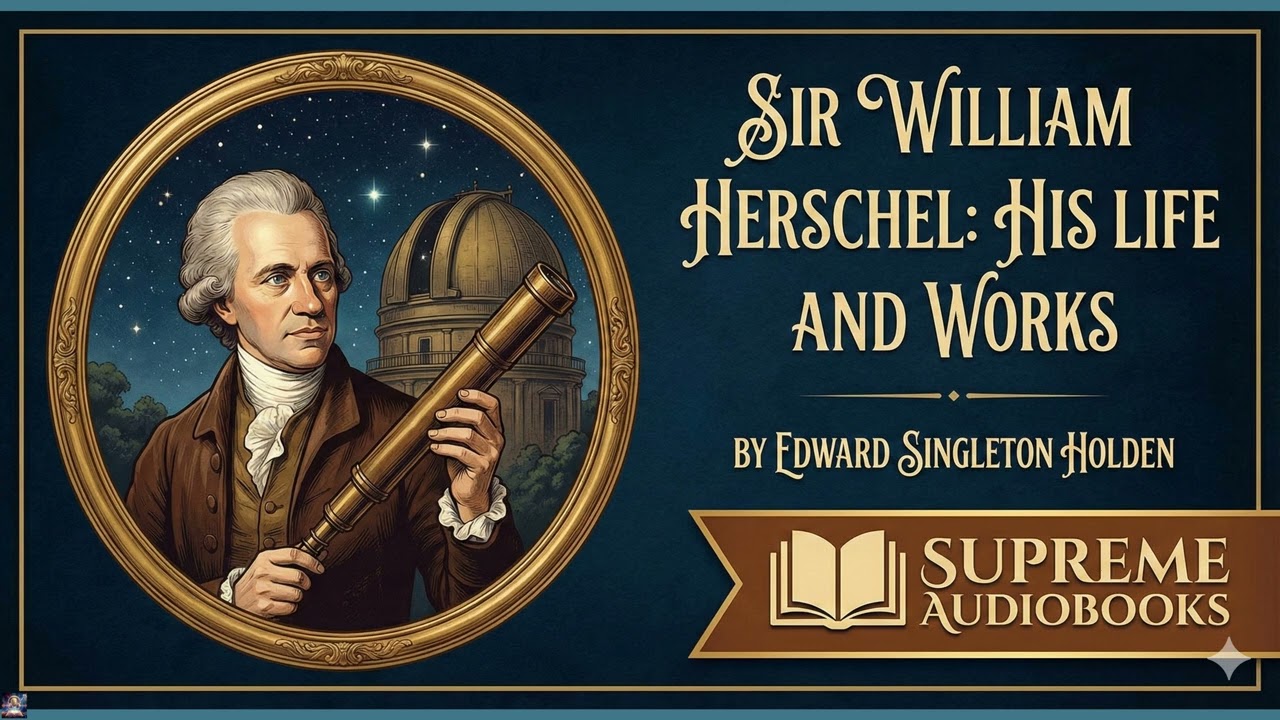
Sir William Herschel: His Life and Works
Edward Singleton Holden's "Sir William Herschel: His Life and Works" brings to life the extraordinary story of a man who fundamentally reshaped humanity’s understanding of the cosmos. This isn't just a biography of a scientist; it's an account of relentless curiosity, self-taught genius, and profound discovery that echoes with relevance even today. William Herschel, a figure from the late eighteenth and early nineteenth centuries, was not merely an astronomer; he was a revolutionary who pushed the boundaries of perception, revealing a universe far grander and more dynamic than anyone had previously imagined. For anyone fascinated by the human drive for knowledge, the sheer power of observation, or the quiet dedication that can overturn millennia of conventional wisdom, Herschel's life—as meticulously chronicled by Holden—offers both inspiration and a reminder of our enduring place in the unfolding scientific story. The narrative unfolds in the Enlightenment era, a period ripe for intellectual flourishing and scientific inquiry across Europe. We meet William Herschel first not as an astronomer, but as a gifted musician from Hanover, Germany, who, alongside his sister Caroline, moves to Bath, England, to pursue a career in music. He quickly establishes himself as an organist, composer, and music teacher, yet a deeper passion for the heavens begins to burn within him. Dissatisfied with the commercial telescopes available at the time, Herschel embarks on a self-imposed apprenticeship, dedicating countless hours to the painstaking craft of grinding and polishing mirrors, determined to build instruments superior to any in existence. This period of intense, solitary work sets the stage for his remarkable astronomical career, demonstrating a singular focus that would define his life. The arc of Herschel’s story shifts dramatically with his accidental discovery of Uranus in 1781. What he initially believed to be a comet soon proved to be a new planet, the first found since antiquity, instantly propelling him from obscurity to international renown. This singular observation not only expanded the known boundaries of the solar system but also secured him a royal pension and the title of King's Astronomer from George III, allowing him to dedicate his life entirely to astronomy. He moves to Slough, near Windsor, where, with the tireless assistance of his sister Caroline, he constructs increasingly larger and more powerful telescopes, including the famous 40-foot reflector, then the largest in the world. The rest of his scientific career is a testament to systematic observation, cataloging nebulae and star clusters, mapping the structure of the Milky Way, and developing groundbreaking theories about the evolution of stars and galaxies, all driven by an insatiable desire to peer deeper into the universe's mysteries. Edward Singleton Holden, the author, was a distinguished American astronomer and educator, born in 1846 and passing away in 1914. Holden himself possessed a remarkable scientific career, serving as the first director of the prestigious Lick Observatory in California from 1888 to 1897, a period during which the observatory made significant contributions to astronomical research. Before that, he directed the Washburn Observatory at the University of Wisconsin. His training and professional life as an astronomer lend an unparalleled authority and insight to his account of Herschel. Holden was not merely recounting facts; he understood the scientific challenges, the technical intricacies of instrument building, and the intellectual rigor required for Herschel's revolutionary discoveries. Holden's writing often reflected a broader movement towards the popularization of science, aiming to make complex subjects accessible and inspiring to a wider audience without sacrificing accuracy. Beyond this biography, he authored numerous scientific papers, textbooks, and books on astronomy, including "The Earth and Sky" and "The Sciences," often with a pedagogical bent. His place in the scientific canon is secure as both a significant researcher in his own right and a highly effective communicator of scientific knowledge. His ability to distill complex astronomical concepts into clear, engaging prose makes his work a valuable bridge between the scientific community and the general public, a quality that shines through in his sympathetic portrayal of Herschel. The book enacts several powerful themes through the life of Sir William Herschel. One prominent theme is the spirit of discovery fueled by relentless dedication. Herschel's move from a comfortable musical career to the arduous, often frustrating, work of telescope construction exemplifies this. The text details his hours spent grinding mirrors, sometimes for sixteen hours straight, a vivid illustration of his almost obsessive commitment to pushing the boundaries of what was possible in observation. Without this singular focus, the discovery of Uranus, or his subsequent groundbreaking surveys of the heavens, would have remained impossible. Another central theme is the indispensable role of collaboration and family in scientific endeavor. The story consistently highlights the profound contributions of Caroline Herschel, William’s sister, who served not merely as an assistant but as a dedicated astronomer in her own right. She meticulously recorded observations, performed complex calculations, and even discovered several comets herself. Her unwavering support and independent scientific work demonstrate that scientific progress is often a collective effort, shattering the myth of the solitary genius and showing how shared passion can elevate individual talent. His life also stands as a testament to the idea that genius can emerge from unconventional paths, as Herschel lacked formal astronomical training but achieved unparalleled success through self-instruction and practical application. Holden's book emerged during a particularly fascinating period in scientific and literary history, roughly spanning the late nineteenth and early twentieth centuries. This era was characterized by a surge in scientific progress, particularly in fields like physics and astronomy, which captivated the public imagination. The success of figures like Darwin and Maxwell had firmly established the scientific method as a powerful tool for understanding the universe, leading to a widespread interest in the lives and achievements of scientific heroes. Biographies of eminent scientists, like Holden's account of Herschel, served multiple purposes: they educated the public about past discoveries, inspired new generations to pursue scientific careers, and reinforced the cultural value of empirical inquiry. It was a time when the "great man" theory of history still held sway, and highlighting individual contributions to scientific advancement was a popular narrative form. Listening to "Sir William Herschel: His Life and Works" as an audiobook offers a unique opportunity to immerse oneself in this compelling biography. The running length of several hours allows for a detailed, yet accessible, account of Herschel's prolific life without feeling rushed. A skilled narrator can bring Holden's clear, precise prose to life, allowing the listener to easily grasp complex scientific concepts and appreciate the historical context of Herschel's discoveries. Imagine a voice that conveys both the intellectual rigor of Holden's analysis and the underlying wonder of Herschel’s personal quest. The pacing would likely be measured, allowing ample time for the listener to contemplate the magnitude of Herschel’s achievements and the painstaking effort behind them, creating an atmosphere of quiet intellectual adventure and awe-inspiring scientific revelation.
Enjoyed Sir William Herschel: His Life and Works? A few ways to support us
Audible & Amazon links are affiliate; we may earn a small commission at no extra cost.
About this production
Human narration by a volunteer reader from LibriVox.org, the public-domain audiobook project. LibriVox volunteers record literary works whose copyright has expired in the United States, releasing the resulting recordings into the public domain.
Sir William Herschel: His Life and Works by Edward Singleton Holden. The underlying text is in the U.S. public domain. We do not republish any modern copyrighted edition, translation, or commentary.
The 4K cinematic visuals accompanying this audiobook are generated by an AI image model from prompts derived from the source text. No copyrighted photos, paintings, or stock footage are used. AI generation is disclosed on every video on our YouTube channel as required by YouTube's altered/synthetic content policy.
English subtitles are transcribed from the LibriVox recording with OpenAI Whisper. Translations into the 11 other supported languages are produced by Meta's NLLB-200 neural translation model. No human translator's copyrighted translation is used.
Questions about sourcing or rights? See our DMCA & Sourcing policy or contact us.
Enjoyed this audiobook?
If you'd like to own a copy of Sir William Herschel: His Life and Works or hear a professionally produced edition, the links below help support free audiobook production at no extra cost to you.
As an Amazon Associate we earn from qualifying purchases. Audible / print links are affiliate.