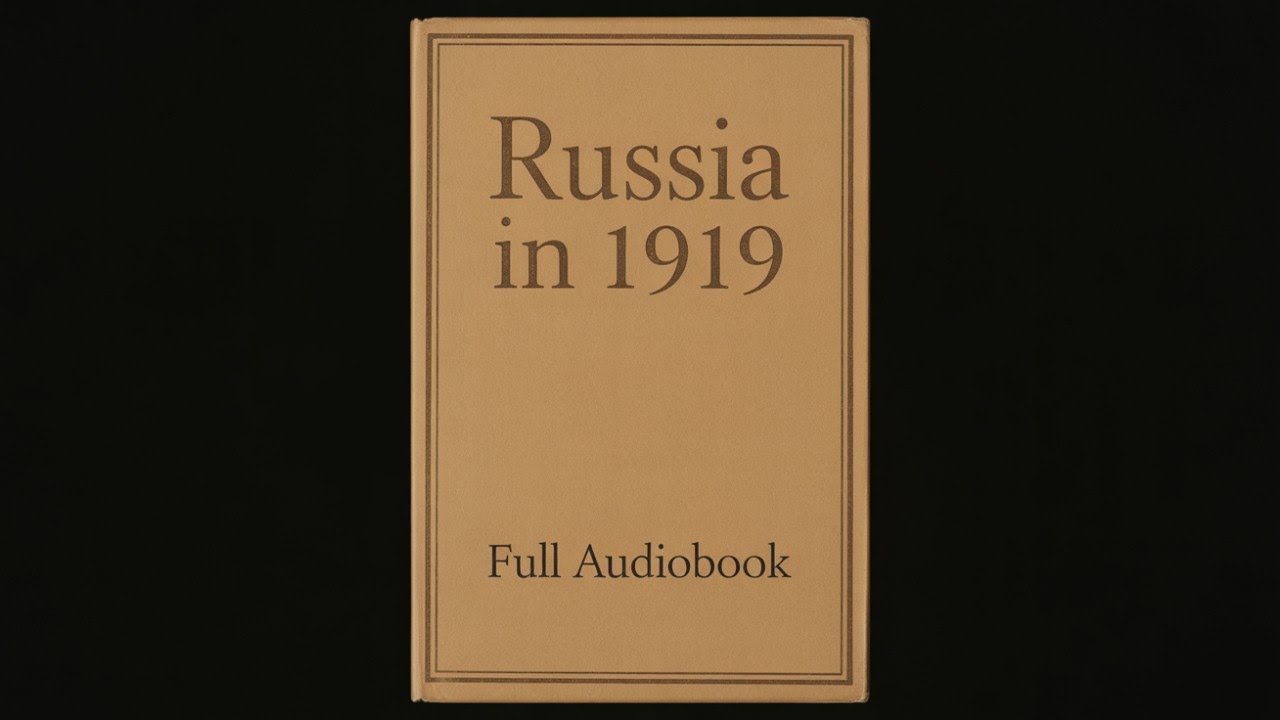
Russia in 1919
In the chaotic aftermath of the Russian Revolution, when the world struggled to comprehend the scale of the upheaval, Arthur Ransome delivered an eyewitness account unlike any other. Russia in 1919 stands as a vital primary source, a dispatch from the very heart of the new Soviet state, written by a British writer living amidst the turmoil. This is not history filtered through hindsight or theory, but rather the immediate, often stark, observations of a man attempting to make sense of a collapsing old order and the brutal birth of a new one. Why does this century-old report still matter? Because it peels back layers of propaganda and assumption, inviting listeners to confront the raw energy, desperation, and idealism of a pivotal historical moment. It asks us to question narratives, both past and present, and to remember the human faces behind grand political experiments. Ransome's account plunges the listener into the bitter winter of 1919, a period of immense scarcity and ongoing civil war. He travels through Moscow and other beleaguered regions, observing the daily grind of a society struggling to survive, let alone rebuild. The setting is one of contrasts: the stark, often hungry reality of the populace against the fervent ideological debates unfolding in official circles. Ransome positions himself as a dispassionate, though not disengaged, observer, keen to report what he sees and hears without immediately condemning or celebrating. His central quest is to cut through the competing layers of disinformation – the sensationalized reports from the Western press painting an apocalyptic picture, and the idealized self-portrayals emanating from Bolshevik leadership. The book details Ransome's encounters with key figures of the revolution, including candid interviews with both Vladimir Lenin and Leon Trotsky, offering rare glimpses into their personalities and strategic thinking. But he does not stop at the top; he speaks with ordinary citizens lining up for food, with soldiers on the front, with workers in struggling factories, and with officials attempting to implement revolutionary decrees. The arc of his story is one of relentless observation and meticulous reporting. He documents the material conditions – the lack of food, fuel, consumer goods – and the profound ideological struggles defining the new Russia. He presents a picture of a nation in flux, where revolutionary enthusiasm coexists with fatigue and privation, where grand visions clash with harsh realities. Arthur Ransome, born in 1884 in Leeds, England, lived a life as varied as his literary output. He began his career as a literary critic and journalist, cultivating an interest in Russian literature and culture that would lead him to move to Russia in the years leading up to the First World War. His intimate knowledge of the country and its people positioned him uniquely to witness and report on the unfolding revolution of 1917. Serving as a correspondent for the Daily News and later the Manchester Guardian, Ransome became one of the few Western journalists to live through the Bolshevik takeover and the subsequent Civil War, providing critical, though often controversial, dispatches to the outside world. His sympathetic yet clear-eyed reporting from Russia, which included his observations on Lenin and Trotsky and even his marriage to Evgenia Shelepina, Trotsky's secretary, earned him accusations of being a spy, both from British and Soviet sides – a testament to his complex position. After his time as a political reporter, Ransome returned to England and pivoted dramatically, establishing himself as one of Britain's most beloved authors of children's literature with his "Swallows and Amazons" series, beginning in 1930. These adventure stories, set in the English Lake District, brought him enduring fame, yet his earlier works, such as Old Peter's Russian Tales and especially Russia in 1919, stand as crucial contributions to both literature and historical understanding, showcasing his remarkable breadth as a writer. A primary theme running through Russia in 1919 is the struggle for truth amidst propaganda. Ransome makes a concerted effort to verify facts, cross-reference reports, and present observations that often contradict the prevailing narratives disseminated by both Bolshevik and Western sources. For example, he describes his direct interviews with key leaders and then contrasts their statements with the rhetoric he reads in foreign newspapers, allowing the reader to judge the discrepancies. Another significant theme is the human cost of revolution. While he clearly engages with the political project, Ransome never loses sight of the everyday struggles of the Russian people. He vividly recounts the bitter cold, the chronic hunger, the worn-out clothing, and the sheer exhaustion of a population enduring war and blockade, illustrating the profound personal sacrifices demanded by such a transformative period. His descriptions of the difficulties of travel and the scarcity of basic goods paint a visceral picture of life in revolutionary Russia. Ransome also highlights the paradox between revolutionary ideology and practical reality. He shows the immense gap between the grand pronouncements of a new society and the chaotic, often inefficient, reality on the ground. He frequently details how theoretical ideals of distribution or governance clashed with the practical challenges of administering a vast, war-torn nation. For instance, discussions of nationalizing industries are juxtaposed with the actual, often dire, state of factories. Finally, the book acts as a meditation on the role of the foreign observer during times of profound political change. Ransome’s struggle for impartiality, his desire to see beyond predetermined biases, makes his presence and his account a central part of the work’s meaning. Russia in 1919 emerged from a deeply unsettled world. The year 1919 marked the immediate aftermath of World War I and the thick of the Russian Civil War, a period when the newly established Bolshevik government fought for its survival against counter-revolutionary forces and foreign intervention. Culturally and politically, the West was grappling with the rise of communism, viewed with a mixture of fear, fascination, and outright hostility. Many governments and media outlets presented a monolithic, demonized image of the Soviet state. It was in this environment that Ransome's book provided a counter-narrative – a nuanced, on-the-ground report that dared to see the complexity, the human elements, and even the idealistic aspirations beneath the surface of the revolution, rather than simply confirming existing prejudices. It filled a crucial void for those seeking a more informed perspective on events that would reshape the entire twentieth century. Listening to Russia in 1919 as an audiobook offers a unique gateway into Ransome's immediate, observational prose. A skilled narrator can bring forth the gravitas of Ransome's reporting, his measured tone of journalistic detachment combined with an underlying human curiosity. The "several hours" runtime makes it an ideal companion for commutes or extended quiet periods, allowing the listener to truly immerse themselves in the historical narrative. Pay attention to the narrator’s pacing, which can emphasize the slow, deliberate accumulation of facts contrasted with moments of intense personal encounter, such as Ransome's direct quotes from historical figures like Lenin and Trotsky. The spoken word adds an immediacy to these dialogues, making them feel less like historical records and more like live exchanges. The atmosphere of a cold, hungry, yet ideologically charged Moscow comes alive through the descriptive power of the text, enhanced by a voice that can convey both the political weight and the resilient human spirit Ransome encountered.
Enjoyed Russia in 1919? A few ways to support us
Audible & Amazon links are affiliate; we may earn a small commission at no extra cost.
About this production
Human narration by a volunteer reader from LibriVox.org, the public-domain audiobook project. LibriVox volunteers record literary works whose copyright has expired in the United States, releasing the resulting recordings into the public domain.
Russia in 1919 by Arthur Ransome. The underlying text is in the U.S. public domain. We do not republish any modern copyrighted edition, translation, or commentary.
The 4K cinematic visuals accompanying this audiobook are generated by an AI image model from prompts derived from the source text. No copyrighted photos, paintings, or stock footage are used. AI generation is disclosed on every video on our YouTube channel as required by YouTube's altered/synthetic content policy.
English subtitles are transcribed from the LibriVox recording with OpenAI Whisper. Translations into the 11 other supported languages are produced by Meta's NLLB-200 neural translation model. No human translator's copyrighted translation is used.
Questions about sourcing or rights? See our DMCA & Sourcing policy or contact us.
Enjoyed this audiobook?
If you'd like to own a copy of Russia in 1919 or hear a professionally produced edition, the links below help support free audiobook production at no extra cost to you.
As an Amazon Associate we earn from qualifying purchases. Audible / print links are affiliate.