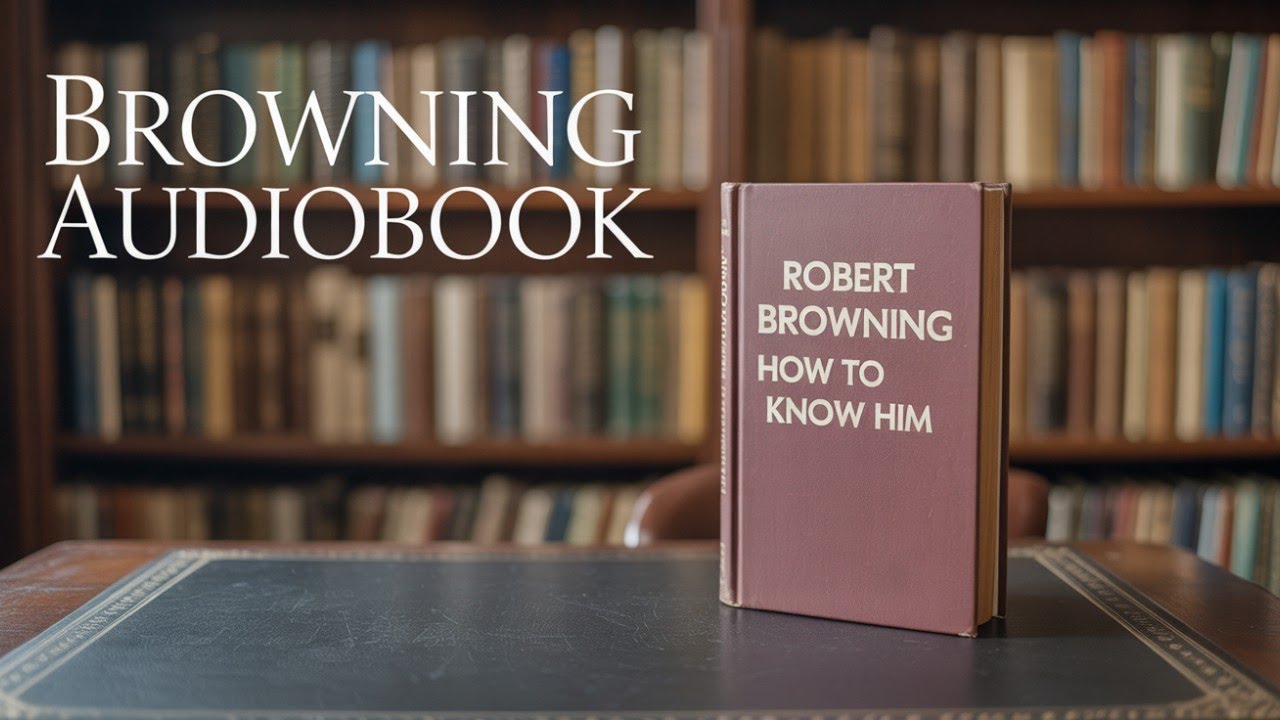
Robert Browning: How to Know Him
Robert Browning, a titan of Victorian letters, often presents a formidable challenge to readers. His complex psychological portraits, dense allusions, and unique dramatic monologues can feel like a puzzle, rewarding profound insight but demanding patience. William Lyon Phelps, a master educator and literary guide, offers an indispensable key to unlock this poetic genius in Robert Browning: How to Know Him. This audiobook is not merely a dry academic commentary; it is an enthusiastic invitation to understand a poet whose profound observations on human nature, love, ambition, and faith remain enduringly relevant. For anyone who has ever been daunted by Browning's reputation or yearned to appreciate the richness of his verse, this recording provides an accessible and illuminating pathway directly into the heart of his literary contribution. Phelps's book functions as a meticulously structured course, designed to equip the listener with the tools needed to approach Browning's often elliptical and challenging poetry. He begins by orienting the listener to Browning's early life and the intellectual ferment of his era, laying the groundwork for understanding the poet's distinctive voice. The narrative then systematically introduces Browning's signature innovation: the dramatic monologue. Phelps meticulously explains this form, where a single speaker — often unreliable, always revealing — addresses a silent listener, inadvertently exposing their true character, motivations, and moral landscape. Through Phelps's clear explanations, the listener gains an appreciation for how Browning uses this technique to create vivid, unsettling, and psychologically acute portraits of historical figures, fictional characters, and everyday people grappling with profound choices. The arc of Phelps's presentation moves through Browning's significant poetic periods, from the experimental boldness of his youth to the mature philosophical depth of his later work. He dedicates considerable attention to the pivotal relationship between Robert Browning and Elizabeth Barrett Browning, demonstrating how their intellectual and romantic partnership influenced their respective oeuvres. Phelps then guides the listener through a careful selection of Browning's most celebrated poems, interpreting their meaning, analyzing their structure, and placing them within the broader context of the poet's development. Listeners are shown how to appreciate the nuances of Browning's language, his use of irony, and the underlying philosophy that permeates his verse, culminating in a comprehensive understanding of a poet whose work rewards repeated engagement. William Lyon Phelps (1865-1943) was a towering figure in American letters, an academic who brought literature to a wider audience with unparalleled enthusiasm and clarity. Born in New Haven, Connecticut, he was educated at Yale University, where he would later teach English literature for over forty years, becoming one of its most beloved and influential professors. Phelps was renowned for his engaging lectures, which often packed auditoriums with students and members of the public alike, making him a household name in educational circles during the first half of the twentieth century. He firmly believed that literature should be accessible and enjoyable, not confined to the ivory tower, and he dedicated his career to fostering a love for reading among all people. Beyond his teaching, Phelps was a prolific writer, contributing regular columns to magazines and publishing numerous books on literary criticism and appreciation. His other notable works include The Advance of English Poetry in the Twentieth Century, Essays on Russian Novelists, and Happiness. He was a literary bridge-builder, connecting the academic rigor of scholarly analysis with the popular desire for understanding and appreciation. Phelps championed both classic and contemporary writers, advocating for the enduring power of storytelling and the moral and intellectual enrichment that literature provides. His work positioned him as a central figure in popularizing literary study in America, making complex authors understandable and inviting new generations to the joys of reading. One of the central themes Phelps elucidates in Browning's poetry is psychological realism, particularly through the dramatic monologue. In poems like "My Last Duchess," Phelps would highlight how the Duke's seemingly casual words, as he describes his late wife's portrait, slowly and chillingly reveal his controlling nature and murderous possessiveness. The listener does not hear the Duke explicitly state his malice; instead, his every pronouncement, his every slight against his former Duchess, lays bare the twisted logic of a man who values possession over affection. Another theme Browning constantly presents is optimism through struggle, particularly apparent in "Rabbi Ben Ezra." Here, Browning's speaker argues that life's challenges and imperfections are not failures but necessary steps in the soul's ascent towards a higher spiritual state. The poem encourages an acceptance of aging and adversity as crucial for growth, a profound counterpoint to the era's materialism. Browning also frequently examines love and its complexities, often with a keen eye for both its ideal and its flawed human manifestations. Phelps would undoubtedly point to poems influenced by Browning's own relationship with Elizabeth Barrett, showcasing how he grappled with devotion, companionship, and the intellectual give-and-take of a true partnership. Furthermore, Browning’s work is infused with a deep sense of moral ambiguity, as he frequently places characters in situations where their actions are open to multiple interpretations. In poems like "Porphyria's Lover," the narrator’s chilling act is presented with a disturbing calm, forcing the listener to confront the subjective nature of morality and the terrifying justifications people invent for their deeds. Phelps’s insights here enable listeners to truly appreciate how Browning’s characters wrestle with profound ethical questions without providing simplistic answers. Phelps’s Robert Browning: How to Know Him was published in 1915, a significant moment in cultural and literary history. The Edwardian era had just concluded, and the world was on the precipice of World War I, a period of immense social and political upheaval. In the literary sphere, Modernism was beginning to assert itself, with writers challenging traditional forms and Victorian sensibilities. Yet, there remained a strong and widespread appreciation for the literary giants of the preceding century. Phelps's book emerged at a time when there was a clear need for works that could bridge the gap between academic literary analysis and the general public's desire to understand complex authors. Browning, though highly regarded, was often considered dense, and Phelps aimed to demystify him, making his profound philosophical and psychological insights accessible to a new generation of readers who might otherwise have found his work impenetrable amidst the changing tides of literary fashion. It was a time when popular education and literary appreciation movements, such as the Chautauqua circuit, were thriving, further underscoring the demand for guides like Phelps. Listening to Robert Browning: How to Know Him as an audiobook offers a particularly rich and rewarding experience. A skilled narrator brings William Lyon Phelps's infectious enthusiasm and scholarly clarity to life, transforming what might be seen as a dense academic text into an engaging, conversational encounter. The several hours of running time allow for a deep, sustained immersion in Browning's world, ideal for thoughtful listening during commutes, walks, or dedicated study sessions. Listeners can fully appreciate Phelps's measured pacing as he unpacks complex ideas, guiding them through the intricacies of Browning's verse with a spoken interpretation that highlights the rhythm and meaning of the poetic examples. The narrator's voice becomes an extension of Phelps's own pedagogical persona, making the journey of understanding Browning not just intellectually stimulating but genuinely enjoyable, creating an atmosphere of shared discovery rather than solitary struggle.
Enjoyed Robert Browning: How to Know Him? A few ways to support us
Audible & Amazon links are affiliate; we may earn a small commission at no extra cost.
About this production
Human narration by a volunteer reader from LibriVox.org, the public-domain audiobook project. LibriVox volunteers record literary works whose copyright has expired in the United States, releasing the resulting recordings into the public domain.
Robert Browning: How to Know Him by William Lyon Phelps. The underlying text is in the U.S. public domain. We do not republish any modern copyrighted edition, translation, or commentary.
The 4K cinematic visuals accompanying this audiobook are generated by an AI image model from prompts derived from the source text. No copyrighted photos, paintings, or stock footage are used. AI generation is disclosed on every video on our YouTube channel as required by YouTube's altered/synthetic content policy.
English subtitles are transcribed from the LibriVox recording with OpenAI Whisper. Translations into the 11 other supported languages are produced by Meta's NLLB-200 neural translation model. No human translator's copyrighted translation is used.
Questions about sourcing or rights? See our DMCA & Sourcing policy or contact us.
Enjoyed this audiobook?
If you'd like to own a copy of Robert Browning: How to Know Him or hear a professionally produced edition, the links below help support free audiobook production at no extra cost to you.
As an Amazon Associate we earn from qualifying purchases. Audible / print links are affiliate.