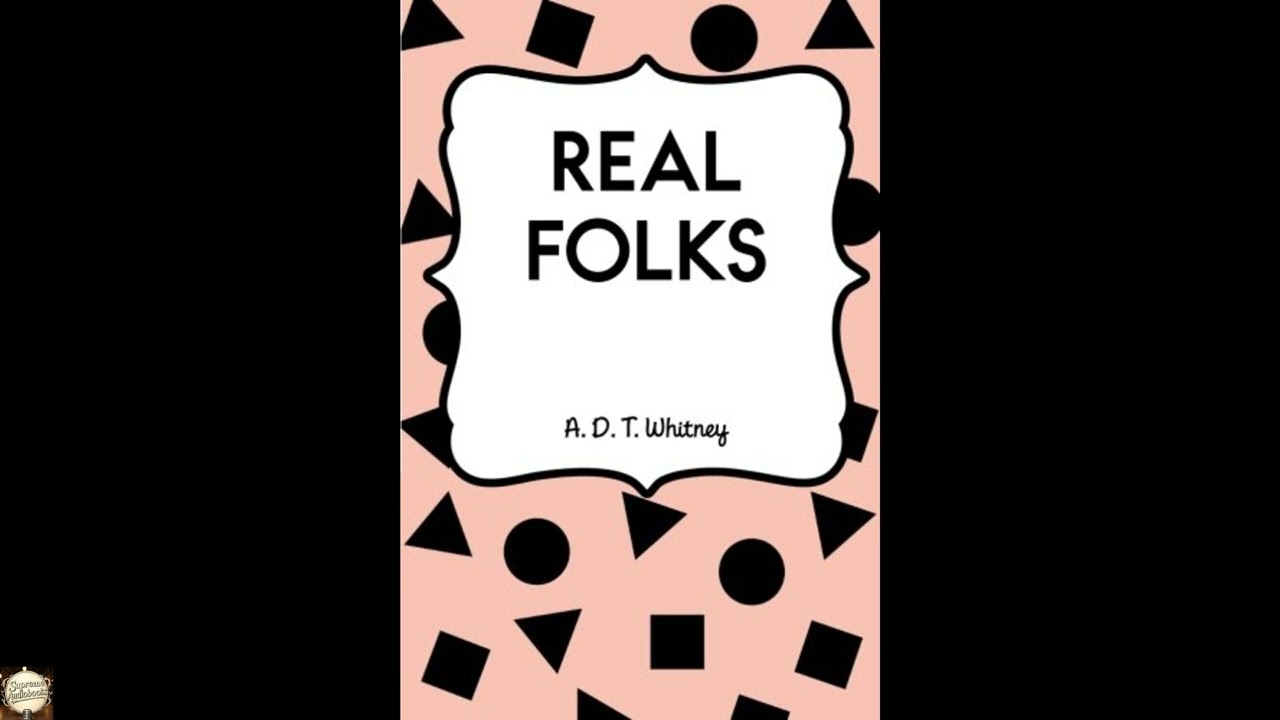
Real Folks
A. D. T. Whitney's "Real Folks," published in 1871, invites us into a particular corner of 19th-century New England, a world seemingly gentler, perhaps simpler, than our own. Yet beneath its surface of domesticity and quiet community life, the novel grapples with questions of authenticity, belonging, and the true measure of a person — concerns as pressing today as they were over a century ago. This isn't merely a quaint period piece; it is a thoughtful study of character, charting the growth of its young protagonist as she navigates societal expectations and the often subtle distinctions between genuine feeling and outward show. In an age where self-image is meticulously curated and presented, "Real Folks" offers a refreshing counter-narrative, prompting us to consider what it truly means to be real, both to ourselves and to those around us. The story introduces us to Faith Gartney, a young woman living in a close-knit, bustling New England town during the post-Civil War era. Faith is at an age where the world is opening up, yet also presenting a myriad of choices and pressures. She is a thoughtful, observant soul, keenly aware of the nuances of human behavior and the unspoken rules that govern her social circle. Her family forms a loving but sometimes demanding backdrop, with various relatives and neighbors contributing to the fabric of her daily existence. As Faith comes into her own, she observes and interacts with a diverse array of individuals, from the outwardly genteel to those whose quiet virtues often go unnoticed. The central arc of "Real Folks" isn't a dramatic struggle against external foes, but Faith's gradual awakening to the complexities of human nature and her place within society. She encounters characters who embody different definitions of "realness" – some who present a polished facade, others whose sincerity is undeniable, and still others who struggle to reconcile their inner selves with the roles they are expected to play. Through a series of everyday occurrences, social gatherings, quiet reflections, and significant conversations, Faith begins to discern the true character of those around her and, more importantly, to define what "real" means for herself. Her challenges lie in distinguishing between superficial appearances and genuine substance, trusting her own judgment, and living authentically amidst varied community expectations. Adeline Dutton Train Whitney, born in Boston, Massachusetts, in 1824, became a prolific and widely read American author during the latter half of the nineteenth century. Raised in a Unitarian household, she married A. D. Whitney in 1843 and spent most of her adult life in Milton, Massachusetts, raising four children. Her writing career began in earnest after the Civil War, quickly gaining a reputation for domestic fiction, often aimed at young women, blending engaging narratives with moral instruction. Whitney published more than twenty novels, poetry collections, and essays during her lifetime, becoming a significant voice in the literary landscape. Early successes included "Faith Gartney's Girlhood" (1863) and "The Gayworthys" (1865), which resonated deeply with readers seeking narratives that affirmed traditional values while acknowledging the complexities of American life. Other notable works include "Hitherto: A Story of Yesterday" (1869) and "Patience Strong's Adentures" (1869). Her work is often categorized within "girl's fiction" or "Sunday School literature" of her era, yet her best writing transcends simple didacticism, offering nuanced character portrayals and sharp social observations. She held a prominent place in the literary consciousness of her time, providing both entertainment and ethical guidance. Adeline Dutton Train Whitney passed away in 1906, leaving a substantial body of work offering a unique window into Victorian American sensibilities. "Real Folks" thoughtfully examines several core themes that continue to resonate. One central idea is the distinction between authenticity and outward show. Through Faith's interactions, the narrative contrasts characters presenting a polished, conventional exterior with those whose deeper integrity shines through, even if less outwardly impressive. For instance, Faith observes how some prioritize social decorum and material possessions, while others, perhaps less polished, possess true generosity and honesty. This subtle but persistent theme encourages listeners to look beyond superficial judgments and seek genuine character. Another prominent theme revolves around the shaping of female identity within societal expectations. Faith Gartney is presented with various models of womanhood – some conforming to strict domestic ideals, others aspiring to greater independence or intellectual pursuits. The novel depicts her process of discerning which paths align with her own values and strengths, rather than simply adopting the roles prescribed by others. Her quiet observations of other women, their choices and contentment, help Faith to forge her own understanding of what it means to be a woman of substance, emphasizing inner conviction over external pressures. When "Real Folks" appeared in 1871, America was deep in the Reconstruction Era, a period of immense social and economic change. The nation grappled with issues of national unity, the integration of formerly enslaved people, and rapid industrialization. While these grand historical narratives unfolded, daily life for many Americans, particularly in New England, focused on domestic concerns, moral uplift, and character formation. It was a time when the middle class was growing, and with it, a demand for literature that reflected their values, offered guidance, and provided wholesome entertainment. The literary landscape of the 1870s was in transition. Romanticism gave way to emerging forms of Realism, but domestic fiction, focusing on family life, community dynamics, and individual moral development, remained hugely popular, especially among female readers and authors. Whitney's work fit squarely into this tradition, providing narratives that reinforced Victorian ideals of piety, purity, and domesticity, yet often subtly empowering her female protagonists through their moral agency. "Real Folks" emerged from a cultural moment valuing stories where character was forged through quiet reflection and interaction, rather than dramatic external conflict, offering comfort and instruction to a society navigating rapid change. To experience "Real Folks" as an audiobook immerses one in the gentle rhythms and nuanced observations of A. D. T. Whitney's prose. Its length makes it an ideal companion for extended listening, whether on a quiet afternoon, during daily commutes, or while engaging in household tasks. A skilled narrator brings the distinct voices of Faith Gartney and her diverse acquaintances to life, allowing listeners to distinguish between the protagonist's earnest reflections and the various tones of her social circle—from the subtly patronizing to the genuinely supportive. The narrative's unhurried, purposeful pacing lends itself wonderfully to the spoken word, allowing for moments of contemplation as Faith processes her experiences. Listening allows the subtle wit and moral undercurrents of the dialogue to shine, drawing one directly into the atmosphere of a 19th-century New England community, making the book's quiet wisdom feel particularly immediate and personal.
Enjoyed Real Folks? A few ways to support us
Audible & Amazon links are affiliate; we may earn a small commission at no extra cost.
About this production
Human narration by a volunteer reader from LibriVox.org, the public-domain audiobook project. LibriVox volunteers record literary works whose copyright has expired in the United States, releasing the resulting recordings into the public domain.
Real Folks by A. D. T. Whitney. The underlying text is in the U.S. public domain. We do not republish any modern copyrighted edition, translation, or commentary.
The 4K cinematic visuals accompanying this audiobook are generated by an AI image model from prompts derived from the source text. No copyrighted photos, paintings, or stock footage are used. AI generation is disclosed on every video on our YouTube channel as required by YouTube's altered/synthetic content policy.
English subtitles are transcribed from the LibriVox recording with OpenAI Whisper. Translations into the 11 other supported languages are produced by Meta's NLLB-200 neural translation model. No human translator's copyrighted translation is used.
Questions about sourcing or rights? See our DMCA & Sourcing policy or contact us.
Enjoyed this audiobook?
If you'd like to own a copy of Real Folks or hear a professionally produced edition, the links below help support free audiobook production at no extra cost to you.
As an Amazon Associate we earn from qualifying purchases. Audible / print links are affiliate.