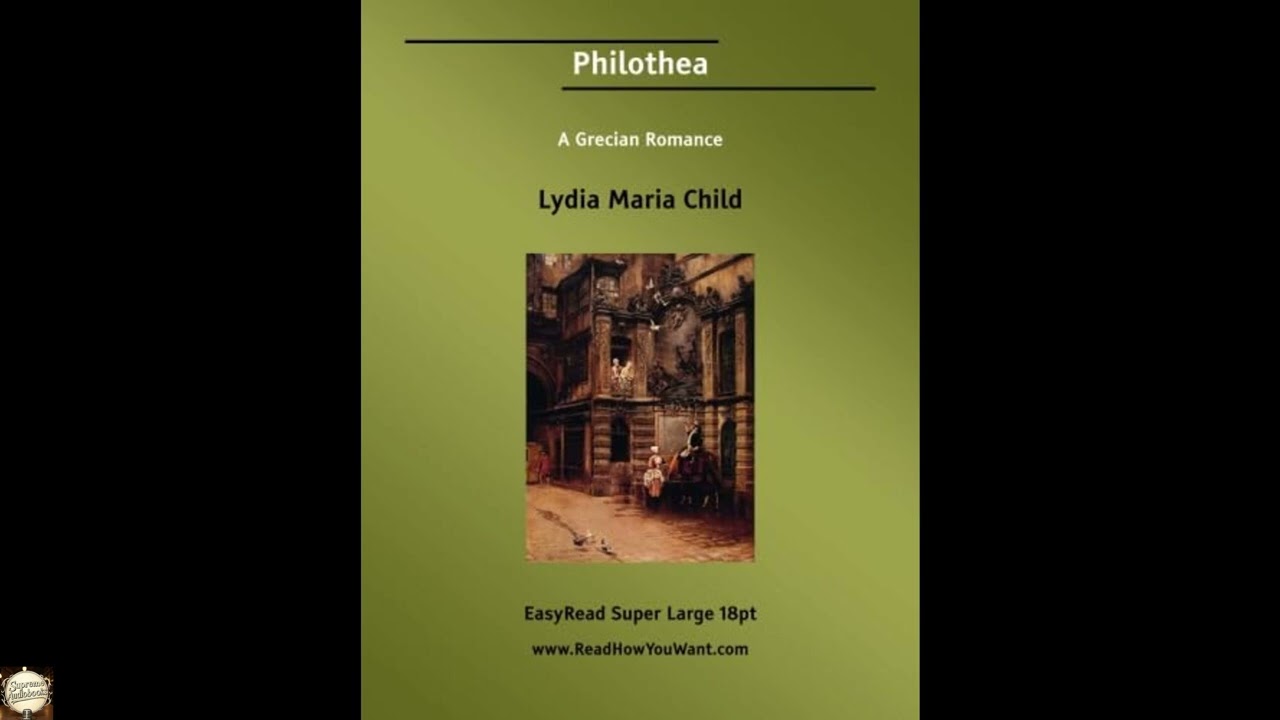
Philothea A Grecian Romance
"Philothea A Grecian Romance," by Lydia Maria Child, sweeps listeners into the dazzling intellectual and social whirl of ancient Athens. This pioneering American historical fiction, published in 1836, invites us to ponder virtue, beauty, and individual agency against a classical backdrop. Why does a tale from a 19th-century abolitionist, set millennia ago, resonate today? It presents a compelling human drama: an innocent soul's struggle to maintain ideals amidst worldly ambition and conflicting philosophies. Child asks if true purity can endure societal pressures, and what sacrifices an authentic life demands. This story challenges perceptions of power and influence, making it a surprisingly immediate and thought-provoking listen. Our story unfolds in Athens' golden age, a city teeming with philosophers, artists, and statesmen, where intellectual debate and political fortunes rise and fall. This era, dominated by figures like the revered Pericles and the brilliant, enigmatic Aspasia, introduces Philothea. She is a young woman of breathtaking beauty and remarkable purity, living a life of quiet contemplation devoted to her guardian Plato's philosophical ideals. Her days are spent amidst nature, finding solace in simple virtues, far removed from the city's marketplace and machinations. Philothea's singular grace cannot remain hidden. Her beauty draws attention, notably from Anaxagoras, a young Athenian nobleman focused on military glory. Smitten, he sees Philothea as a prize, yet struggles to comprehend her philosophical convictions. As Philothea enters Athenian social circles, her innocence and ideals are tested. She navigates a landscape where physical beauty is admired, but moral fortitude often seems an obstacle. She grapples with societal expectations, differing paths from suitors, and worldly power's allure against her mentors' quiet wisdom. The story follows her earnest attempts to reconcile personal desires for truth with Athenian life's compromised realities, forcing her to define her own destiny. The mind behind "Philothea," Lydia Maria Child, born Lydia Maria Francis in Medford, Massachusetts, on February 11, 1802, was a significant 19th-century American writer and social reformer. Her prolific career spanned fiction, journalism, and advocacy. Child's literary beginnings were notable; her debut novel, Hobomok, a Tale of Early Times (1824), was among the earliest historical novels by an American woman, challenging racial and religious prejudices. She quickly followed this with The Rebels, or Boston before the Revolution (1825). Beyond fiction, she achieved widespread popularity with her influential domestic manual, The Frugal Housewife (1829), offering practical advice. Child's unwavering commitment to social justice truly defined her legacy. In 1833, she published An Appeal in Favor of That Class of Americans Called Africans, a groundbreaking abolitionist treatise passionately arguing for immediate emancipation and racial equality. This bold work alienated many but profoundly influenced leading abolitionists like William Lloyd Garrison. Her activism extended to editing the National Anti-Slavery Standard for years and advocating for women's and Native American rights. Child’s life, which concluded on October 20, 1880, in Wayland, Massachusetts, demonstrated how art and activism could challenge deeply entrenched prejudices. "Philothea," published early in her abolitionist work, showcases her ability to craft imaginative historical settings alongside social change. "Philothea A Grecian Romance" engages with several compelling themes. A central idea is the enduring tension between idealism and pragmatism. Philothea embodies pristine idealism, committed to philosophical truth and inner virtue, often at odds with Athens' worldly ambitions. Her initial reluctance to engage with city life and discomfort with superficiality highlight this. Her conversations with Plato emphasize a life guided by principles, not power. Conversely, figures like Anaxagoras and Pericles represent the pragmatic pursuit of worldly success, demonstrating how political expediency often overrides more abstract moral concerns. The narrative constantly pits Philothea's unwavering ideals against reality's compelling, sometimes corrupting, demands. Another key theme concerns the nature of beauty and virtue. Philothea's extraordinary physical beauty is a catalyst, drawing admirers and placing her in complex situations. However, Child skillfully pivots focus from mere physical allure to the profound importance of inner virtue and intellectual grace. The novel suggests true beauty is inseparable from moral integrity and a cultivated mind. Characters are drawn to Philothea's outward appearance, but her depth of character, wisdom, and principles truly distinguish her. The narrative poses questions about beauty's potential burdens and how one navigates such a gift without compromising one's true self. Additionally, the novel subtly addresses the role of women in society, presenting contrasting figures like the innocent Philothea and the sophisticated, intellectual Aspasia, offering a nuanced look at female agency. Published in 1836, "Philothea" emerged from a distinct period in American literary and cultural history. The early 19th century witnessed a powerful wave of American Romanticism, characterized by an interest in emotion, individualism, and the past. Concurrently, a widespread Classical Revival in America, fueled by democratic ideals, sought parallels and inspiration in ancient Greece and Rome. This extended into literature, as writers looked to antiquity not just for aesthetic appeal but for moral lessons and civic models relevant to the young American republic. Child, part of the burgeoning tradition of American historical fiction, followed European authors like Sir Walter Scott. Her choice of ancient Greece allowed her to explore universal themes of virtue, power, and societal pressures through a lens both exotic and intellectually resonant for her audience, particularly at a time when America grappled with its own national identity and moral future. For an immersive literary encounter, "Philothea A Grecian Romance" shines particularly brightly in its audiobook format. The descriptions of ancient Athens—with its bustling agora, revered temples, and philosophical gardens—gain an almost palpable presence through skilled narration. A talented voice artist can render the philosophical dialogues, political speeches, and Philothea's earnest conversations with a clarity and depth print alone cannot always convey. The story's pacing, alternating between contemplative moments and dramatic encounters, is amplified by vocal interpretation, allowing full absorption of the shifting atmosphere. Nuances in character—Philothea's quiet wisdom, Anaxagoras's worldly ambition, Aspasia's sophisticated charm—are vividly brought to life through distinct vocal portrayals, transporting the listener directly into a world of ancient ideals and enduring human struggles.
Enjoyed Philothea A Grecian Romance? A few ways to support us
Audible & Amazon links are affiliate; we may earn a small commission at no extra cost.
About this production
Human narration by a volunteer reader from LibriVox.org, the public-domain audiobook project. LibriVox volunteers record literary works whose copyright has expired in the United States, releasing the resulting recordings into the public domain.
Philothea A Grecian Romance by Lydia Maria Child. The underlying text is in the U.S. public domain. We do not republish any modern copyrighted edition, translation, or commentary.
The 4K cinematic visuals accompanying this audiobook are generated by an AI image model from prompts derived from the source text. No copyrighted photos, paintings, or stock footage are used. AI generation is disclosed on every video on our YouTube channel as required by YouTube's altered/synthetic content policy.
English subtitles are transcribed from the LibriVox recording with OpenAI Whisper. Translations into the 11 other supported languages are produced by Meta's NLLB-200 neural translation model. No human translator's copyrighted translation is used.
Questions about sourcing or rights? See our DMCA & Sourcing policy or contact us.
Enjoyed this audiobook?
If you'd like to own a copy of Philothea A Grecian Romance or hear a professionally produced edition, the links below help support free audiobook production at no extra cost to you.
As an Amazon Associate we earn from qualifying purchases. Audible / print links are affiliate.