Nonsense Songs
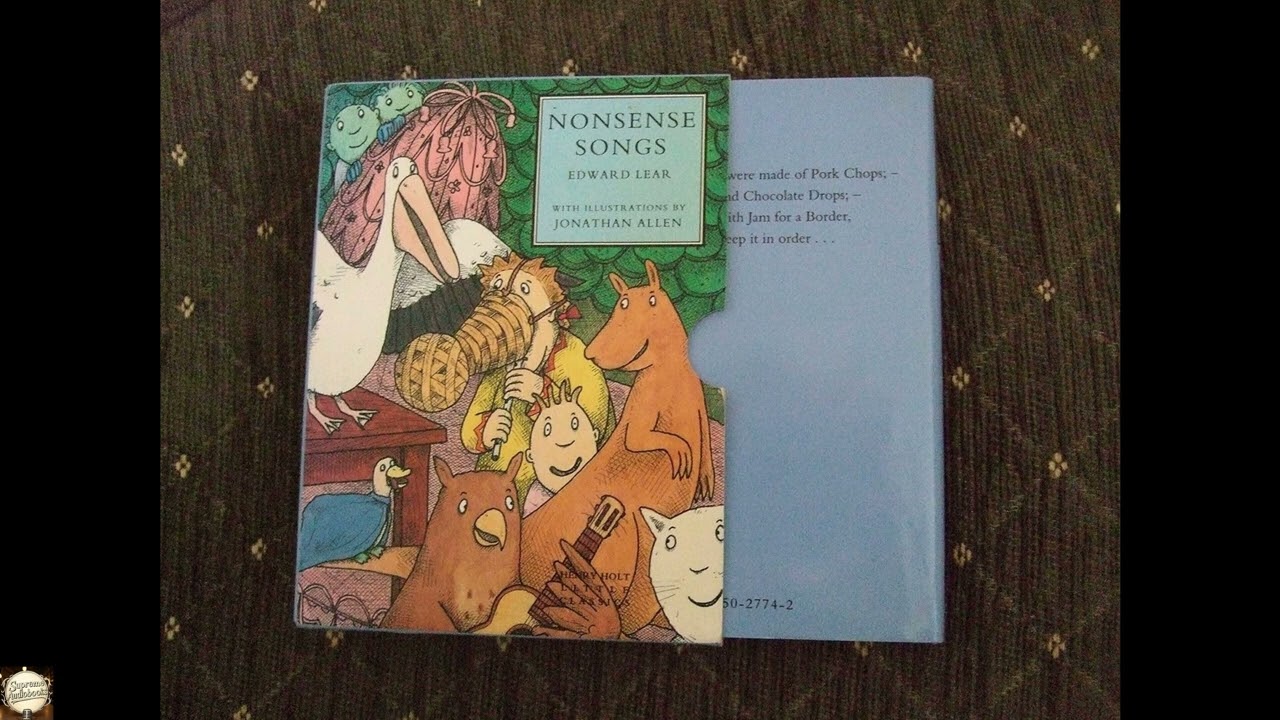
Step into a world where sense is happily abandoned for pure, unadulterated sound and delightful absurdity. Edward Lear's Nonsense Songs offers a portal to an imagination unbound by logic, a place where cats play stringed instruments and owls set sail for distant shores. This collection, a cornerstone of classic literature, resonates today not as a relic of a bygone era, but as a perpetual invitation to childhood wonder, a reminder of the sheer joy found in linguistic play and the freedom of thought unburdened by didactic purpose. For anyone seeking a refreshing escape from the weight of the everyday, or simply a hearty laugh at life's inherent silliness, this body of work remains an essential and invigorating listen. It asks nothing of its audience but an open ear and a willing heart, promising only good humor and indelible images in return. The stories contained within these songs often revolve around peculiar characters who find themselves in even more peculiar predicaments. Listeners will meet a host of eccentric individuals – an Old Man with a beard, a Young Lady from Norway, or a rather unique Pobble who discovers the unexpected disadvantages of having no toes. Setting is usually simple, sketched with a few evocative lines: a distant hill, a "beautiful pea-green boat," or a "land where the Bong-tree grows." The narratives seldom follow conventional plot structures, instead presenting a situation, developing its inherent absurdity through charming rhyme and rhythm, and often concluding with a whimsical resolution, or sometimes, no resolution at all – simply a continuation of the delightful oddity. Think of the romantic pairing of an Owl and a Pussy-cat, their journey across the sea, their encounter with a Pig, and their eventual wedding, all told with a light touch and an infectious musicality. Another series of these songs introduces the Jumblies, a hardy folk who venture to sea in a sieve, despite the warnings of their neighbors. Their determination against all odds, their bizarre destination, and their peculiar appearance make for a touching and humorous narrative about individuality and perseverance. Each song, while standing alone, shares a common thread of gentle rebellion against the ordinary, celebrating characters who, through their unconventional choices or appearances, reveal the joy of being different. There is rarely a central conflict in the dramatic sense; rather, the tension comes from the initial oddity of a situation and the delightful progression of its illogical consequences, all presented with an unwavering cheerfulness that encourages acceptance rather than judgment. Edward Lear, born in 1812, was a British artist, illustrator, and author, recognized chiefly for his literary nonsense. He was the twentieth of twenty-one children, a fact which perhaps contributed to his unique perspective on the world. Lear suffered from poor health throughout his life, including epilepsy and depression, yet he poured immense vitality into his artistic and literary creations. His early career saw him as a gifted ornithological draughtsman, illustrating birds with remarkable precision and beauty. His "Illustrations of the Family of Psittacidae, or Parrots" (published in the early 1830s) earned him considerable acclaim and led to work for the London Zoological Society. This scientific exactitude, however, stands in delightful contrast to the unrestrained imagination of his later writing. Much of Lear's life was spent traveling across Europe and the Middle East, capturing landscapes in his distinctive painting style. It was during his time as a drawing master for the grandchildren of the Earl of Derby that he first began to write and illustrate his humorous verse and limericks to entertain the children. These verses were eventually collected and published in his "Book of Nonsense" in the mid-1840s, marking his definitive entrance into the literary world. He did not confine his creativity to limericks; he also composed "Nonsense Alphabets," "Nonsense Botany," and longer poems like "The Dong with a Luminous Nose," which, like his songs, are celebrated for their invented words, playful rhythms, and whimsical imagery. Lear's unique style secured his place as a pioneering figure in the genre of literary nonsense, often associated with the Victorian era but distinctly separate from its more earnest literary trends. The recurring theme of logical subversion lies at the very heart of these songs. Lear systematically dismantles expected order, replacing it with an exhilarating, if utterly illogical, sequence of events. Consider the poem "The Daddy Long-Legs and the Fly," where mundane creatures engage in human-like activities and conversations that defy their natural biology, simply because it makes for a more amusing narrative. This playful distortion extends to language itself, with Lear coining new words and phrases – "runcible spoon," "scroobious," "borascible," "gongoozling" – that possess an irresistible phonetic charm, even if their definitions remain gloriously opaque. These invented words do not merely add to the humor; they create a unique sonic landscape, inviting listeners to revel in the sheer sound of language divorced from strict meaning. Another significant thread running through the songs is the gentle celebration of the eccentric and the acceptance of the 'other.' Many of Lear's characters are defined by their unusual appearance or habits, like the "Pobble Who Has No Toes," whose uniqueness sets him apart, yet the narrative presents his condition with a matter-of-fact innocence rather than pity or judgment. The songs often suggest a yearning for escape or a quiet rebellion against the mundane, as characters depart for fantastical lands or pursue peculiar whims. This resonates with a subtle social commentary, offering a space where individuality, even in its most absurd manifestations, is not just tolerated but cherished. It’s a quiet advocacy for difference, wrapped in the most charming and unassuming verses. Edward Lear's creative output emerged during the high Victorian era, a period often characterized by its strict social conventions, moral earnestness, and a burgeoning interest in scientific classification and industrial progress. Literature of the time frequently aimed to instruct or edify, even in children's books, which often carried clear moral lessons. Lear's nonsense verse provided a radical counterpoint to this prevailing atmosphere. His work offered a deliberate rejection of didacticism and logical coherence, instead embracing pure imagination and the liberating power of the absurd. It was a refreshing breath of fresh air in a society that valued order and seriousness, creating a protected space where silliness was not just allowed, but elevated to an art form. This emergence speaks to a human need for levity, for stories that simply entertain and delight, without any deeper message than the joy of invention. Listening to Nonsense Songs as an audiobook transforms the experience of these verses into something truly special. The inherent musicality, the intricate rhyme schemes, and the infectious rhythms come alive through skilled narration. A good reading highlights the pacing, allowing the listener to fully appreciate the build-up of absurdity and the satisfying snap of a perfectly delivered rhyme. The narrator's voice becomes a crucial instrument, distinguishing characters like the Owl and the Pussy-cat, or lending gravitas to the pronouncements of an Old Man, all while maintaining the light, whimsical atmosphere essential to Lear's genius. The several-hour run length allows for a deep immersion into Lear's distinctive world, letting the listener bask in the repetitive charm and inventive wordplay, transforming a simple collection of poems into an auditory feast designed for pure, unadulterated delight.
Enjoyed Nonsense Songs? A few ways to support us
Audible & Amazon links are affiliate; we may earn a small commission at no extra cost.
About this production
Human narration by a volunteer reader from LibriVox.org, the public-domain audiobook project. LibriVox volunteers record literary works whose copyright has expired in the United States, releasing the resulting recordings into the public domain.
Nonsense Songs by Edward Lear. The underlying text is in the U.S. public domain. We do not republish any modern copyrighted edition, translation, or commentary.
The 4K cinematic visuals accompanying this audiobook are generated by an AI image model from prompts derived from the source text. No copyrighted photos, paintings, or stock footage are used. AI generation is disclosed on every video on our YouTube channel as required by YouTube's altered/synthetic content policy.
English subtitles are transcribed from the LibriVox recording with OpenAI Whisper. Translations into the 11 other supported languages are produced by Meta's NLLB-200 neural translation model. No human translator's copyrighted translation is used.
Questions about sourcing or rights? See our DMCA & Sourcing policy or contact us.
Enjoyed this audiobook?
If you'd like to own a copy of Nonsense Songs or hear a professionally produced edition, the links below help support free audiobook production at no extra cost to you.
As an Amazon Associate we earn from qualifying purchases. Audible / print links are affiliate.