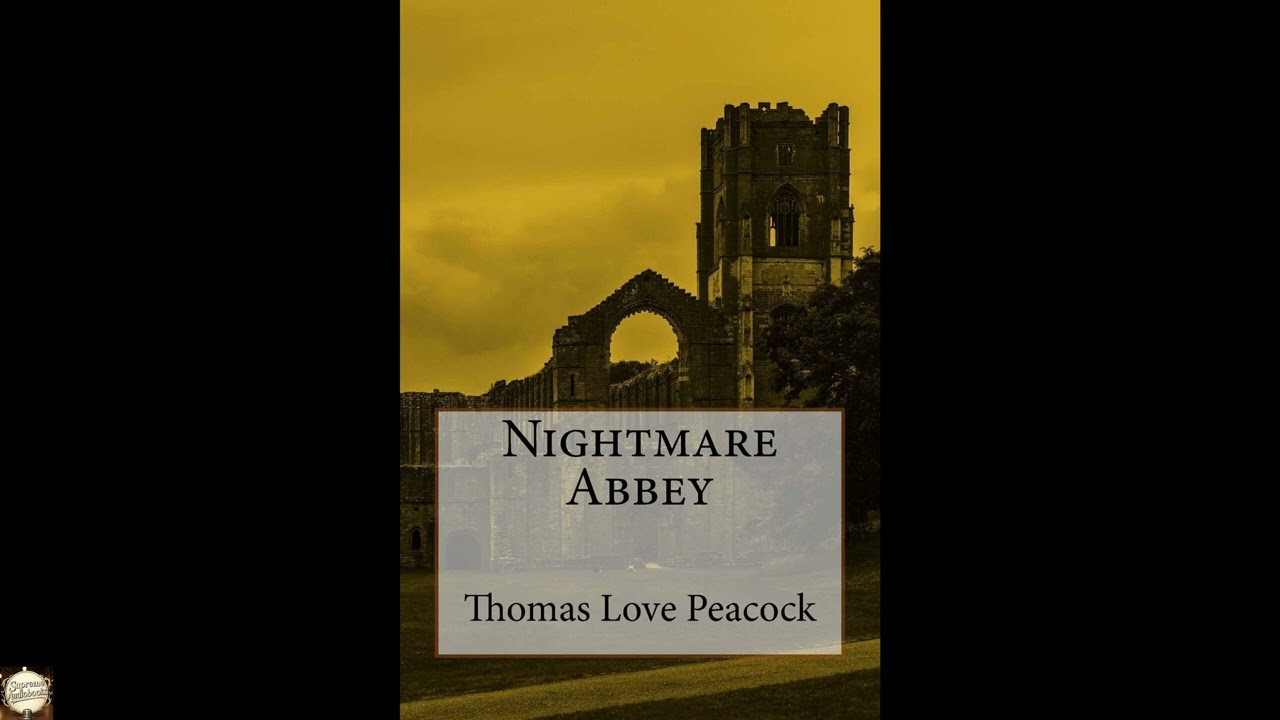
Nightmare Abbey
Step into a world where gloom is a fashion statement, where philosophical despair is a dinner-table topic, and where the most dramatic personal crises unfold amidst an unending stream of witty, cutting remarks. Thomas Love Peacock’s Nightmare Abbey, first published in 1818, offers listeners a unique entry point into the early 19th century, a time when Romantic ideals swept through literature and society. But instead of celebrating these trends, Peacock skewers them with a keen eye and a sharp pen, creating a satirical comedy that remains surprisingly relevant. It’s a brilliant examination of intellectual fads and human foibles, inviting us to laugh at the very things we often take too seriously, and reminding us that even the most profound philosophies can be reduced to absurdity with a little well-placed irony. The story unfolds within the atmospheric, decaying walls of Nightmare Abbey, a setting perfectly suited to its melancholic inhabitants. Young Scythrop Glowry, a profoundly gloomy and introspective scholar, lives here with his father, Mr. Glowry, whose spirits are equally low, though more stoically maintained. Scythrop finds himself in a predicament that, despite his self-imposed gloom, is quite traditional: he is torn between two women. One is Marionetta, his lively and charming cousin, whose cheerful disposition clashes dramatically with Scythrop's own temperament but offers a glimmer of lightness. The other is Celinda, a mysterious, intellectual, and equally melancholy woman who arrives at the abbey, immediately appealing to Scythrop’s more morose sensibilities. His indecision is the engine of the plot, creating a series of awkward encounters and internal monologues. Adding to the chaotic charm of the abbey are the many guests who cycle through its doors, each a thinly veiled caricature of a prominent contemporary figure or a specific intellectual movement. We meet Mr. Flosky, a transcendentalist philosopher given to obscure pronouncements, and Mr. Cypress, a world-weary poet whose pronouncements on human misery echo Lord Byron's fashionable despair. There is also Mr. Toobad, a devoted Manichaean who attributes all evil to a malevolent principle, and the perpetually bored Mr. Listless, an aristocrat for whom life holds no interest. These characters engage in endless, often ridiculous, conversations, debating everything from German philosophy to the merits of suicide, all while Scythrop grapples with his dual affections and his own overwhelming sense of despondency. The narrative follows these various threads, focusing more on the clash of personalities and ideas than on a conventional dramatic progression, building to a humorous, though unresolved, peak of romantic and philosophical confusion. Thomas Love Peacock (1785–1866) was an English novelist, poet, and official of the East India Company, whose literary career spanned the height of the Romantic era. Born in Weymouth, Dorset, Peacock was largely self-educated, displaying an early and voracious appetite for classical and contemporary literature. His friendship with the poet Percy Bysshe Shelley was a pivotal relationship, influencing both men's works and providing fodder for Peacock’s satirical portraits in novels like Nightmare Abbey (where Shelley himself is gently parodied as Scythrop Glowry) and Crotchet Castle. Peacock’s unique contribution to English literature lies in his "novels of ideas," a genre he practically invented. These books, including Headlong Hall, Melincourt, and Gryll Grange, are characterized by their episodic structure, their reliance on witty dialogue, and their parade of eccentric characters who serve as mouthpieces for various philosophical, political, and literary viewpoints. His work often satirized the intellectual fads and social absurdities of his day, blending sharp social commentary with classical erudition and a distinctly British sense of humor. Despite his keen literary output, Peacock also maintained a demanding professional career, serving for thirty-three years with the East India Company, where he rose to the position of Examiner of Indian Correspondence, a role of considerable responsibility. Nightmare Abbey deftly employs satire to critique the excesses of the Romantic movement, particularly the fashionable melancholy and exaggerated sensibility that permeated the arts of the time. Through characters like Scythrop Glowry, whose gloom is almost performative, and Mr. Cypress, whose pronouncements on human misery are delivered with dramatic flourish, Peacock pokes fun at the self-indulgent sorrow and the "Weltschmerz" (world-weariness) that many Romantic poets embraced. For example, Scythrop’s agonizing internal debates over his two loves, which are less about genuine emotional turmoil and more about the idea of being tragically conflicted, perfectly illustrate this lampooning. The novel also highlights the clash between philosophical idealism and practical reality, as the lofty pronouncements of the abbey’s guests often dissolve into absurdities when confronted with the mundane aspects of life or the sharp wit of their fellow characters. Another key theme is the intellectual posturing that often accompanies new ideas. Peacock showcases how philosophical and literary theories, no matter how profound, can become mere affectations when adopted without genuine understanding or tempered by common sense. The conversations at Nightmare Abbey are filled with pronouncements on destiny, the nature of evil, and transcendental thought, yet these discussions frequently devolve into misunderstandings, personal attacks, or simply loop back to the characters' own entrenched biases. This reveals Peacock’s skepticism towards uncritical adoption of intellectual trends, suggesting that true wisdom requires more than just quoting fashionable thinkers; it demands engagement with the real world, something Scythrop and his companions often struggle to do. The period in which Nightmare Abbey emerged was one of significant cultural and political ferment in Britain. Published in 1818, it appeared in the immediate aftermath of the Napoleonic Wars, a time of national introspection and shifting social structures. It was also the height of the Romantic era, a literary movement that emphasized emotion, individualism, the sublime, and often, a profound sense of melancholy and alienation from society. Poets like Byron, Shelley, and Coleridge were at the peak of their influence, and their ideas, often challenging established norms, were widely discussed and debated in intellectual circles. Peacock's work was a direct, humorous response to these prevailing trends, a voice of classical rationality and wit amidst a tide of passionate, often overwrought, sentimentality. He saw much to ridicule in the fashionable despair and philosophical obscurities that he believed were taking hold, choosing to engage with them through the lens of parody rather than direct opposition, creating a work that served as both commentary and entertainment. Listening to Nightmare Abbey as an audiobook offers an ideal way to experience Peacock’s distinctive style. The novel is fundamentally conversational, with much of its humor and insight delivered through rapid-fire dialogue and extended philosophical debates. A skilled narrator brings the distinct voices of Scythrop, Marionetta, Celinda, and the array of eccentric guests vividly to life, allowing the listener to easily differentiate between the various intellectual postures and personal quirks. The relatively moderate length of several hours makes it a perfect choice for a commute or an afternoon listen, enabling sustained immersion in the abbey’s peculiar atmosphere. Pay close attention to the pacing of the exchanges, the subtle shifts in vocal tone as characters deliver their pronouncements, and the underlying current of comedic irony that permeates every scene. The auditory format enhances the feeling of being a fly on the wall at these extraordinary, often hilarious, gatherings, letting Peacock’s verbal artistry truly shine.
Enjoyed Nightmare Abbey? A few ways to support us
Audible & Amazon links are affiliate; we may earn a small commission at no extra cost.
About this production
Human narration by a volunteer reader from LibriVox.org, the public-domain audiobook project. LibriVox volunteers record literary works whose copyright has expired in the United States, releasing the resulting recordings into the public domain.
Nightmare Abbey by Thomas Love Peacock. The underlying text is in the U.S. public domain. We do not republish any modern copyrighted edition, translation, or commentary.
The 4K cinematic visuals accompanying this audiobook are generated by an AI image model from prompts derived from the source text. No copyrighted photos, paintings, or stock footage are used. AI generation is disclosed on every video on our YouTube channel as required by YouTube's altered/synthetic content policy.
English subtitles are transcribed from the LibriVox recording with OpenAI Whisper. Translations into the 11 other supported languages are produced by Meta's NLLB-200 neural translation model. No human translator's copyrighted translation is used.
Questions about sourcing or rights? See our DMCA & Sourcing policy or contact us.
Enjoyed this audiobook?
If you'd like to own a copy of Nightmare Abbey or hear a professionally produced edition, the links below help support free audiobook production at no extra cost to you.
As an Amazon Associate we earn from qualifying purchases. Audible / print links are affiliate.