My Terminal Moraine. 1892
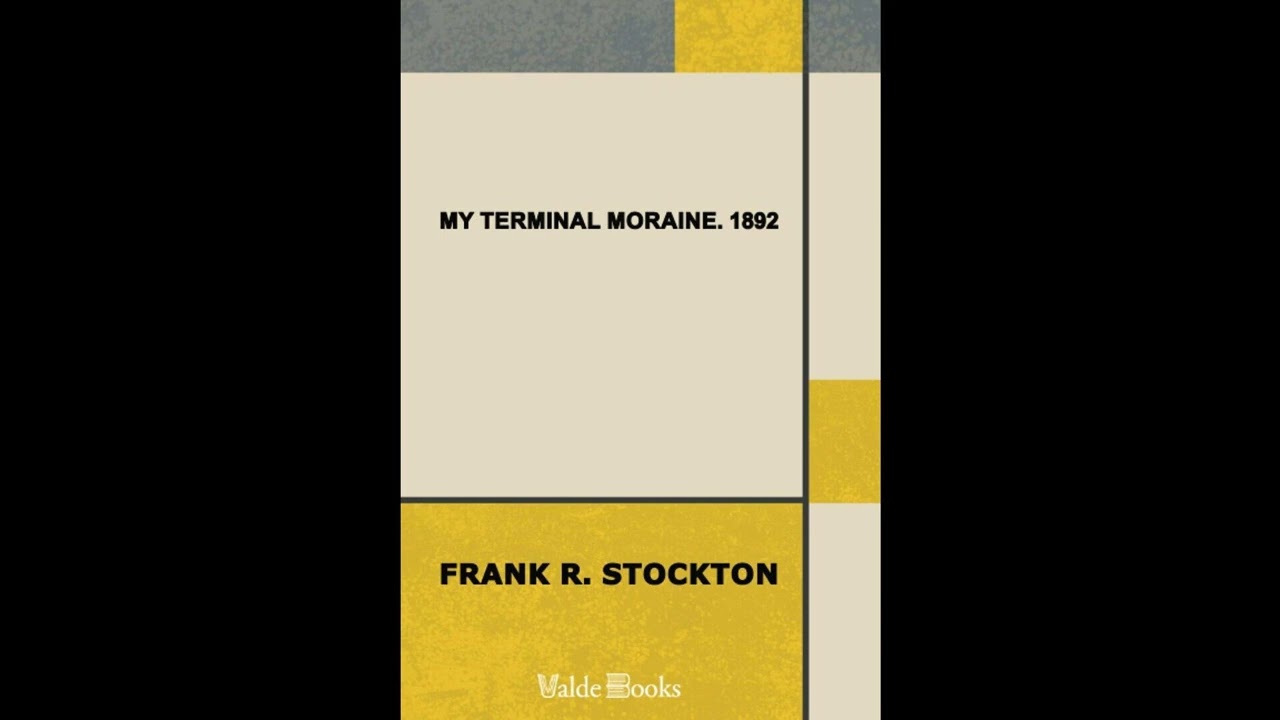
Imagine finding a unique geological marvel on your own property – a testament to ancient glacial power, yet utterly unremarkable to the untrained eye. What would you do with it? Would you exploit it, ignore it, or, perhaps, become its fiercely devoted guardian against a world that simply doesn't understand? Frank Richard Stockton's delightful and thought-provoking novella, "My Terminal Moraine," originally published in 1892, poses just such a question, wrapping it in a whimsical tale of human eccentricity, property rights, and the often-absurd clash between individual passion and societal expectation. This story, with its deadpan humor and keen observations of human nature, remains remarkably relevant today, inviting us to consider our own obsessions, our relationship with the natural world, and the peculiar ways we choose to leave our mark upon it. The story unfolds on the seemingly tranquil rural estate of Mr. Robert Tharpe, a man of comfortable means and a contemplative nature. His quiet life takes an unexpected turn when, during a casual stroll across his fields, he uncovers what he correctly identifies as a terminal moraine – a ridge of debris left by a retreating glacier thousands of years ago. Unlike most people, who might see a pile of rocks and earth as nothing more than an impediment to cultivation, Tharpe is instantly captivated. He develops an intense, almost paternal, affection for this ancient geological formation, dedicating himself to its preservation and study. His conviction grows that this particular moraine, on his land, must be protected at all costs from both the ravages of nature and the incursions of human progress. This singular passion quickly draws him into a series of increasingly bizarre and comical conflicts. His initial efforts involve simple fencing, but as news of his "discovery" spreads, scientists descend upon his property, eager to study, classify, and, in Tharpe's view, desecrate his beloved moraine. Local farmers and land developers, meanwhile, view it as nothing more than an inconvenient obstruction to their own plans. The central conflict thus solidifies: Mr. Tharpe against the world, or at least against anyone who does not share his profound, unwavering devotion to this geological remnant. His steadfast defense of his moraine, fueled by a logic that seems perfectly sound to him but utterly bewildering to everyone else, forms the heart of this singular tale, propelling him into situations of escalating absurdity and philosophical debate. The unique blend of humor and earnestness that defines "My Terminal Moraine" is the unmistakable signature of Frank Richard Stockton. Born in Philadelphia in 1834, Stockton initially pursued a career as a wood engraver, a meticulous craft that perhaps honed the precision of his later prose. He eventually abandoned engraving for writing, finding his initial success in children's literature, contributing significantly to magazines like St. Nicholas Magazine. However, it was his adult fiction that cemented his place in American letters. Stockton possessed a singular talent for taking a fundamentally absurd premise and treating it with such unwavering logical consistency that the reader cannot help but be drawn into its peculiar reality. His most enduring work, "The Lady, or the Tiger?" published in 1882, perfectly illustrates this, presenting an insoluble dilemma that has fascinated readers for generations. Stockton’s output included several popular novels, such as "Rudder Grange" (1879) and "The Casting Away of Mrs. Lecks and Mrs. Aleshine" (1886), both celebrated for their inventive plots and understated humor. He was not aligned with any specific literary movement of his time in the conventional sense, often standing apart from the realism and naturalism that were gaining traction in the late nineteenth century. Instead, Stockton carved out his own niche as a master of whimsical fantasy and social satire, often using seemingly trivial events to illuminate deeper truths about human character and societal norms. His stories are characterized by their gentle irony, a playful subversion of expectations, and protagonists who navigate outlandish circumstances with remarkable calm, a style that continues to resonate with readers who appreciate wit and imagination. Stockton passed away in 1902, leaving behind a legacy of highly original and distinctive American fiction. At its core, "My Terminal Moraine" enacts several profound themes through its engaging narrative. One prominent idea is the clash between individual eccentricity and societal norms. Mr. Tharpe's devotion to his moraine, while logical to him, becomes an increasingly strange and isolating obsession in the eyes of his community and the scientific establishment. His decision to protect a geological feature, rather than exploit or ignore it, highlights how personal values can diverge sharply from prevailing utilitarian views. The story also keenly examines the nature of property rights and ownership. Tharpe believes his moraine is his to protect, a sentiment that brings him into direct conflict with those who argue for its scientific importance or its potential for commercial development. The novella questions where the bounds of private ownership truly lie when a discovery holds broader public or scientific interest. Furthermore, Stockton subtly critiques the limitations of specialized knowledge and bureaucratic thinking. The scientists who arrive at Tharpe's property, while experts in their field, often fail to grasp the deeper, almost spiritual, connection Tharpe has with his landform. Their proposals for excavation or exhibition, while academically sound, ignore the intensely personal aspect of Tharpe's guardianship. The narrative’s dry humor underscores the often-absurd disconnect between objective scientific pursuit and subjective human experience. Finally, the story touches on the nascent idea of environmental preservation, long before it became a widespread movement. Tharpe's desire to keep his moraine untouched, free from human alteration, anticipates modern ecological concerns, albeit in a highly individualized and idiosyncratic way. The year 1892, when "My Terminal Moraine" first appeared, placed it squarely in America's Gilded Age—a period of rapid industrialization, burgeoning scientific discovery, and profound social change. The nation was grappling with the aftershocks of the Civil War, the expansion of its territories, and the growth of large cities. Scientific inquiry, particularly in fields like geology and natural history, was flourishing, leading to both greater understanding of the natural world and new forms of human intervention. This was also a time when the concept of natural preserves was slowly gaining traction, with Yellowstone National Park already established and the preservation movement slowly beginning to take shape. Stockton's story, therefore, reflects a society grappling with its relationship to the vast, often untamed American landscape and the responsibilities that came with its ownership and study. Literarily, the late nineteenth century was a complex era. While realism and naturalism were emerging as dominant forces, challenging earlier romantic ideals, there remained a strong appetite for humorous, imaginative, and often didactic tales. Stockton's work, with its unique blend of fantasy, satire, and domestic comedy, offered a distinct voice. "My Terminal Moraine" can be seen as a gentle satire on the era's growing professionalization of science, the often-inflexible logic of bureaucracy, and the quaint, sometimes maddening, individualism that characterized many American figures. It offered readers a chance to laugh at human foibles while quietly considering larger questions about progress, property, and the peculiar value we assign to things. To experience "My Terminal Moraine" as an audiobook is to truly immerse oneself in Stockton's distinctive narrative style. The concise length of this story, running for only a few hours, makes it an ideal listen for a focused afternoon or a commute. Listeners will appreciate how the narrator's voice brings to life Mr. Tharpe's quiet determination and the escalating exasperation of those around him. The subtle, deadpan humor that is Stockton's hallmark relies heavily on tone and delivery, making the spoken word an exceptional medium for conveying its wit. Pay attention to the pacing, which often builds slowly from a simple premise to a cascade of logical absurdities, and how the dialogue, though seemingly straightforward, often carries layers of unspoken amusement and irony. This audio presentation offers a perfect opportunity to savor a unique classic of American literature, allowing its quiet brilliance and quirky charm to unfold directly into your imagination.
Enjoyed My Terminal Moraine. 1892? A few ways to support us
Audible & Amazon links are affiliate; we may earn a small commission at no extra cost.
About this production
Human narration by a volunteer reader from LibriVox.org, the public-domain audiobook project. LibriVox volunteers record literary works whose copyright has expired in the United States, releasing the resulting recordings into the public domain.
My Terminal Moraine. 1892 by Frank Richard Stockton. The underlying text is in the U.S. public domain. We do not republish any modern copyrighted edition, translation, or commentary.
The 4K cinematic visuals accompanying this audiobook are generated by an AI image model from prompts derived from the source text. No copyrighted photos, paintings, or stock footage are used. AI generation is disclosed on every video on our YouTube channel as required by YouTube's altered/synthetic content policy.
English subtitles are transcribed from the LibriVox recording with OpenAI Whisper. Translations into the 11 other supported languages are produced by Meta's NLLB-200 neural translation model. No human translator's copyrighted translation is used.
Questions about sourcing or rights? See our DMCA & Sourcing policy or contact us.
Enjoyed this audiobook?
If you'd like to own a copy of My Terminal Moraine. 1892 or hear a professionally produced edition, the links below help support free audiobook production at no extra cost to you.
As an Amazon Associate we earn from qualifying purchases. Audible / print links are affiliate.