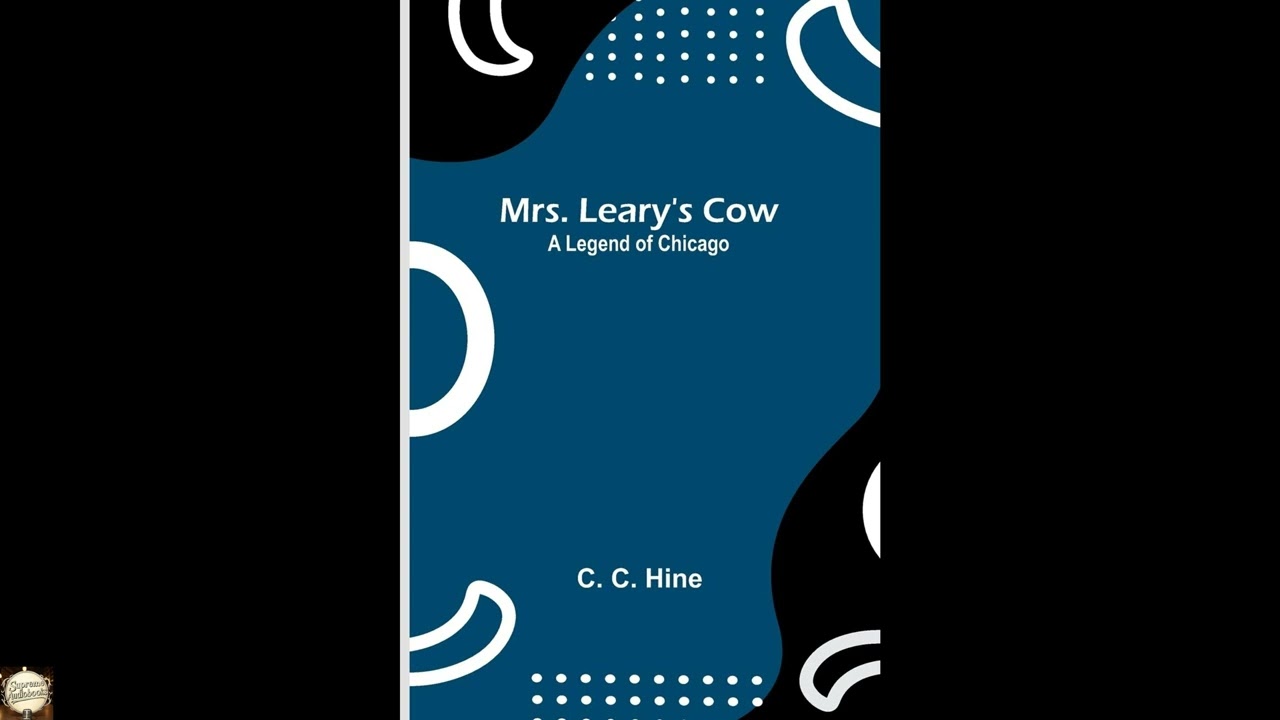
Mrs. Leary's Cow: A Legend of Chicago
The legend of Mrs. Leary's cow is more than just a quaint historical anecdote; it is a foundational American myth, a story that shaped the perception of one of the nation's most catastrophic urban disasters: the Great Chicago Fire of 1871. C.C. Hine's literary rendition, Mrs. Leary's Cow: A Legend of Chicago, takes this well-worn tale and imbues it with narrative depth, drawing listeners into the very heart of how a simple accident – or perhaps, a convenient fabrication – can become indelibly woven into the fabric of a city's identity. This audiobook presents a chance to listen closely to the whispers of history, to understand not just what might have happened, but how communities process tragedy, assign blame, and ultimately, how they tell their own stories for generations to come. It’s a compelling look at the human impulse to find a single, understandable cause for monumental events, even when the truth is far more complex. The scene opens in the bustling, rapidly expanding city of Chicago, specifically in the humble barn of Patrick and Catherine O'Leary, nestled at 137 DeKoven Street. It is the evening of Sunday, October 8th, 1871, a night that would become infamous. The air is dry and hot, after weeks of drought, and Chicago, with its proliferation of wooden buildings and plank sidewalks, is a tinderbox awaiting a spark. The central figures are the O'Learys themselves, a working-class Irish immigrant family, and their livestock, particularly a cow whose kick, legend says, knocked over a lantern, igniting a wisp of straw that rapidly became an inferno. Hine’s narrative brings this moment to vivid life, capturing the domestic rhythms of the farm animals and the family’s routine, lending an almost pastoral calm to the prelude of unimaginable chaos. As the fire begins to spread from the barn, the initial reaction is one of confusion and underestimation. Neighbors rush to assist, but the blaze quickly overwhelms their efforts. The narrative describes the frantic attempts to douse the flames, the growing realization of the fire's uncontrollable nature, and the harrowing speed at which it consumes the adjacent wooden structures. The story builds with the relentless, fiery march across Chicago, detailing the immediate panic and the futile struggle against the burgeoning conflagration. It's a gripping account that focuses on the moments of ignition and the first hours of the fire, showing how a small incident escalated into an urban catastrophe, leaving the full extent of the devastation to the listener's imagination, underscoring the relentless power of the event without revealing its final, widespread impact. C.C. Hine, the author credited with giving enduring literary form to this iconic American legend, was a chronicler whose work fit within a tradition of capturing and popularizing regional stories and historical events in the late nineteenth and early twentieth centuries. During an era when America was rapidly defining its cultural identity, figures like Hine played a crucial role in collecting and shaping the folklore that would become part of the national consciousness. While specific dates and an extensive bibliography for C.C. Hine might remain elusive, the existence of a work like Mrs. Leary's Cow speaks to an author who understood the power of narrative, transforming a simple, circulating rumor into a more structured, compelling piece of writing that could be read and retold. Such authors often acted as literary custodians of the public imagination, formalizing the oral histories and urban myths that flourished in a period of intense societal change. Their contributions lie in their ability to articulate stories that resonate deeply with common human experiences – in this case, the search for meaning in disaster, and the tendency to personalize grand events. Hine’s work here is significant for taking what began as a popular accusation and molding it into a narrative, offering a fixed version of the story that helped solidify its place in popular memory and in the larger body of American literature. This act of writing down and expanding a legend ensured its survival and widespread dissemination, making the tale of the cow and the lantern a persistent touchstone for understanding the Chicago Fire. The narrative of Mrs. Leary's Cow enacts several profound themes. One prominent idea is the concept of scapegoating and the swift assignment of blame. From the moment the fire begins, the O'Leary family, particularly Mrs. O'Leary, becomes the immediate, tangible cause in the public imagination, a convenient figure onto whom the city's collective trauma and shock could be projected. The story demonstrates how quickly a rumor can take root and harden into accepted truth, often at the expense of an individual or group. Another theme is the power of myth-making itself. The book shows how facts can become secondary to the compelling nature of a good story, especially one that offers a simple explanation for an incomprehensible disaster. The image of the cow, the lantern, and the kick is an inherently dramatic and memorable sequence, easily grasped and retold, making it a perfect candidate for legendary status. Beyond individual blame, the story also touches on the vulnerability inherent in rapid urban development. Chicago's quick growth, fueled by the lumber industry, meant a city largely built of wood, poorly equipped to handle a large-scale fire. The narrative implicitly highlights how human ambition and progress, if not tempered with foresight, can create conditions ripe for catastrophe. The final theme present is human fallibility; whether it was Mrs. O'Leary, a careless neighbor, or simply an act of God, the story points to the fragility of human endeavor when confronted with natural forces or simple accidents, reminding us that even the grandest cities can be brought to their knees by the smallest spark. The late nineteenth century, the period when the legend of Mrs. Leary's cow would have been most vigorously discussed and eventually codified in literature, was a time of immense change and cultural ferment in America. The country was still grappling with the aftermath of the Civil War, experiencing unprecedented industrial expansion, and witnessing the rapid growth of its cities. Chicago, in particular, was a symbol of this progress, a boomtown bursting with ambition and activity, serving as a hub for commerce and transportation. The fire itself became a potent symbol of both the dangers and the resilience inherent in this rapid urbanization. Culturally, there was a keen public interest in stories of disaster, heroism, and the triumph of the human spirit. Newspapers played a significant role in shaping public narratives, and the legend of Mrs. Leary's cow, fueled by sensational reporting and the human need for a simple explanation, quickly captured the public's imagination. This was also an era when American literary figures were increasingly turning to realism and naturalism, attempting to depict life and events as they truly were, yet the appetite for folk tales and dramatic legends remained strong. Mrs. Leary's Cow emerged from this environment, a narrative that straddled the line between historical account and popular folklore, reflecting the era's fascination with both fact and fiction in its efforts to understand itself. Listening to Mrs. Leary's Cow: A Legend of Chicago as an audiobook offers a singular experience, particularly given its grounding in oral tradition. The narrator's voice becomes the storyteller, guiding you through the dry, tense evening in 1871 Chicago, building the atmosphere of a city on the cusp of disaster. The run length of several hours allows for a deep immersion into the details Hine provides, moving beyond a simple recounting of facts to build a genuine sense of dread and suspense. Listen for the pacing, how the narrative subtly quickens as the fire takes hold, mirroring the escalating panic and the unstoppable spread of the flames. A skilled narrator can make the sounds of the farm, the initial shouts of alarm, and the growing roar of the fire come alive, transporting you directly into the chaotic scene. The dialogue, though perhaps not extensive, will reveal the attitudes and fears of the city's inhabitants, contributing to an atmospheric portrayal of a critical moment in American history, allowing the listener to fully appreciate the power of a legend taking hold.
Enjoyed Mrs. Leary's Cow: A Legend of Chicago? A few ways to support us
Audible & Amazon links are affiliate; we may earn a small commission at no extra cost.
About this production
Human narration by a volunteer reader from LibriVox.org, the public-domain audiobook project. LibriVox volunteers record literary works whose copyright has expired in the United States, releasing the resulting recordings into the public domain.
Mrs. Leary's Cow: A Legend of Chicago by C C Hine. The underlying text is in the U.S. public domain. We do not republish any modern copyrighted edition, translation, or commentary.
The 4K cinematic visuals accompanying this audiobook are generated by an AI image model from prompts derived from the source text. No copyrighted photos, paintings, or stock footage are used. AI generation is disclosed on every video on our YouTube channel as required by YouTube's altered/synthetic content policy.
English subtitles are transcribed from the LibriVox recording with OpenAI Whisper. Translations into the 11 other supported languages are produced by Meta's NLLB-200 neural translation model. No human translator's copyrighted translation is used.
Questions about sourcing or rights? See our DMCA & Sourcing policy or contact us.
Enjoyed this audiobook?
If you'd like to own a copy of Mrs. Leary's Cow: A Legend of Chicago or hear a professionally produced edition, the links below help support free audiobook production at no extra cost to you.
As an Amazon Associate we earn from qualifying purchases. Audible / print links are affiliate.