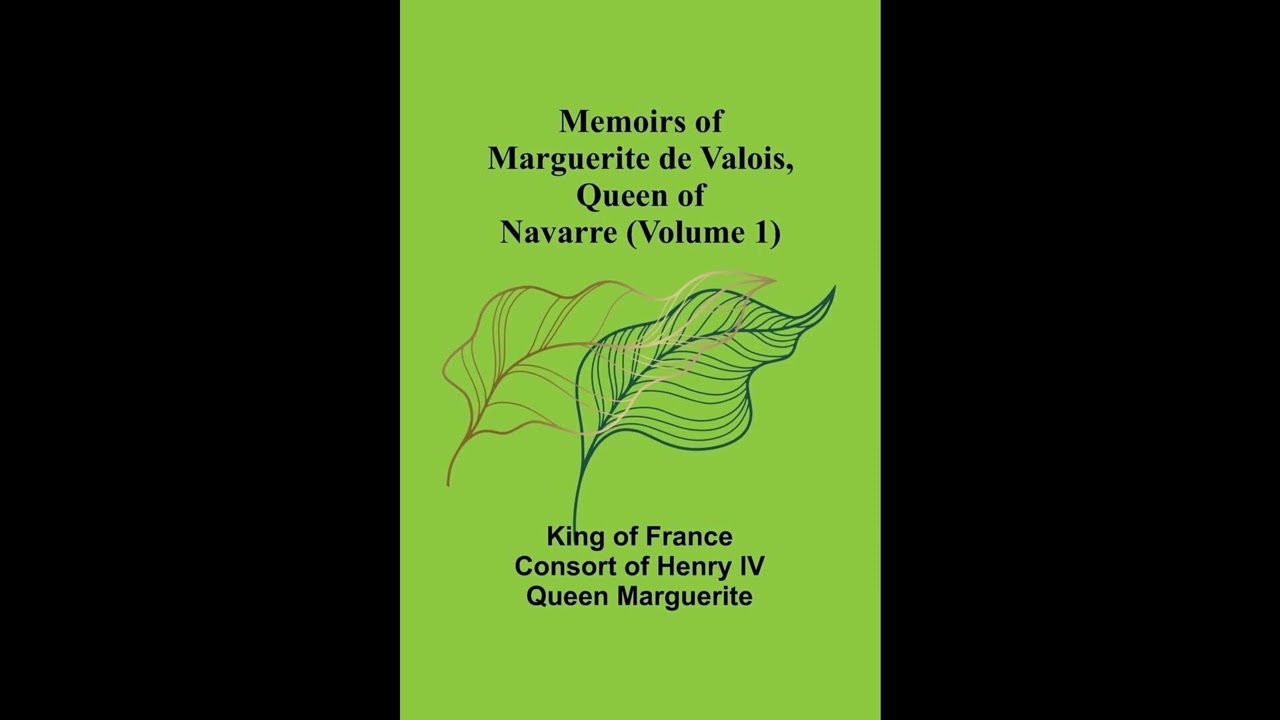
Memoirs of Marguerite de Valois, Queen of Navarre (Volume 1)
Step back into a world of cutthroat royal intrigue, religious fervor, and personal survival with the Memoirs of Marguerite de Valois, Queen of Navarre (Volume 1). This extraordinary firsthand account pulls back the velvet curtains on one of history's most tumultuous periods, narrated by a woman at the very center of power, constantly walking a tightrope between love, duty, and betrayal. Known to history as "La Reine Margot," Marguerite was a queen born into an age of unprecedented violence, and her words offer an unfiltered, often shocking, glimpse into the life of a royal who not only witnessed but actively shaped the destiny of France. Listeners who seek to understand how personal wills clash with political necessity, or how a woman navigated a dangerous, male-dominated world, will find her story compelling and startlingly relevant. The setting for this first volume is the opulent yet treacherous court of 16th-century France, specifically during the waning years of the Valois dynasty and the escalating French Wars of Religion. We meet Marguerite as a young princess, highly educated and keenly observant, navigating the complex web of her powerful family. Her mother is the formidable Catherine de' Medici, a queen regent whose political maneuvering defined an era, and her brothers include a succession of French kings—Charles IX and Henry III—each struggling to maintain control amidst bitter Catholic-Huguenot strife. The central conflict revolves around Marguerite's position as a political pawn, her personhood often secondary to the strategic alliances her marriage might forge. Her life becomes inextricably linked to the desperate quest for peace between warring religious factions, culminating in the fateful arrangement of her marriage to Henry of Navarre, a leading Protestant prince. This arranged union, meant to symbolize reconciliation, instead sets the stage for one of history's most infamous atrocities. Marguerite's memoir recounts, with stark clarity, the days leading up to her wedding, the uneasy truce, and then the sudden, horrifying eruption of the St. Bartholomew's Day Massacre. Her personal experience during these terrifying hours—hiding, witnessing brutal violence, and fearing for her own life and that of her new husband—forms a chilling centerpiece of this volume. She details the immediate aftermath, the paranoia, and the desperate attempts to survive within a court consumed by suspicion and fear. The narrative then follows her as she strives to adapt to her new role as Queen of Navarre, tethered to a Protestant husband while remaining a devout Catholic, caught between two worlds with her life constantly hanging in the balance. The authorship of these memoirs is attributed to Marguerite de Valois herself, though like many historical accounts of its kind, the exact process of its creation remains a subject of scholarly discussion. Written much later in her life, during a period of relative quietude, these personal reflections serve not only as a historical record but also as a form of self-justification and a testament to her resilience. Marguerite, a woman of formidable intellect and education, was perfectly positioned to offer such an account. She was a keen observer of human nature and courtly machinations, possessing a sharp memory for detail and an engaging narrative voice. Her perspective as a woman, a queen, and a Catholic caught in the epicenter of religious war makes her account invaluable. It is her voice, intelligent and often surprisingly candid, that breathes life into these pages, presenting her version of events with an undeniable authority. One of the prominent themes woven through Marguerite's memoirs is the precarious nature of female agency within the rigid confines of 16th-century royalty. Despite being a queen, her personal desires and choices were almost entirely subjugated to the political machinations of her mother and brothers. We see her constant struggle to exert influence and maintain a degree of autonomy, whether through carefully chosen alliances or subtle resistance. For instance, her account of the arranged marriage to Henry of Navarre underscores this: a personal bond forced into existence for state reasons, which she nevertheless navigates with a blend of resignation and strategic intelligence. Another compelling theme is the harrowing impact of religious conflict on personal lives and political stability. The vivid descriptions of the St. Bartholomew's Day Massacre, recounted from her direct experience of the carnage and terror within the Louvre, powerfully illustrate how ideological divides could shatter families, destroy trust, and plunge an entire nation into chaos. Her narrative consistently highlights the profound intersection of the personal and the political, showing how every interaction, every perceived slight or alliance, carried immense weight in the struggle for power and survival. These memoirs emerge from a period of intense upheaval in France, often referred to as the French Wars of Religion, which spanned the latter half of the 16th century. This era saw a clash between the established Catholic monarchy and the growing Protestant (Huguenot) movement, deeply fracturing the nation. Politically, the Valois dynasty was in decline, struggling to maintain its authority amidst constant civil war and external pressures. Culturally, it was still a time of Renaissance flourishing, with art, literature, and learning highly valued, especially in court circles. However, the shadow of religious intolerance hung heavy over all aspects of life. Marguerite's memoirs were likely composed much later, in the early 17th century, when she was in exile or retirement, reflecting on her past and perhaps seeking to clarify her role and justify her actions in the turbulent events she witnessed. This act of writing personal history during a time of national rebuilding offered a vital perspective on the causes and consequences of the preceding decades of conflict. Listening to Memoirs of Marguerite de Valois, Queen of Navarre (Volume 1) as an audiobook provides an exceptionally immediate and intimate experience. The duration, spanning several hours, allows for deep immersion into Marguerite's complex world, her careful observations, and her dramatic recollections. The narrator's voice becomes the conduit for her own, allowing listeners to hear the calculated intelligence, the subtle wit, and the underlying pathos of a woman who faced unimaginable pressures. A skilled performance brings out the urgency of her descriptions of the St. Bartholomew's Day Massacre, the measured tones of her political commentary, and the nuanced expressions of her personal feelings. This format transforms historical documentation into a living narrative, making the listener feel as if they are receiving a personal confidence directly from a queen whose story continues to resonate across centuries.
Enjoyed Memoirs of Marguerite de Valois, Queen of Navarre (Volume 1)? A few ways to support us
Audible & Amazon links are affiliate; we may earn a small commission at no extra cost.
About this production
Human narration by a volunteer reader from LibriVox.org, the public-domain audiobook project. LibriVox volunteers record literary works whose copyright has expired in the United States, releasing the resulting recordings into the public domain.
Memoirs of Marguerite de Valois, Queen of Navarre (Volume 1) by Marguerite de Valois. The underlying text is in the U.S. public domain. We do not republish any modern copyrighted edition, translation, or commentary.
The 4K cinematic visuals accompanying this audiobook are generated by an AI image model from prompts derived from the source text. No copyrighted photos, paintings, or stock footage are used. AI generation is disclosed on every video on our YouTube channel as required by YouTube's altered/synthetic content policy.
English subtitles are transcribed from the LibriVox recording with OpenAI Whisper. Translations into the 11 other supported languages are produced by Meta's NLLB-200 neural translation model. No human translator's copyrighted translation is used.
Questions about sourcing or rights? See our DMCA & Sourcing policy or contact us.
Enjoyed this audiobook?
If you'd like to own a copy of Memoirs of Marguerite de Valois, Queen of Navarre (Volume 1) or hear a professionally produced edition, the links below help support free audiobook production at no extra cost to you.
As an Amazon Associate we earn from qualifying purchases. Audible / print links are affiliate.