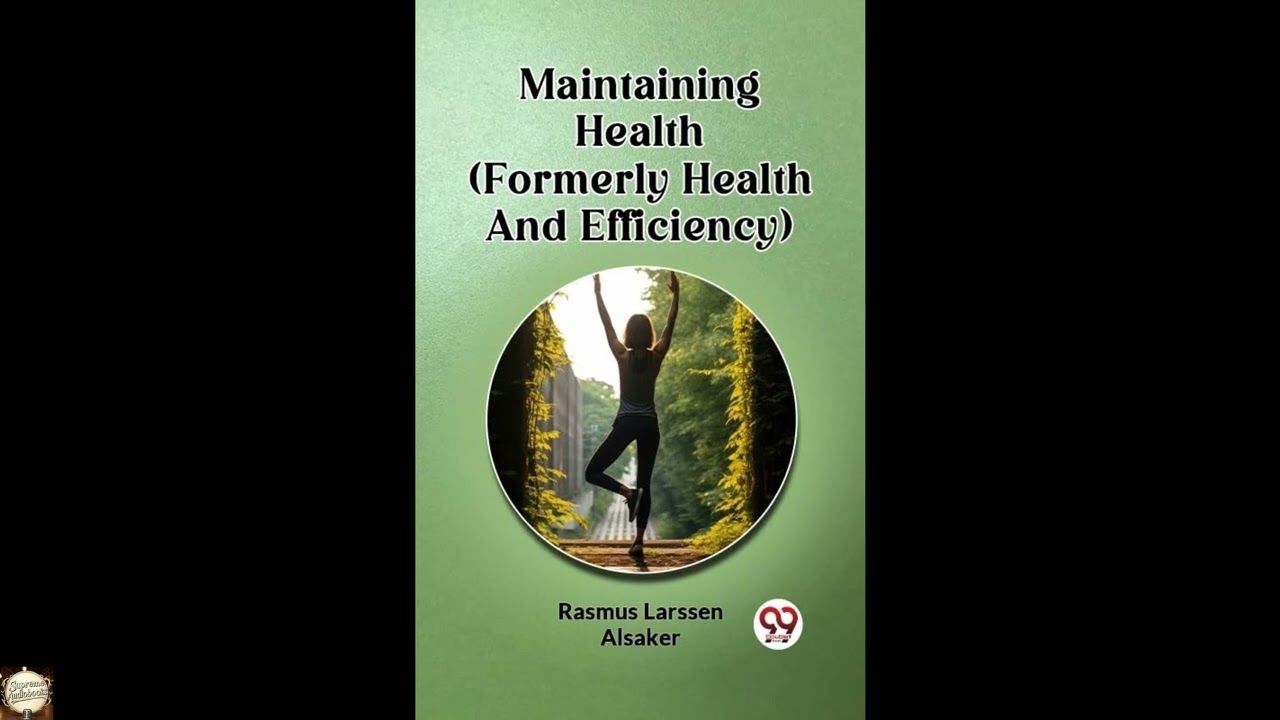
Maintaining Health (Formerly Health And Efficiency)
The relentless human aspiration for enduring health, for robust vitality that defies the passage of years, remains as potent today as it was a century ago. Long before the modern wellness movement or the widespread availability of dietary supplements, Rasmus Larssen Alsaker presented a straightforward, often revolutionary, perspective on achieving and preserving physical well-being. His book, now titled Maintaining Health (formerly Health And Efficiency), stands as a foundational text for anyone seeking to understand the body's innate capacity for self-repair and the profound impact of simple, natural living. This is not a collection of fads or quick fixes; instead, Alsaker offers a systematic, logical framework for cultivating genuine health, stripping away layers of misconception to reveal fundamental truths about nourishment, hygiene, and lifestyle. For listeners grappling with the complexities of modern health advice, Alsaker's clear, no-nonsense counsel provides a refreshing return to core principles that resonate with surprising power in our contemporary world. Alsaker's work operates not with fictional characters, but with a vivid portrayal of the human body and its relationship to its environment. The setting is less a geographical location and more the landscape of human physiology itself, presented against the backdrop of societal habits and medical practices of the early twentieth century. The central conflict Alsaker addresses is the pervasive struggle of the individual against the insidious forces of ill-health—whether born from dietary ignorance, poor lifestyle choices, or the misdirection of conventional remedies. He casts the listener as the aspiring seeker, burdened perhaps by chronic ailments or a general lack of energy, yearning for a path towards greater vigor and clarity. The "story" unfolds as Alsaker systematically dismantles common medical myths and dietary superstitions, guiding the listener through a process of intellectual re-education. The narrative arc of Alsaker's exposition begins with an unflinching look at the root causes of disease, asserting that most suffering stems not from mysterious external forces but from internal imbalances created by improper living. He methodically builds his case, moving from the foundational importance of digestive health and proper elimination to the specifics of food selection and preparation. The book progresses, much like a carefully constructed argument, through discussions of fresh air, adequate rest, mental attitude, and the body's remarkable ability to heal itself when given the right conditions. Alsaker challenges the listener to become an active participant in their own health, presenting a coherent system designed to prevent illness rather than merely treating symptoms, and promising a life characterized by genuine energy and resilience. The "resolution" for the listener comes not as a dramatic plot twist, but as a gradual awakening to the simplicity and efficacy of Alsaker's holistic philosophy. Rasmus Larssen Alsaker, born in Norway in 1883, later made his significant mark as an American physician and naturopath. A prolific author and advocate for natural hygiene, Alsaker was a forceful voice in an era that saw both burgeoning scientific advancements in medicine and a concurrent rise in alternative health philosophies. Educated as an allopathic physician, Alsaker ultimately diverged from mainstream medical practices, becoming a staunch proponent of the body's inherent capacity for healing through proper diet and lifestyle. His work often placed him at odds with the medical establishment of his day, but his message found a wide and receptive audience among those disillusioned with conventional treatments and seeking practical, empowering health advice. He passed away in 1959, leaving behind a substantial body of work that continues to influence natural health discourse. Throughout his active career, Alsaker authored numerous books that extended his principles beyond general health. Titles like Conquering Consumption, Curing Catarrh, and Dieting to Live demonstrate his focus on specific ailments and the application of his natural hygiene principles to common conditions. He was part of a broader movement that emphasized physical culture and self-improvement, advocating for vegetarianism, fasting, and the avoidance of processed foods. His clear, direct prose and unwavering conviction made him a powerful figure in the natural health movement, establishing his legacy as a leading proponent of a preventative, self-directed approach to well-being. At its heart, Alsaker's work champions self-responsibility for one's own health. He consistently argues that true wellness is not something granted by external authorities or pharmaceutical interventions, but is cultivated through conscious daily choices. One prominent theme is the absolute primacy of diet, with Alsaker dedicating considerable attention to the specific impact of foods. He explains, for instance, how consuming refined sugars and starches leads to systemic inflammation and weakens the body's defenses, while a diet rich in fresh fruits, vegetables, and whole grains provides the necessary building blocks for robust health. He provides concrete examples of dietary shifts that can reverse chronic conditions, illustrating the direct link between what we eat and how we feel. Another powerful theme is the body's profound, often underestimated, ability to heal itself. Alsaker repeatedly stresses that the body is designed for health and will revert to a state of balance if obstructions are removed and proper conditions are established. This is tied to his critique of the symptomatic treatment prevalent in conventional medicine during his time; he argues for addressing root causes rather than merely suppressing outward manifestations of disease. He also emphasizes the interconnectedness of mind and body, asserting that a positive mental attitude, alongside good physical hygiene, is indispensable for achieving and maintaining complete health. His instructions on ensuring adequate sleep and reducing stress showcase his holistic perspective, moving beyond mere caloric intake to consider the full spectrum of human needs. The emergence of Alsaker's writings coincided with a pivotal period of rapid change in Western societies. The late nineteenth and early twentieth centuries witnessed unprecedented industrialization, urbanization, and a dramatic shift in dietary patterns with the rise of processed and refined foods. Patent medicines, often unregulated and ineffective, proliferated, creating a public eager for health solutions but often misled by misinformation. At the same time, scientific medicine was making strides, but many felt disconnected from a healthcare system that seemed increasingly impersonal. This societal backdrop fostered a fertile ground for alternative health philosophies and the burgeoning physical culture movement. Figures like Alsaker offered an appealing alternative to individuals seeking greater autonomy over their bodies and health. His call for a return to natural principles resonated deeply with those who felt that modern life was creating new forms of illness and discomfort. His work was therefore not an isolated voice, but a significant contribution to a wider cultural conversation about health, lifestyle, and the pursuit of human potential in an increasingly complex world. Listening to Maintaining Health as an audiobook offers a unique engagement with Alsaker's direct, instructional prose. The experience allows his clear, logical arguments to unfold at a natural pace, making complex principles feel accessible. The narrator's steady voice can convey the conviction in Alsaker's writing, allowing the practical advice on diet and lifestyle to sink in with greater impact than a hurried read might allow. Over the course of its several hours, listeners can absorb Alsaker's holistic philosophy incrementally, perhaps during daily walks or commutes, letting the cumulative effect of his wisdom gradually reshape their understanding of personal well-being. The spoken word brings a timeless quality to Alsaker's insights, making them feel as immediately relevant as if he were speaking directly to today's health-conscious individual.
Enjoyed Maintaining Health (Formerly Health And Efficiency)? A few ways to support us
Audible & Amazon links are affiliate; we may earn a small commission at no extra cost.
About this production
Human narration by a volunteer reader from LibriVox.org, the public-domain audiobook project. LibriVox volunteers record literary works whose copyright has expired in the United States, releasing the resulting recordings into the public domain.
Maintaining Health (Formerly Health And Efficiency) by Rasmus Larssen Alsaker. The underlying text is in the U.S. public domain. We do not republish any modern copyrighted edition, translation, or commentary.
The 4K cinematic visuals accompanying this audiobook are generated by an AI image model from prompts derived from the source text. No copyrighted photos, paintings, or stock footage are used. AI generation is disclosed on every video on our YouTube channel as required by YouTube's altered/synthetic content policy.
English subtitles are transcribed from the LibriVox recording with OpenAI Whisper. Translations into the 11 other supported languages are produced by Meta's NLLB-200 neural translation model. No human translator's copyrighted translation is used.
Questions about sourcing or rights? See our DMCA & Sourcing policy or contact us.
Enjoyed this audiobook?
If you'd like to own a copy of Maintaining Health (Formerly Health And Efficiency) or hear a professionally produced edition, the links below help support free audiobook production at no extra cost to you.
As an Amazon Associate we earn from qualifying purchases. Audible / print links are affiliate.