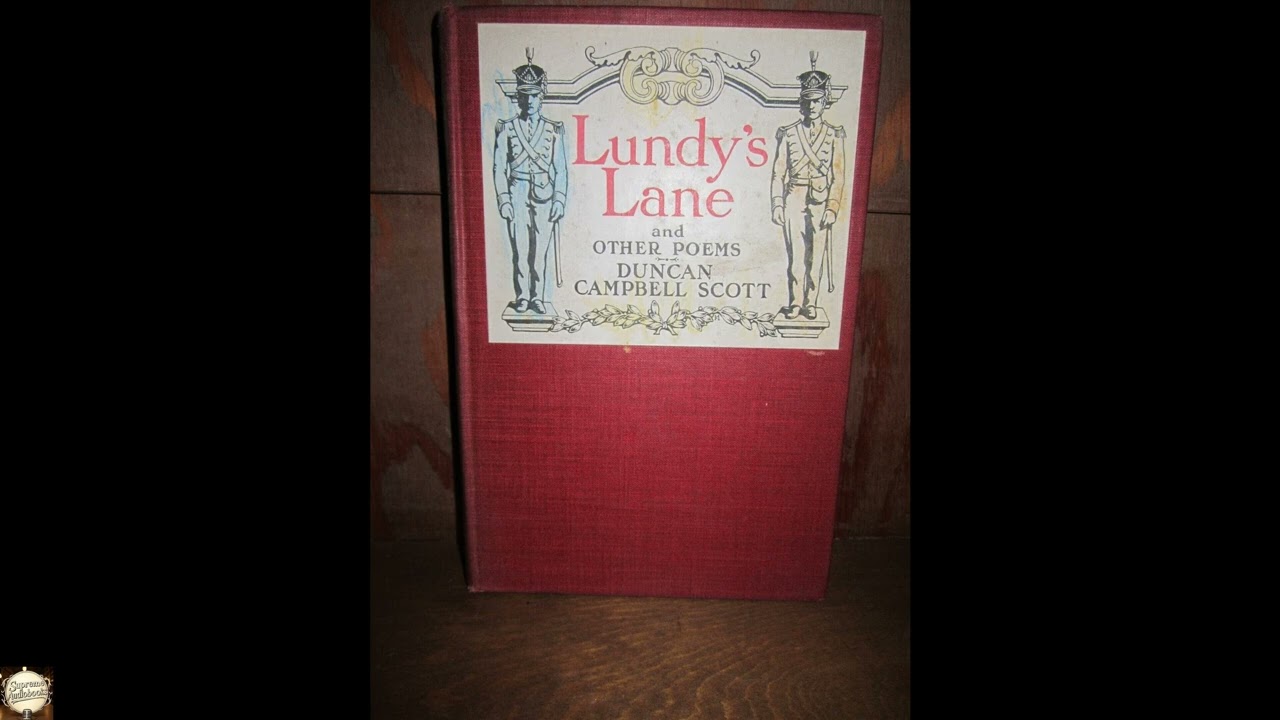
Lundy's Lane and Other Poems
Step into a literary landscape shaped by grand natural forces and the complex tides of history with Duncan Campbell Scott's "Lundy's Lane and Other Poems." This collection is more than a historical artifact; it is a resonant echo from a pivotal era in Canadian letters, offering a profound engagement with a nation still finding its voice and defining its relationship to its vast geography and its past. Through these verses, Scott brings to life the stark beauty of the Canadian wilderness, the courage and folly of human endeavor, and the enduring questions of identity that continue to shape our understanding of ourselves and our place in the world. Listening today provides not just a glimpse into a bygone era, but an invitation to confront the foundations of Canadian culture and the enduring power of carefully crafted language. The collection, anchored by its namesake poem, "Lundy's Lane," offers a panoramic view of human experience against the backdrop of an emerging nation. "Lundy's Lane" itself plunges listeners into the heart of a decisive battle from the War of 1812, painting vivid scenes of conflict, sacrifice, and the raw courage of soldiers fighting for nascent Canadian territory. Beyond this historical epic, the collection expands its scope considerably, transporting the audience from the smoke-filled fields of war to the hushed solitude of northern forests and the powerful flow of great rivers. Listeners will encounter figures carved by the wilderness – indigenous hunters, fur traders, and early settlers – whose lives are deeply intertwined with the landscape. Scott’s poetic vision extends to meditations on nature's formidable power and delicate grace, portraying icy lakes under silent stars, the whisper of pines, and the relentless progression of seasons. Each poem acts as a distinct scene or character study, whether it is a lyrical meditation on natural phenomena or a poignant portrait of an individual struggling against the elements or the march of time. There is no single overarching narrative in the traditional sense, but rather a compelling sequence of emotional and descriptive vignettes that together form a mosaic of early Canadian life and consciousness. The collection moves between moments of stark realism and profound lyricism, allowing the listener to experience the varied rhythms of life and thought that defined turn-of-the-century Canada. Duncan Campbell Scott (1862-1947) stands as a foundational figure among the "Confederation Poets," a group instrumental in forging a distinct Canadian literary tradition in the late 19th and early 20th centuries. Born in Ottawa, Scott spent the majority of his adult life working in the Canadian civil service, most notably for the Department of Indian Affairs, where he rose to the position of Deputy Superintendent General. This administrative career profoundly shaped his poetic output, offering him direct exposure to both the vast landscapes of Canada and the Indigenous communities residing within them. His work alongside fellow poets such as Charles G.D. Roberts, Bliss Carman, and Archibald Lampman sought to capture the unique spirit and geography of Canada, moving away from purely British literary models. Beyond "Lundy's Lane and Other Poems," published in 1900, Scott contributed significantly to Canadian literature with collections such as "The Magic House and Other Poems" and "New World Lyrics and Ballads," as well as a volume of short stories, "In the Village of Viger." His poetry is characterized by a formal elegance, a keen eye for natural detail, and often, a melancholic tone. Scott's legacy, however, is complex. While lauded for his contributions to Canadian poetry, his role in the administration of residential schools for Indigenous children in Canada casts a long shadow, representing a deeply problematic chapter of Canadian history. His poems sometimes reflect the prevailing, often paternalistic and romanticized, views of Indigenous peoples of his era, a perspective that requires critical engagement from today's listeners. The poems gathered in this collection consistently return to several potent themes. Foremost among them is the power and majesty of the Canadian landscape. Scott frequently uses vivid natural imagery, depicting the overwhelming scale of the wilderness, its capacity for both breathtaking beauty and unforgiving harshness. Consider the stark description of winter's grip on a remote outpost, where ice and snow become active forces shaping human destiny, or the sense of awe evoked by the immense, silent forests. Another prominent theme is Canadian history and memory, particularly the War of 1812. In "Lundy's Lane," the clash of armies is not merely a historical recounting but an exploration of how a nation's identity is forged in moments of profound struggle and collective memory. The poem invokes the ghosts of the past, making them palpable through evocative language. A third significant theme, though often fraught by modern standards, is the encounter between European settlers and Indigenous peoples. Scott's administrative work afforded him unique, if biased, insight into these communities. Poems like "The Onondaga Madonna," for instance, offer a sympathetic, yet ultimately colonial and romanticized, portrayal of an Indigenous woman, reflecting the prevailing attitudes and artistic conventions of his time regarding race and identity. This work serves as an important historical document, revealing both the artistic sensibilities and the social blind spots of the period. Finally, the collection probes the frailty and resilience of the human spirit when confronted with nature's indifference or the inevitability of change. Whether through the bravery of soldiers, the stoicism of frontiersmen, or the quiet contemplation of a solitary figure, Scott highlights humanity's enduring capacity for emotion, thought, and survival. The emergence of "Lundy's Lane and Other Poems" in 1900 coincided with a crucial period in Canadian history. Confederation, which unified the British North American colonies into a dominion, had occurred just over three decades prior, and the young nation was actively engaged in defining its cultural and political identity. There was a burgeoning sense of nationalism, coupled with a desire to distinguish Canadian literature from its British and American counterparts. This era saw a fascination with establishing a distinct "Canadian voice" – one that reflected the unique geography, history, and social fabric of the country. Scott's work, along with that of his Confederation Poet peers, was a direct response to this cultural imperative, seeking to articulate what it meant to be Canadian through verse that celebrated the land, its legends, and its peoples, however complexly portrayed. Listening to "Lundy's Lane and Other Poems" as an audiobook brings an unparalleled intimacy to Scott's verse. The spoken word liberates the poems from the page, allowing the listener to fully absorb the rhythm, meter, and carefully chosen phonetics that are central to their power. The run length, several hours in total, encourages a sustained engagement, perfect for thoughtful listening over several sessions. A skilled narrator can modulate their voice to convey the martial gravitas of historical narratives, the serene contemplation of nature poems, or the nuanced emotional weight of character studies. Listen for the subtle shifts in pacing – the quickening of a battle scene, the lingering pause during a moment of reflection, and the resonant clarity of the language. The audio presentation allows the atmosphere to envelop you, transforming the written word into an immediate, evocative experience that highlights the enduring impact of Scott's contribution to Canadian literature.
Enjoyed Lundy's Lane and Other Poems? A few ways to support us
Audible & Amazon links are affiliate; we may earn a small commission at no extra cost.
About this production
Human narration by a volunteer reader from LibriVox.org, the public-domain audiobook project. LibriVox volunteers record literary works whose copyright has expired in the United States, releasing the resulting recordings into the public domain.
Lundy's Lane and Other Poems by Duncan Campbell Scott. The underlying text is in the U.S. public domain. We do not republish any modern copyrighted edition, translation, or commentary.
The 4K cinematic visuals accompanying this audiobook are generated by an AI image model from prompts derived from the source text. No copyrighted photos, paintings, or stock footage are used. AI generation is disclosed on every video on our YouTube channel as required by YouTube's altered/synthetic content policy.
English subtitles are transcribed from the LibriVox recording with OpenAI Whisper. Translations into the 11 other supported languages are produced by Meta's NLLB-200 neural translation model. No human translator's copyrighted translation is used.
Questions about sourcing or rights? See our DMCA & Sourcing policy or contact us.
Enjoyed this audiobook?
If you'd like to own a copy of Lundy's Lane and Other Poems or hear a professionally produced edition, the links below help support free audiobook production at no extra cost to you.
As an Amazon Associate we earn from qualifying purchases. Audible / print links are affiliate.