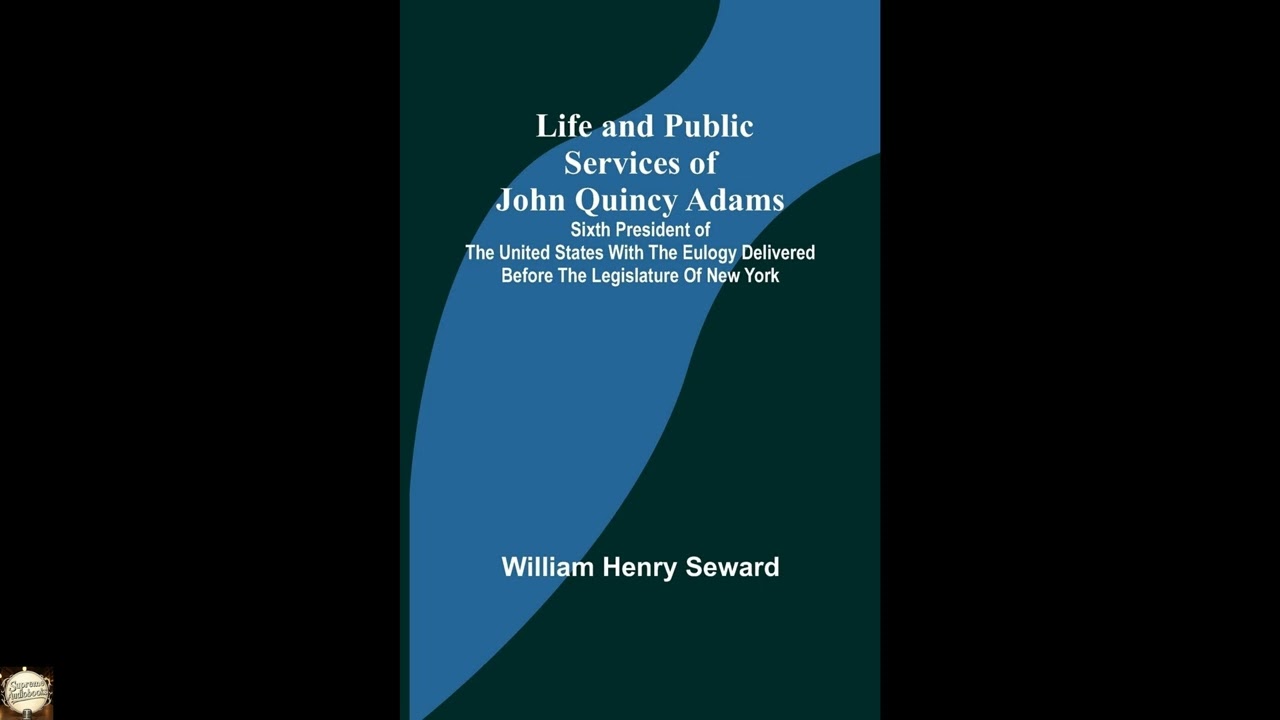
Life and Public Services of John Quincy Adams: Sixth President of the Unied States
To comprehend the complex soul of America's early republic, one must truly understand its architects—not merely their triumphs, but their often-painful struggles and their deep-seated convictions. Life and Public Services of John Quincy Adams: Sixth President of the United States offers a profound immersion into the mind and career of one of the nation's most extraordinary figures. This biography, presented here as an audiobook, presents not just a historical account, but a compelling narrative of a man whose principles frequently clashed with political reality, making his story remarkably relevant for anyone seeking insight into leadership, integrity, and the enduring challenges of self-governance in a changing world. It is a testament to the idea that true service sometimes means standing alone, even against the tide of popular opinion. The narrative opens with Adams's formative years, born into the crucible of revolutionary fervor as the son of John Adams, second President of the United States. His early life was shaped by constant travel and exposure to European courts, serving alongside his father on diplomatic missions, which instilled in him an early and profound understanding of international affairs and the delicate art of diplomacy. This foundation propelled him into a distinguished career as a diplomat, representing the young United States in courts across Europe, including the Netherlands, Prussia, Russia, and Great Britain. A critical moment comes with his role in negotiating the Treaty of Ghent, which formally ended the War of 1812, showcasing his formidable intellect and negotiating prowess in securing America's interests on the world stage. His ascension continued as he became Secretary of State under President James Monroe, a period during which he left an indelible mark on American foreign policy, most notably through his significant contributions to the Monroe Doctrine. This defining statement warned European powers against further colonization or interference in the Americas, firmly establishing the United States as a dominant force in the Western Hemisphere. The story then transitions to his contentious and highly scrutinized election to the presidency in 1824, an outcome decided by the House of Representatives. His single term as president is depicted as a period of principled but often frustrated ambition, where his vision for national infrastructure, scientific advancement, and a unified, progressive America frequently ran aground against the rising tide of partisan rancor and the nascent populism of the Jacksonian era. The account closes with his astonishing return to public service after the presidency, serving multiple terms in the House of Representatives, where he became a tireless and vocal opponent of slavery, battling the infamous "gag rule" and asserting the right to petition Congress. The author of this biographical work remains unnamed, a common practice in the nineteenth century when historical accounts and polemics often circulated without explicit attribution. Such works were frequently compiled by admirers, political allies, or even commissioned for specific didactic purposes, aiming to solidify a public figure's legacy or to draw moral lessons from their life. Lacking a named author, this biography is less a singular literary voice and more a product of the intellectual and political currents of the era in which it was produced. It stands as an artifact of how John Quincy Adams was perceived and interpreted by his contemporaries or the generation immediately following his death. The focus on his "public services" suggests an intention to present him as a model statesman, drawing upon widely available public records, speeches, and contemporary newspaper accounts to construct a narrative of a life dedicated to the nation. This approach allows listeners to consider not just Adams's life, but also the historical lens through which his actions were viewed, offering a dual perspective on both the subject and the period of its creation. Several powerful themes resonate throughout the narrative, painting a vivid picture of the moral and political struggles that defined Adams's existence. One central theme is the perennial conflict between integrity and political expediency. Adams frequently prioritized his moral compass and long-term national good over short-term political gain, often to his own detriment. For instance, as president, he famously refused to engage in the patronage system, alienating many potential allies by not dismissing his opponents from office, a decision that cemented his reputation for unyielding principle but contributed to his political isolation. Another significant theme is the burden of public service and personal sacrifice. The biography clearly illustrates the immense personal cost of Adams’s lifelong dedication to the state, highlighting his relentless work ethic, his intellectual rigor, and the emotional toll exacted by constant scrutiny and political opposition. His detailed diaries, though not directly quoted in this general biography, stand as a testament to this constant interior wrestling. A third theme is the evolving nature of American democracy and national identity. Adams lived through the early formation of the republic, witnessing its growth from a fragile experiment to a continental power grappling with its foundational contradictions, most notably the institution of slavery. His later career in Congress, where he became "Old Man Eloquent" in his fierce opposition to slavery, starkly demonstrates this struggle to reconcile the nation's ideals with its realities. His persistent, often lonely fight against the gag rule—which sought to silence any debate on slavery petitions—serves as a compelling example of his commitment to fundamental democratic principles, even when unpopular. These themes, woven through the story of one man's relentless commitment to his vision for America, offer enduring lessons for understanding both historical and contemporary political landscapes. This work likely emerged in the mid-19th century, following John Quincy Adams's death in 1848, a period of intense cultural and political ferment in the United States. The decades before the Civil War were marked by escalating sectional tensions over slavery, rapid territorial expansion driven by Manifest Destiny, and the rise of a more democratic, often populist, political culture epitomized by Andrew Jackson. In this environment, biographies of founding figures and prominent statesmen often served multiple purposes: to instruct citizens in civic virtue, to celebrate national heroes, and sometimes, implicitly or explicitly, to influence contemporary political discourse. A biography focusing on Adams's "public services" would have been particularly relevant during a time when the nature and scope of federal power, the role of moral conscience in politics, and the future of the Union itself were subjects of passionate debate. His late-career stance against slavery, for example, would have resonated powerfully with abolitionist sentiments, even as his earlier career as a diplomat and president provided a template for national leadership and international engagement. Listening to Life and Public Services of John Quincy Adams as an audiobook transforms a historical document into an engaging personal experience. The sustained narrative, delivered by a thoughtful and clear narrator, allows for a continuous engagement with Adams's intellectual rigor and the significant historical events he shaped. Its length, spanning several hours, is perfectly suited for deep immersion, whether during daily commutes, leisurely walks, or dedicated listening sessions at home. The vocal performance can imbue the formal prose of the era with a human pulse, allowing the listener to appreciate the cadence of historical writing and the gravity of the decisions Adams faced. Pay attention to how the narrator articulates the descriptions of political debates and the characterizations of key figures, bringing a sense of drama and immediacy to events long past. The absence of visual distractions encourages a focus on the precise language and the unfolding sequence of Adams's remarkable life, making it an ideal format for truly absorbing this profound account of American statesmanship.
Enjoyed Life and Public Services of John Quincy Adams: Sixth President of the Unied States? A few ways to support us
Audible & Amazon links are affiliate; we may earn a small commission at no extra cost.
About this production
Human narration by a volunteer reader from LibriVox.org, the public-domain audiobook project. LibriVox volunteers record literary works whose copyright has expired in the United States, releasing the resulting recordings into the public domain.
Life and Public Services of John Quincy Adams: Sixth President of the Unied States by William H. Seward. The underlying text is in the U.S. public domain. We do not republish any modern copyrighted edition, translation, or commentary.
The 4K cinematic visuals accompanying this audiobook are generated by an AI image model from prompts derived from the source text. No copyrighted photos, paintings, or stock footage are used. AI generation is disclosed on every video on our YouTube channel as required by YouTube's altered/synthetic content policy.
English subtitles are transcribed from the LibriVox recording with OpenAI Whisper. Translations into the 11 other supported languages are produced by Meta's NLLB-200 neural translation model. No human translator's copyrighted translation is used.
Questions about sourcing or rights? See our DMCA & Sourcing policy or contact us.
Enjoyed this audiobook?
If you'd like to own a copy of Life and Public Services of John Quincy Adams: Sixth President of the Unied States or hear a professionally produced edition, the links below help support free audiobook production at no extra cost to you.
As an Amazon Associate we earn from qualifying purchases. Audible / print links are affiliate.