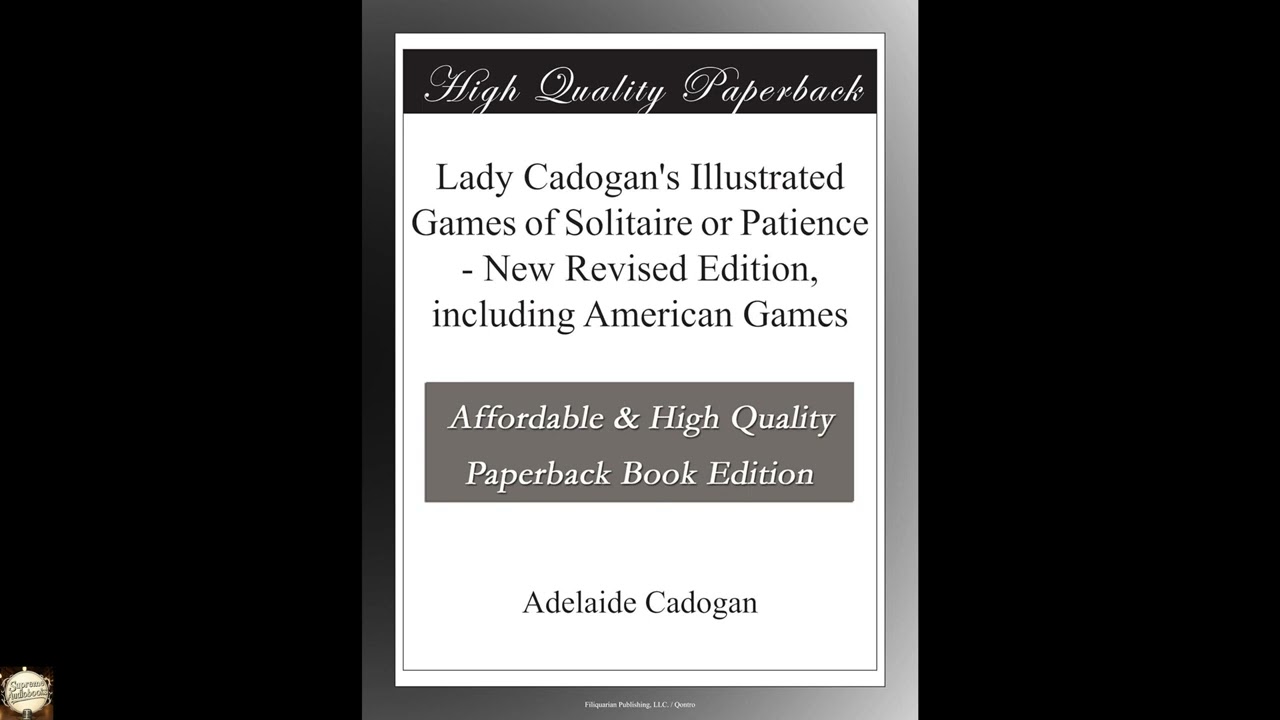
Lady Cadogan's Illustrated Games of Solitaire or Patience - New Revised Edition, in
Step into a quiet corner of contemplation, a space where the logic of cards meets the calm of a solitary mind, with Lady Cadogan's Illustrated Games of Solitaire or Patience - New Revised Edition. This classic compendium offers more than just rules; it presents an invitation to engage with a timeless form of mental exercise and focused diversion. While the world outside might rush with demands and distractions, these pages — now brought to life through spoken word — preserve a refined pursuit, a gentle challenge for intellect and composure. It is a work that speaks to the enduring human desire for order amidst chaos, for a private moment of structured thought, and for the simple satisfaction of a game well played, reminding us that patience is not merely a virtue but often its own reward. The "story" within this unique volume unfolds not through fictional characters and dramatic events, but through the engagement of the player with the seventy or more distinct games presented. Imagine the scene: a quiet room, the soft shuffle of a deck of cards, the focused gaze of an individual. The main "character" here is the player’s own intellect, pitted against the randomness of a shuffled pack and the elegant precision of the game’s rules. Each game, whether it be the deceptively simple "Klondike" or the more elaborate "Napoleon's Favorite," sets up a distinct challenge. The central conflict lies in the struggle to transform a jumbled array of cards into a perfectly ordered sequence or pile, guided by strategy and a measure of luck. Can one clear the tableau, build the foundations, or successfully maneuver the cards to their designated places? The arc of this engagement begins with the initial choice of a game, perhaps one of the easier entries designed to acclimate the player to the fundamental mechanics of solitaire. As the listener progresses through the book’s explanations, they move from basic principles to increasingly complex layouts and rule sets. The satisfaction comes not from an external narrative resolution, but from the internal triumph of bringing a chaotic deck into perfect sequence, or from the quiet acceptance of a game lost, prompting a fresh shuffle and another attempt. The illustrations, which were a key feature of the original physical book, are translated here into vivid, precise descriptions by the narrator, allowing the listener to visualize the card layouts and understand the strategic implications of each move, creating a truly immersive experience of learning and mental play. While the compiler of this specific edition, "Lady Cadogan," remains a figure shrouded in the mists of publishing history—her true identity perhaps a pseudonym or a collaborative effort—her name has become synonymous with the careful presentation of these popular card games. This compendium stands as a testament to a tradition of practical guides and manuals that flourished in the late nineteenth and early twentieth centuries. During an era before electronic entertainment became ubiquitous, such books served as essential companions for domestic leisure, offering structured ways to pass time, hone mental acuity, and provide a quiet form of personal entertainment. Lady Cadogan’s collection entered a field where numerous similar guides existed, but her particular "New Revised Edition" suggests an authority and a dedication to updating and refining the rules for a continuously evolving audience. These compilations were often seen as authoritative sources, passed down through families, consulted regularly, and revered for their clarity and comprehensiveness in preserving and popularizing these enduring pastimes. The fundamental themes woven through Lady Cadogan's Illustrated Games of Solitaire or Patience are those intrinsic to the games themselves, reflecting universal aspects of the human condition. Foremost among them is the idea of patience and perseverance. The very name "Patience" suggests the need for sustained effort and calm endurance; one must often play many hands, enduring numerous losses, before achieving a successful outcome. Consider "Pyramid," where a player might repeatedly fail to clear the tableau, yet returns with renewed resolve, demonstrating the spirit of enduring through challenges. Another significant theme is order from chaos. Every game of solitaire begins with a shuffled, seemingly random deck. The objective is always to impose structure, to arrange cards into suits, sequences, or specific piles. In a game like "Canfield," the player systematically builds foundation piles, visually transforming a jumbled starting layout into an organized, logical arrangement, thereby achieving a sense of control and clarity. A third theme centers on solitude and self-reflection. Solitaire, by its very nature, is a solitary pursuit. It offers a private space for thought, free from the demands of social interaction or external stimuli. It becomes a quiet form of meditation, where the mind can focus intently on the problem at hand, making decisions without pressure, much like a contemplative practice. Finally, the interplay of strategy and chance forms a vital undercurrent. While luck in the deal plays a role, successful solitaire players understand that careful planning, foresight, and adaptability are crucial. The choice of which card to move, which pile to build, or when to expose a hidden card in "Spider Solitaire" highlights the continuous weighing of probabilities and potential outcomes against the inevitable randomness of the draw, a microcosm of decision-making in life itself. These games and their instructional guides emerged during a period marked by significant social and cultural shifts, particularly in the Victorian and Edwardian eras when their popularity surged. The rise of a burgeoning middle class, coupled with increased leisure time and a growing emphasis on domestic life, created a demand for structured, home-based entertainment. Solitaire offered an ideal diversion, requiring only a deck of cards and a quiet space, making it accessible to individuals in a variety of settings. It provided a mentally engaging activity that could be enjoyed without partners, contrasting with the more social card games prevalent at the time. This era also saw a fascination with systems, rules, and the ordering of knowledge, making a meticulously compiled guide like Lady Cadogan's a perfect fit for the cultural sensibilities of the day. It served as a tranquil counterpoint to the accelerating pace of industrialization and urban life, offering a personal refuge and a chance for focused, individual mental engagement. Listening to Lady Cadogan's Illustrated Games of Solitaire or Patience as an audiobook offers a unique and distinct way to appreciate this classic compendium. The "several hours" of runtime allow for an incredibly thorough and unhurried presentation of each game's rules, variations, and strategic nuances. A skilled narrator transforms the precise, instructional language of the original text into an engaging, guiding voice, making even the most complex setups clear and comprehensible. Without the need to hold a physical book, listeners can absorb the detailed instructions while relaxing, commuting, or even engaging in other light activities, allowing the principles of each game to sink in at a comfortable pace. The clarity of the narration, the measured pacing, and the authoritative yet calming tone create an atmosphere of focused learning and quiet contemplation, inviting listeners to visualize the card layouts and internalize the strategies, much like a patient, knowledgeable teacher guiding them through each step. It is an opportunity to connect with a historical practice of leisure, presented in a format perfectly suited for modern listening.
Enjoyed Lady Cadogan's Illustrated Games of Solitaire or Patience - New Revised Edition, in? A few ways to support us
Audible & Amazon links are affiliate; we may earn a small commission at no extra cost.
About this production
Human narration by a volunteer reader from LibriVox.org, the public-domain audiobook project. LibriVox volunteers record literary works whose copyright has expired in the United States, releasing the resulting recordings into the public domain.
Lady Cadogan's Illustrated Games of Solitaire or Patience - New Revised Edition, in by New Revised Edition, in. The underlying text is in the U.S. public domain. We do not republish any modern copyrighted edition, translation, or commentary.
The 4K cinematic visuals accompanying this audiobook are generated by an AI image model from prompts derived from the source text. No copyrighted photos, paintings, or stock footage are used. AI generation is disclosed on every video on our YouTube channel as required by YouTube's altered/synthetic content policy.
English subtitles are transcribed from the LibriVox recording with OpenAI Whisper. Translations into the 11 other supported languages are produced by Meta's NLLB-200 neural translation model. No human translator's copyrighted translation is used.
Questions about sourcing or rights? See our DMCA & Sourcing policy or contact us.
Enjoyed this audiobook?
If you'd like to own a copy of Lady Cadogan's Illustrated Games of Solitaire or Patience - New Revised Edition, in or hear a professionally produced edition, the links below help support free audiobook production at no extra cost to you.
As an Amazon Associate we earn from qualifying purchases. Audible / print links are affiliate.