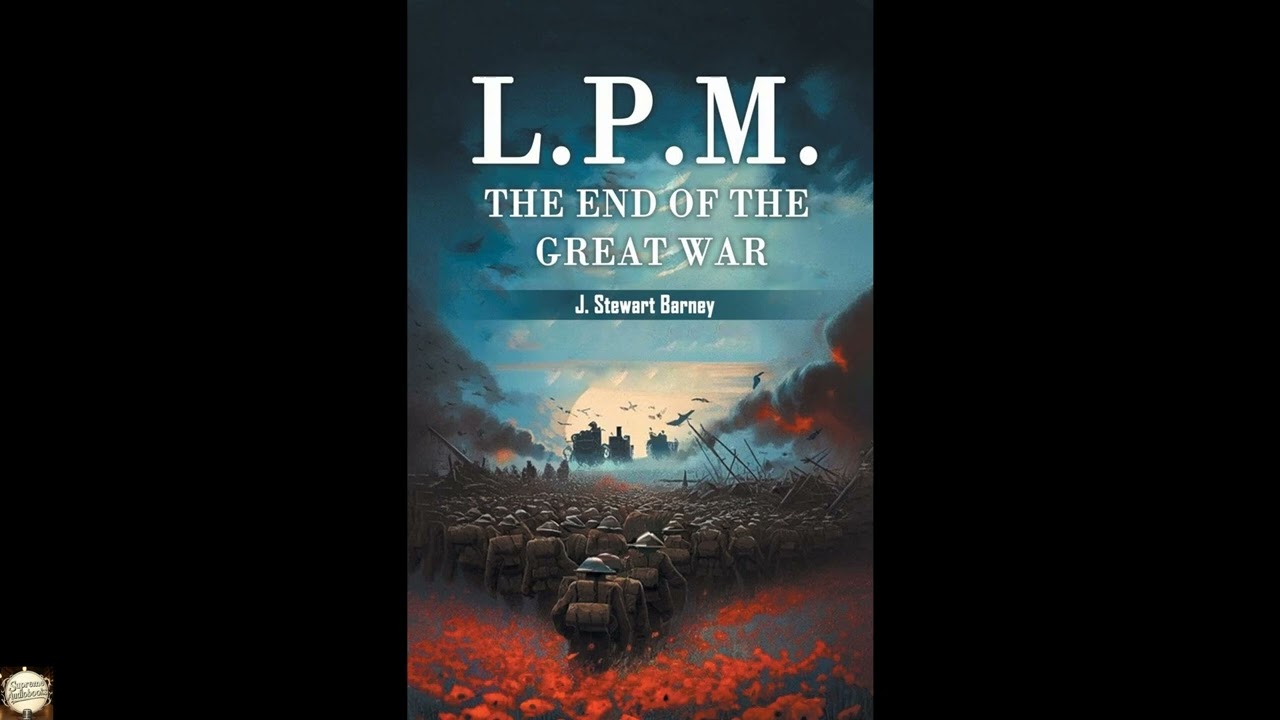
L.P.M. The End of the Great War
The Great War, often called the war to end all wars, concluded with an uneasy quiet, leaving behind not just devastated landscapes but an entire generation profoundly altered. "L.P.M. The End of the Great War" stands as a poignant record of that silent aftermath, a powerful literary statement on the personal cost of global conflict long after the last shot is fired. This is not a tale of grand battles or strategic triumphs, but a deeply personal account of a soldier’s return to a world he no longer recognizes, and perhaps, no longer belongs to. It asks us to consider what truly ends when a war concludes, and why the echoes of the trenches continue to resonate in the human spirit, making it an essential listen for anyone grappling with the enduring impact of historical events on individual lives. The story centers on a young man known only by his initials, L.P.M., as he navigates the labyrinthine transition from the front lines of France back to the ostensibly peaceful streets of his hometown. His initial encounters with civilian life are marked by a profound sense of dislocation; the familiar has become alien, and the simple rhythms of everyday existence feel starkly out of sync with the recent horrors he has witnessed. He struggles to reconnect with his family, particularly his younger sister, whose innocent questions about the war expose the chasm between his lived experience and their comfortable ignorance. This initial alienation deepens into a struggle for identity, as L.P.M. grapples with the chasm between the soldier he was and the civilian he is expected to be, questioning what parts of himself survived the conflict and what was irrevocably lost in the mud and blood of the Western Front. As the narrative unfolds, L.P.M. attempts to build a new life, finding solace, albeit fleetingly, in new relationships and old friendships that have also been scarred by the war. Yet, the specter of his past continually overshadows his present. His days are haunted by intrusive memories—the cacophony of artillery, the camaraderie of fallen comrades, the visceral terror of combat—which intrude upon his attempts at normalcy. The central conflict becomes an internal one, a battle to reconcile his wartime self with his civilian aspirations, to find meaning in a world that seems to have moved on while his own spirit remains tethered to the trenches. The story follows his arduous path towards understanding the true nature of peace, not just as the absence of war, but as an internal state achieved through confronting and integrating the burdens of memory. J Stewart Barney, though not widely known outside of academic circles today, was a significant voice in the immediate post-Great War literary landscape. Born in a quiet English market town in the late 1880s, Barney’s own experiences serving as an infantry officer in the British Expeditionary Force deeply informed his writing. He endured the brutal realities of trench warfare, including periods of intense combat and convalescence from injury, which left an indelible mark on his psyche and his prose. Unlike some of his contemporaries who focused on the grand sweep of battle or the political machinations of war, Barney consistently turned his gaze inward, seeking to articulate the psychological and emotional aftermath for the individual soldier. Upon his return from the war, Barney pursued a quiet life, largely shunning the literary limelight, a decision that contributed to his relative obscurity in later decades. He published several short stories and a lesser-known novella, "The Grey Interval," which similarly dealt with themes of memory and the return to normalcy, but it is "L.P.M." that is often regarded as his most potent and fully realized statement. He is thought to have aligned loosely with the emerging realist tradition, seeking to portray the raw truth of human experience without sentimentality or hero worship, placing him firmly among the first wave of writers who sought to dismantle the romanticized view of war. His work, while spare, is praised for its stark honesty and its unflinching portrayal of trauma, earning him a quiet but respected place in the canon of Great War literature. The book powerfully enacts themes of disillusionment and the erosion of innocence. We witness this vividly in L.P.M.'s return home, where the simple, brightly colored world he left behind has become muted, almost insubstantial. A scene where he tries to explain the smell of gas to his sister, only for her to dismiss it as a bad dream, highlights the insurmountable barrier between those who fought and those who remained behind, shattering any lingering illusions of a shared reality. There is also the persistent theme of the weight of memory and trauma. L.P.M. frequently experiences flashbacks, not as dramatic visions, but as sudden, involuntary intrusions of sound or smell—the distant rumble of a train sparking the phantom echo of artillery, or the smell of damp earth conjuring images of dugouts. These moments serve to illustrate how deeply embedded the war's psychological scars were, shaping every aspect of his present. Furthermore, the book sensitively portrays the search for meaning in a profoundly altered world. L.P.M. attempts to find purpose in various avenues, from seeking out former comrades to engaging in mundane civilian employment, yet each path seems to lead to a deeper sense of emptiness. His internal struggle to define himself outside the context of soldiering, to find a reason to continue existing beyond the simple fact of survival, speaks to a generation grappling with fundamental questions about life, death, and the very fabric of society. The book does not offer easy answers, but rather a frank look at the slow, arduous process of rebuilding a sense of self in a landscape both physically and spiritually ravaged. "L.P.M. The End of the Great War" emerged from a period of profound global upheaval and shifting cultural paradigms. The immediate aftermath of the Great War saw the collapse of old empires, the rise of new political ideologies, and a widespread questioning of traditional values. Intellectually, Freudian psychology began to gain traction, offering new frameworks for understanding human behavior and trauma, while in literature, modernism was ascendant, pushing against established narrative forms to reflect a fragmented, uncertain reality. Barney's work directly reflects this zeitgeist, speaking to the collective sense of disillusionment and the psychological burden carried by those who had experienced the war firsthand. It was a time when the world was struggling to make sense of unprecedented destruction, and authors like Barney provided a voice to the personal, often unspoken, suffering of individuals caught in its wake. Listening to "L.P.M. The End of the Great War" as an audiobook offers an intensely personal and immersive experience. The narrator's carefully modulated voice brings L.P.M.'s internal monologue to life, allowing listeners to intimately connect with his quiet suffering and his arduous path towards reconciliation. The "several hours" run time is perfectly suited to the book's contemplative pace, providing ample opportunity to absorb the atmospheric details and the subtle emotional shifts of the protagonist. Pay close attention to the nuanced delivery of dialogue, where unspoken emotions often carry more weight than the words themselves, and allow the narrator's pacing to draw you into L.P.M.'s fragmented memories and his struggle for peace, creating a direct, unfiltered connection to a pivotal moment in history and the human spirit's resilience.
Enjoyed L.P.M. The End of the Great War? A few ways to support us
Audible & Amazon links are affiliate; we may earn a small commission at no extra cost.
About this production
Human narration by a volunteer reader from LibriVox.org, the public-domain audiobook project. LibriVox volunteers record literary works whose copyright has expired in the United States, releasing the resulting recordings into the public domain.
L.P.M. The End of the Great War by J Stewart Barney. The underlying text is in the U.S. public domain. We do not republish any modern copyrighted edition, translation, or commentary.
The 4K cinematic visuals accompanying this audiobook are generated by an AI image model from prompts derived from the source text. No copyrighted photos, paintings, or stock footage are used. AI generation is disclosed on every video on our YouTube channel as required by YouTube's altered/synthetic content policy.
English subtitles are transcribed from the LibriVox recording with OpenAI Whisper. Translations into the 11 other supported languages are produced by Meta's NLLB-200 neural translation model. No human translator's copyrighted translation is used.
Questions about sourcing or rights? See our DMCA & Sourcing policy or contact us.
Enjoyed this audiobook?
If you'd like to own a copy of L.P.M. The End of the Great War or hear a professionally produced edition, the links below help support free audiobook production at no extra cost to you.
As an Amazon Associate we earn from qualifying purchases. Audible / print links are affiliate.