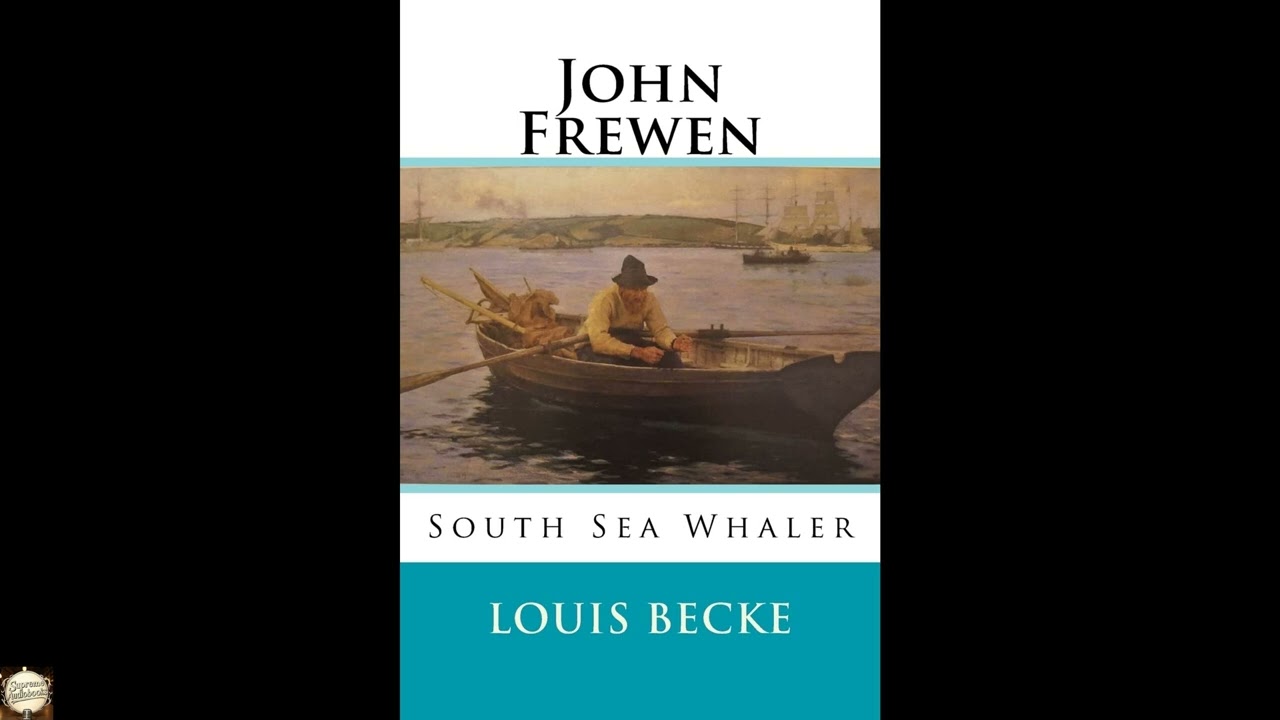
John Frewen: South Sea Whaler
Step into a world where the horizon stretched endless, the sea held both peril and promise, and a young man's mettle was forged in the crucible of the South Pacific. Louis Becke's John Frewen: South Sea Whaler offers listeners a bracing immersion into the brutal, exhilarating reality of 19th-century whaling. This is not a romanticized tale of gentleman adventurers, but a stark, authentic account drawn from the deep well of Becke's own extraordinary life. It peels back the veneer of history to reveal the raw courage, the daily grind, and the dangerous encounters that defined an industry now lost to time. For anyone seeking to understand the true cost of human ambition and the indomitable spirit required to survive on the world's most unforgiving stage, this narrative remains as vital and compelling today as it was over a century ago. The story opens with John Frewen, a spirited English lad, finding himself swept into the harsh world of deep-sea whaling. He signs on aboard a vessel bound for the remote, whale-rich waters of the Pacific. Almost immediately, Frewen is confronted with the stark realities of life aboard a whaler: the cramped, often unsanitary conditions, the rigid hierarchy, and the ever-present threat of a violent death. His initial innocence quickly erodes as he learns the ropes, from standing watch in the teeth of a gale to the grisly, backbreaking work of butchering a whale on deck, a process known as "cutting in." The sheer scale of the operation, the specialized skills of the crew, and the relentless pursuit of the leviathan are rendered with a vividness that transports the listener directly onto the heaving deck. As the whaling voyage progresses, Frewen's ship navigates the treacherous currents and uncharted shoals of the South Seas. The crew's encounters with the indigenous islanders form another crucial element of the story, ranging from tense stand-offs over resources to moments of uneasy trade and cultural exchange. Mutiny brews among the discontented sailors, testing Frewen's loyalty and forcing him to make difficult choices that define his character. The constant pursuit of the whales leads to dramatic, often deadly confrontations, where tiny boats are pitted against the immense power of nature's largest creatures. Through it all, Frewen steadily transforms from a greenhorn boy to a hardened, resourceful seaman, learning lessons about survival, leadership, and the unpredictable nature of both man and sea. The author, George Louis Becke, was born in Port Macquarie, New South Wales, Australia, in 1855, and lived a life as adventurous as any of his fictional characters. He ran away to sea at the age of twelve, beginning an almost twenty-year career that saw him traverse the breadth of the South Pacific. Becke worked as a supercargo, a pearl trader, and a general trader, living for extended periods among various island communities. He absorbed local languages, customs, and legends, witnessing firsthand the dramatic changes brought by European contact, trade, and colonial ambition. This unparalleled direct experience provided him with an inexhaustible store of authentic detail and anecdote, forming the bedrock of his literary output. Becke did not begin writing until the 1890s, encouraged by J.F. Archibald of the Sydney Bulletin. His first collection of stories, By Reef and Palm, was published in 1894, marking the arrival of a distinctive voice in English literature. He followed this with a prolific output of novels and short stories, including His Native Wife, Ewa: A Tale of the Amazon, and Helen Adair. Becke's work often focused on the lives of sailors, traders, and islanders, chronicling the harsh realities of life on the Pacific frontier with an unsentimental eye. He is recognized as a pioneer of South Sea fiction, influencing later writers and offering a raw, unvarnished perspective on a part of the world that captivated readers during the late Victorian era. John Frewen: South Sea Whaler compellingly dramatizes several enduring themes. One prominent theme is the struggle of humanity against nature's overwhelming power. Becke illustrates this with visceral clarity during scenes of the whale hunt, where a small harpoon boat is smashed to splinters by a wounded leviathan, scattering its crew into the turbulent ocean. It's a testament to the fragile existence of those who dared to challenge the deep. Another central concern is the complex relationship between cultures. The narrative often places Frewen and his European shipmates in contact with various island societies, demonstrating the misunderstandings, exploitations, and occasional alliances that defined the colonial period. For instance, the exchange of trade goods for essential supplies or navigational knowledge often thinly veiled deeper cultural chasms and power imbalances. A further theme that emerges is the relentless test of survival and resilience. Frewen endures not only the perils of the sea—storms, shipwrecks, and shark attacks—but also the grueling demands of his profession, from the sheer physical labor of flensing a whale to the psychological strain of prolonged isolation and danger. His personal growth throughout the story exemplifies a coming-of-age narrative. He enters the story as a relatively naive young man, yet through each harrowing experience—whether narrowly escaping a charging whale or navigating a tricky negotiation with a local chief—he develops a tougher skin, a keener wit, and a deeper understanding of the world and his place within it. His transformation highlights the profound impact such an extreme environment had on the individual psyche. The period in which Becke wrote, roughly the 1890s through the early 1900s, was one of intense interest in exotic lands and burgeoning imperial expansion. European powers were carving up the Pacific, and narratives from these distant frontiers found a ready audience. Readers were fascinated by tales of adventure, discovery, and encounters with "other" cultures. Whaling, though declining, held a powerful grip on the popular imagination, representing a bygone era of daring and resourcefulness. Becke's personal history, living and working within this very context, allowed him to craft stories that felt authentic and immediate, distinguishing them from the more generalized adventure stories of the time. He offered a view from the ground, or rather, from the deck, providing a level of detail and realism that few contemporaries could match. Listening to John Frewen: South Sea Whaler as an audiobook brings the salt spray and the shout of the harpooner vividly to life. The narration allows the listener to settle into the rhythmic creak of the ship's timbers, the urgent calls during a chase, and the quiet moments of contemplation Frewen experiences under the vast Pacific sky. Over its several hours' run length, the unfolding narrative becomes an immersive soundscape. A skilled voice actor can convey the rough dialects of the crew, the tension in a captain's command, and the subtle inflections that distinguish islander dialogue, adding layers of authenticity and atmosphere to Becke's already potent prose. It makes the world of the South Sea whaler feel less like history and more like an immediate, gripping experience.
Enjoyed John Frewen: South Sea Whaler? A few ways to support us
Audible & Amazon links are affiliate; we may earn a small commission at no extra cost.
About this production
Human narration by a volunteer reader from LibriVox.org, the public-domain audiobook project. LibriVox volunteers record literary works whose copyright has expired in the United States, releasing the resulting recordings into the public domain.
John Frewen: South Sea Whaler by Mr Louis Becke. The underlying text is in the U.S. public domain. We do not republish any modern copyrighted edition, translation, or commentary.
The 4K cinematic visuals accompanying this audiobook are generated by an AI image model from prompts derived from the source text. No copyrighted photos, paintings, or stock footage are used. AI generation is disclosed on every video on our YouTube channel as required by YouTube's altered/synthetic content policy.
English subtitles are transcribed from the LibriVox recording with OpenAI Whisper. Translations into the 11 other supported languages are produced by Meta's NLLB-200 neural translation model. No human translator's copyrighted translation is used.
Questions about sourcing or rights? See our DMCA & Sourcing policy or contact us.
Enjoyed this audiobook?
If you'd like to own a copy of John Frewen: South Sea Whaler or hear a professionally produced edition, the links below help support free audiobook production at no extra cost to you.
As an Amazon Associate we earn from qualifying purchases. Audible / print links are affiliate.